

GST 2.0: The Biggest Overhaul Since 2017 — What Every Business Must Know Before July 2026
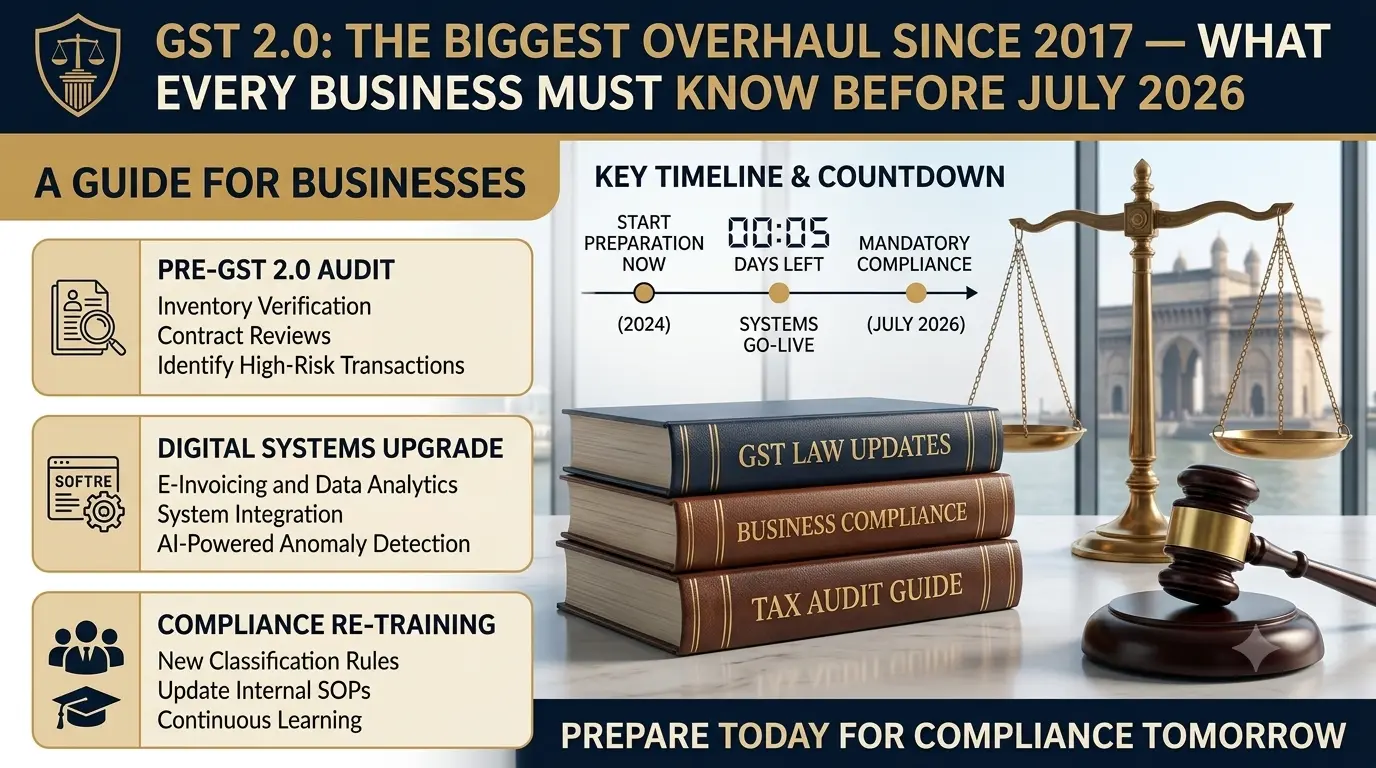
GST 2.0 Compliance Guide 2026: New Slabs, ITC Rules & Filing Deadlines Every Business Must Know
The 56th GST Council’s rate rationalisation, effective 22 September 2025, is now the operative framework for all GST filings in 2026. The 12% and 28% slabs have been scrapped. A new 40% luxury rate has been introduced. ITC rules are tighter than ever. And from December 2025, returns older than three years are permanently blocked. The Q1 FY 2026-27 filing deadline — July 13, 2026 — is your first full-quarter reckoning under the new rules.
Why GST 2.0 Is Not Just Another Rate Revision
When GST was introduced in July 2017, it replaced over a dozen indirect taxes with a single, unified framework. That was a structural revolution. What happened in September 2025 — and what continues to roll out through mid-2026 — is the second revolution: a fundamental restructuring of how GST is calculated, reported, validated, and enforced.
The 56th GST Council didn’t just tinker with rates. It collapsed a messy five-slab system into a cleaner three-tier structure, killed the 12% slab entirely, moved hundreds of items, introduced a new 40% rate for luxury and sin goods, overhauled ITC validation from “provisional claim” to “hard match only,” and set hard statutory deadlines that permanently close off old compliance backlogs.
For businesses — particularly SMEs, CFOs managing multi-GSTIN operations, and business owners who’ve relied on accountants to “sort it out later” — the message from the government is unambiguous: the era of loose GST compliance is over.
- 2 primary slabs now (5% & 18%), down from 4 slabs
- 40% new luxury/sin rate replacing the 28% + cess structure
- 3-year hard deadline — older returns permanently blocked
- 18% interest p.a. on wrongful ITC claims, up to 24% for excess claims
The New GST Slab Structure — Fully Explained
The GST 2.0 rate rationalisation replaces the old 0%–5%–12%–18%–28% multi-slab structure with a streamlined four-tier framework. Here’s exactly what the new structure looks like and what falls where:
0% — Exempt / Nil
- Fresh fruits & vegetables
- Unpacked food grains
- Milk, bread, salt
- Education services
- Health services
- Individual health & life insurance (new)
- School supplies: notebooks, pencils, maps
5% — Merit Rate
- Packaged food items
- Toothpaste, soap
- Basic medicines
- Healthcare services
- Transport (economy class)
- Packaged grains
18% — Standard Rate
- Consumer electronics
- Cement & steel (moved from 28%)
- IT & digital services
- Restaurants (AC)
- Compact cars & motorcycles
- Most B2B services
40% — Luxury / Sin
- Tobacco & cigarettes
- Pan masala
- Aerated beverages
- Premium luxury cars
- High-end luxury goods
What Moved — Critical for Businesses
12% slab scrapped: Items either dropped to 5% or moved up to 18%. 28% slab largely scrapped: Most items moved to 18%; sin/luxury moved to 40%. Individual health & life insurance: Exempted entirely (was 18%) — suppliers now lose ITC on related inputs and must recalculate under Rules 42/43. Cement, electronics, capital goods: Now at 18% (was 28%) — cash flow improvement for manufacturers.
What This Means for Your Business Pricing
Every product and service your business sells that moved slabs on 22 September 2025 required an immediate HSN-code and billing-software update. Businesses that issued invoices at old rates after that date — even if they had pre-September purchase stock — are potentially exposed to GST mismatch notices. Inventory procured at old rates but sold post-rationalisation must follow time-of-supply rules precisely.
For buyers of cement, electronics, and capital goods: the reduction from 28% to 18% means less working capital blocked in input tax. This is a genuine cash-flow improvement — but only if your GSTR-2B reconciliation is clean and your ITC claims are correctly mapped to the new rate codes.
“The era of filing whenever is over. The hard ITC validation system and the three-year return filing bar mean that businesses can no longer treat GST compliance as a problem to be solved later — later no longer exists.”
— Elixir Legal Services · Tax & Business Compliance Practice · Mumbai
The New ITC Hard Validation Rules: What Every CFO Must Understand
Input Tax Credit is the backbone of GST efficiency — it’s how businesses avoid paying tax on tax. In 2026, the rules governing who can claim ITC, when, and how much have been tightened to a degree that many businesses are only now discovering. Here’s what changed:
1. GSTR-2B Is Now the Only Basis for ITC Claims
The GST portal has moved to a hard validation system for ITC. This means: if your supplier has not uploaded an invoice, or has made an error in your GSTIN, that invoice will not appear in your GSTR-2B. GSTR-2B is a static, once-generated monthly statement — and it is now the only document the government recognises for ITC eligibility. Your internal purchase register is irrelevant. Your payment confirmation is irrelevant. Only what appears in GSTR-2B counts.
High-Risk Zone: Claiming ITC that doesn’t appear in GSTR-2B — even on a genuine, paid invoice — triggers an automated demand for reversal with 18–24% interest. If the system detects a mismatch between your GSTR-3B claim and your GSTR-2B, it generates an automatic demand. No notice required.
2. Rule 37A — Supplier Non-Filing Reversal
Rule 37A is now one of the most operationally damaging provisions for businesses with large vendor bases. It mandates that you must reverse ITC if your supplier fails to file GSTR-3B — even if you have already paid the supplier in full. If your office landlord, freight vendor, or raw material supplier skips their GST filing, you absorb the hit. You can reclaim the credit only after the supplier eventually files, creating a cash-flow crater in the interim.
3. ITC Deadline — October 2026 Cut-Off for FY 2025-26
ITC on any invoice from FY 2025-26 must be claimed no later than the due date of filing GSTR-3B for September 2026 (i.e., 20 October 2026) or the date of filing GSTR-9 for FY 2025-26 — whichever is earlier. ITC claimed after this date is ineligible and must be reversed with 18% interest. This is a hard statutory deadline — there is no extension mechanism.
4. Rule 86B — Minimum 1% Cash Payment
Businesses with monthly taxable turnover exceeding ₹50 lakh must pay at least 1% of total GST liability in cash (from the cash ledger, not ITC). Violation attracts a penalty of ₹10,000 or the amount of ITC used in excess — whichever is higher. The GST portal will restrict GSTR-3B filing if this rule is breached.
5. Section 17(5) — Blocked Credits Still Apply
Even a perfectly reconciled GSTR-2B claim can be denied if the underlying expense falls under Section 17(5) blocked credits. Common examples businesses routinely get wrong: motor vehicles and related services, food and beverages for employees, membership of clubs, personal use items. The Invoice Management System (IMS) “Deemed Accepted” status does not validate a blocked credit — auditors will reverse it with interest.
Best Practice for CFOs in 2026: Implement monthly GSTR-2B reconciliation as a non-negotiable close process. Tag all purchases at entry with eligibility status (Eligible / Ineligible under 17(5) / Pending GSTR-2B). For high-value suppliers, include a GST compliance warranty clause in contracts — if a supplier’s non-filing results in your ITC reversal, you have a contractual basis for recovery.
The Three-Year Return Filing Bar — Act Now or Lose Forever
From 1 December 2025, the GST portal enforces a hard three-year filing bar: any GST return that is more than three years past its original due date cannot be filed — permanently. There is no amnesty extension. There is no manual override. The system simply blocks the filing.
What this means in practice: if your business has unfiled returns for any period in FY 2022-23 or earlier, and you haven’t filed them by their three-year anniversary, those returns are gone forever. The compliance gap is permanent. And a permanent compliance gap means:
- Potential retrospective tax demand for the unreconciled period
- Loss of any ITC that would have been claimable in those periods
- Risk of GSTIN cancellation for prolonged non-filing
- Disqualification from GST tenders, government contracts, and lender due diligence
- Director-level exposure for companies where non-filing was intentional
Immediate Action Required: If your business has any unfiled GST returns for periods in FY 2022-23 (April 2022 – March 2023), the window to file them closes on a rolling basis through March 2026. Do not wait for a notice. A proactive DRC-03 voluntary payment with interest is significantly less expensive — legally and financially — than a departmental audit, demand order, and penalty proceedings.
E-Invoicing Mandate: Your Invoice Is Legally Void Without an IRN
If your Aggregate Annual Turnover (AATO) is ₹5 crore or above, every B2B invoice you issue in 2026 must be uploaded to the Invoice Registration Portal (IRP) to generate a unique Invoice Reference Number (IRN). Without the IRN, the invoice is not legally valid for ITC purposes.
For businesses near the ₹10 crore threshold: from that level onwards, invoices must be reported within 30 days of the invoice date to generate a valid IRN. Missing this window means the invoice cannot be registered, your buyer loses ITC, and you face potential penalties.
GST Penalties & Consequences at a Glance
| Non-Compliance Type | Penalty / Consequence | Trigger |
|---|---|---|
| Invoice without IRN (e-invoicing applicable) | Buyer loses ITC; GST notice under Sec. 122 up to ₹25,000 per error | Any B2B invoice issued without IRP registration |
| Late GSTR-1 / GSTR-3B filing | ₹50/day capped at ₹5,000; ₹20/day for NIL returns + 18% interest on tax due | Filing after due date (11th / 20th respectively) |
| Wrongful ITC claim (Rule 86B / 2B mismatch) | 18% interest + ₹10,000 or ITC amount — whichever is higher; GSTR-3B filing blocked | Automated system detection |
| ITC on blocked credits (Sec. 17(5)) | Reversal with 24% interest + potential Sec. 74 proceedings for “suppression” | Departmental audit or AI-triggered scrutiny |
| Non-registration despite threshold breach | 10% of tax due or ₹10,000 (non-fraud); 100% of tax due (fraud) | GSTN system detection or third-party data match |
| Returns older than 3 years unfiled | Permanent filing block; GSTIN cancellation risk; retrospective demand | Rolling deadline from December 2025 |
GST 2026 Compliance Checklist: 10 Things Every Business Must Do Before July
The Q1 FY 2026-27 return cycle (April–June 2026) closes on 13 July 2026 (GSTR-1) and 20 July 2026 (GSTR-3B). This is the first full quarter under the GST 2.0 framework. Here is your action checklist:
- Update your HSN / SAC rate master in billing software. Every product and service must be mapped to the correct rate under the new structure. Invoices issued at the wrong rate after 22 September 2025 create GSTR-1 mismatches that cascade into your buyers’ GSTR-2B and trigger notices for both parties.
- Run a GSTR-2B reconciliation for all months since October 2025. Pull your GSTR-2B for October 2025 through May 2026. Match every line against your purchase register. Flag any invoices missing from GSTR-2B — these represent ITC you cannot claim until the supplier files. Do not claim them in GSTR-3B until they appear.
- Audit your vendor base for GSTR-3B compliance (Rule 37A). Identify your top 20 vendors by invoice value. Check whether they filed GSTR-3B for each month since October 2025. Non-filing suppliers are a live ITC risk. Consider adding a GST compliance warranty clause to vendor contracts for FY 2026-27 renewals.
- Clear all pending returns from FY 2022-23 immediately. The three-year rolling bar is live. For any unfiled period in FY 2022-23 whose three-year anniversary falls before June 2026, file now with voluntary DRC-03 interest payment. Do not wait for a notice — the window is closing month by month.
- Review Section 17(5) blocked credit exposure. Ask your accounting team to audit all ITC claimed in the last 12 months against the Section 17(5) blocked credit list. If any blocked credits were claimed (e.g. on company cars, employee food, club memberships), file a voluntary DRC-03 before the department raises a demand — the interest rate drops significantly on voluntary reversal vs. detected reversal.
- Verify e-invoicing compliance for your AATO threshold. If your FY 2024-25 AATO crossed ₹5 crore, every B2B invoice since then needed an IRN. If you’re above ₹10 crore AATO, you additionally have the 30-day IRN reporting window. Non-IRN invoices are legally void for ITC — your buyers will start raising this in vendor audits.
- Check Rule 86B cash ledger compliance. If your monthly taxable turnover exceeds ₹50 lakh, confirm that at least 1% of GST liability each month was paid from the cash ledger, not fully offset by ITC. Review each month since April 2025 for potential violations.
- Reassess composition scheme eligibility. The 2026 rules clarify that composition dealers cannot supply through e-commerce platforms. If you’re a composition dealer selling on Amazon, Flipkart, or any marketplace, you may be in inadvertent violation. Seek advice on whether to migrate to regular GSTIN.
- Enable multi-factor authentication (MFA) on your GSTIN. GSTN has made MFA mandatory for high-risk GSTIN categories and is expanding it. Ensure all authorised signatories for your GSTIN have MFA enabled. Failure to comply can block return filing access at the worst possible time.
- Book a comprehensive GST compliance review before July 13. The July 2026 filing cycle closes your Q1 FY 2026-27 returns. A pre-filing compliance review with a qualified GST practitioner can identify and resolve mismatches, ITC gaps, and rate errors before they become automated demands. Prevention costs a fraction of cure under the GST 2.0 enforcement regime.
How GST 2.0 Hits Different Business Sectors
| Sector | Key GST 2.0 Impact | Urgency Level |
|---|---|---|
| Manufacturers (cement, electronics, capital goods) | Rate drop from 28% to 18% = cash flow boost on inputs. But ITC reversal risk on old inventory transition period (Sept–Oct 2025 purchases) requires careful time-of-supply analysis. | Positive — review ITC mapping |
| Insurance & Financial Services | Individual health & life insurance now NIL-rated. Suppliers lose ITC on related inputs — full proportional reversal under Rules 42/43 mandatory. Mixed-supply businesses need new ITC apportionment calculations. | High — ITC recalculation urgent |
| Real Estate Developers | Construction materials at 18% (previously 28%). Improved input cost economics. But RERA-registered projects with pre-September contracts must reconcile old vs new rate on ongoing invoices carefully. | Beneficial — verify contract billing |
| E-Commerce Sellers | TCS at 0.5% (revised from 1%). Composition dealers blocked from e-commerce platforms. All B2B invoices from platforms need IRN — ensure your integrations are updated. | High — platform compliance check |
| IT / SaaS / Digital Services | Stays at 18%. ITC on software subscriptions, cloud services, and digital marketing is eligible — but hard GSTR-2B validation means your vendor’s filing speed directly affects your cash flow. | Moderate — vendor audit needed |
| Hotels & Restaurants | Rate rationalisation of hospitality services under the new 18% standard bracket. AC restaurants consolidated. ITC on food and beverages for employees remains blocked under Section 17(5). | Moderate — review rate applicability |
| SMEs (turnover ₹1–5 Cr) | QRMP scheme filers: Q1 GSTR-1 due July 13. Three-year filing bar is the biggest risk — many SMEs have old pending returns. ITC mismatch from unverified vendors is the second biggest risk. | High — compliance backlog review |
GST 2026 Business FAQs
The 12% slab has been scrapped — but some of my products used to attract 12%. What rate applies now?
Items that were at 12% either moved down to 5% (typically essential goods) or up to 18% (most services and goods). The exact classification depends on your specific HSN code. There is no universal rule — you need to check the revised rate notification against your product’s HSN. Billing at the wrong rate after 22 September 2025 is a compliance breach regardless of intent. Your accountant should have a rate-change impact list specific to your product/service catalogue.
My supplier didn’t file GSTR-3B. Do I really have to reverse my ITC even though I paid them?
Yes — this is Rule 37A in practice. If your supplier fails to file GSTR-3B by the 30th of September following the end of the financial year in which the invoice was issued, you must reverse the ITC. You can reclaim it only when the supplier subsequently files. This creates a genuine cash-flow timing risk. Your mitigation options are: (a) contractual clause requiring suppliers to file on time or compensate you for the ITC reversal, and (b) monthly GSTR-2B monitoring to identify non-filing suppliers before the reversal deadline hits.
Is the GST Amnesty Scheme 2026 still available for old compliance gaps?
The GST Amnesty Scheme 2026 provides a window for settling old Section 73/74 demands (for tax periods up to FY 2023-24) with reduced penalties and a waiver of interest in certain categories. However, it does not override the three-year return filing bar — if a return is permanently blocked, the amnesty cannot undo that. For businesses with pending demands rather than unfiled returns, the amnesty window should be assessed carefully with a tax consultant to quantify the benefit before the scheme’s expiry.
My business AATO is ₹4 crore. Do I need e-invoicing?
The current e-invoicing threshold for mandatory IRN generation is ₹5 crore AATO. At ₹4 crore, you are currently below the threshold. However, the government has consistently reduced this threshold over time — it started at ₹500 crore and has progressively come down. Many industry observers expect it to reach ₹1 crore in the next 12–18 months. Voluntarily adopting e-invoicing now (it is permitted below the threshold) future-proofs your billing infrastructure and makes you more credible to larger B2B buyers who do require IRN-backed invoices from their vendors.
GSTR-9 (Annual Return) for FY 2025-26 — when is it due and what changes?
GSTR-9 for FY 2025-26 will typically be due by 31 December 2026. Under the GST 2.0 framework, the annual return for this year will be the first to reflect the mid-year rate rationalisation — meaning you’ll need to carefully reconcile figures for the April–September 2025 period (old rates) against October 2025 – March 2026 (new rates). Businesses with significant inventory at the cut-off date will need detailed time-of-supply documentation to support their GSTR-9 positions.
Is Your Business GST 2.0 Ready Before July 2026?
Elixir Legal Services advises SMEs, CFOs, and business owners on GST compliance, ITC audits, notice responses, and GSTIN structuring across Mumbai and Maharashtra.
GST Notices · ITC Audits · GSTR Filing · E-Invoicing · Amnesty Scheme
Legal Disclaimer: This article is for general informational purposes only and does not constitute legal or tax advice. GST rules described reflect the position as of May 2026 following the 56th GST Council’s rationalisation (effective 22 September 2025) and subsequent notifications. Tax positions are fact-specific. Consult a qualified GST practitioner before taking any compliance action.