9:30 - 19:30

Our Opening Hours Mon. - Sat.

+91 9137045481

Call Us For Consultation


mediation Tag

SRA Redevelopment Legal Issues in Mumbai: A Complete Homeowner Guide

Mumbai’s redevelopment boom is reshaping the city skyline. From ageing cooperative housing societies to large-scale slum rehabilitation projects, redevelopment under the Slum Rehabilitation Authority (SRA) has become one of the most discussed real estate topics in Maharashtra.

But while redevelopment promises bigger homes, better amenities, and increased property value, it also comes with serious legal risks. Many homeowners, tenants, and society members face disputes related to consent, delayed possession, developer fraud, documentation issues, and unfair redevelopment agreements.

Understanding the legal framework before signing any redevelopment document is critical.

In this guide, we explain the most common SRA legal issues in Mumbai, homeowners’ rights, and why consulting an experienced redevelopment lawyer in Mumbai can protect your long-term interests.

What Is SRA Redevelopment?

The Slum Rehabilitation Authority (SRA) was established to improve housing conditions for slum dwellers and redevelop old or unsafe structures across Mumbai.

Under SRA schemes, developers receive incentives such as additional Floor Space Index (FSI) in exchange for rehabilitating eligible occupants with free or subsidized housing.

SRA redevelopment projects generally involve:

  • Slum rehabilitation projects

  • Cluster redevelopment

  • Cooperative housing society redevelopment

  • MHADA redevelopment projects

  • Cessed building redevelopment

Because these projects involve multiple stakeholders — societies, developers, tenants, government authorities, and financial institutions — legal disputes are extremely common.

Common SRA Legal Issues in Mumbai

1. Consent Disputes Among Society Members

One of the most common redevelopment disputes arises when members disagree on redevelopment terms.

Under Maharashtra redevelopment regulations, certain levels of member consent are required before redevelopment can proceed. Disputes often arise regarding:

  • Validity of consent letters

  • Forced or manipulated consent

  • Lack of transparency in voting

  • Improper Special General Body Meetings (SGMs)

  • Failure to follow redevelopment guidelines

Bombay High Court rulings have repeatedly emphasized that redevelopment decisions must follow proper legal procedure and protect member rights.

A redevelopment lawyer in Mumbai can review society resolutions, notices, and meeting procedures to identify procedural violations.

2. Unfair Development Agreements

Many homeowners sign redevelopment agreements without fully understanding the legal implications.

A poorly drafted development agreement may expose members to risks such as:

  • Delayed possession

  • Reduced carpet area

  • Unclear rent compensation clauses

  • No penalty for project delays

  • Hidden commercial rights granted to developers

  • Ambiguous corpus fund terms

Several redevelopment disputes in Mumbai originate from vague or one-sided contractual clauses.

Before signing any Permanent Alternate Accommodation Agreement (PAAA) or development agreement, legal scrutiny is essential.

3. Delay in Possession and Stalled Projects

Project delays are one of the biggest concerns in Mumbai redevelopment.

In many cases:

  • Developers stop paying transit rent

  • Construction remains incomplete for years

  • Regulatory approvals are delayed

  • Financial disputes halt the project

Residents may remain in rented accommodation for extended periods without clarity on completion timelines.

Under RERA and redevelopment laws, homeowners may have legal remedies against developers for delays and contractual breaches.

An experienced redevelopment lawyer can help initiate legal action before:

  • MahaRERA

  • Cooperative Court

  • Civil Court

  • Bombay High Court

depending on the nature of the dispute.

4. Carpet Area and Flat Size Disputes

Another major SRA legal issue in Mumbai involves disputes over promised carpet area.

Common issues include:

  • Reduction in carpet area after construction

  • Unauthorized changes in approved plans

  • Misleading measurement calculations

  • Lack of clarity regarding balcony or fungible FSI areas

Homeowners should ensure that redevelopment agreements clearly define:

  • Existing carpet area

  • Additional area entitlement

  • Measurement methodology

  • Compensation for shortfall

Failure to include these clauses may result in prolonged litigation later.

5. Developer Fraud and Misrepresentation

Mumbai has witnessed multiple redevelopment fraud allegations involving:

  • Illegal flat sales

  • Misuse of project funds

  • Unauthorized plan modifications

  • Fake approvals

  • Sale of rehab units without compliance

Recent enforcement actions in Mumbai highlight increasing scrutiny of SRA developers and redevelopment projects.

Homeowners must conduct proper due diligence before approving any developer proposal.

6. Lack of Transparency by Housing Societies

In many redevelopment cases, society committees are accused of:

  • Pre-selecting developers

  • Avoiding open tender processes

  • Not sharing structural audit reports

  • Concealing redevelopment terms

  • Restricting member participation

These issues often create distrust among residents and trigger litigation. Discussions among Mumbai homeowners online frequently highlight concerns regarding transparency and procedural irregularities in redevelopment projects.

A redevelopment lawyer can verify whether the society has complied with Maharashtra redevelopment guidelines and cooperative housing laws.

7. Missing Conveyance and Title Issues

Many Mumbai societies face redevelopment complications because:

  • The conveyance deed was never executed

  • Land ownership remains unclear

  • Builder title documents are incomplete

  • Property records contain discrepancies

Without proper conveyance and title verification, redevelopment can face serious legal obstacles.

Legal due diligence is necessary before redevelopment begins.

Key Legal Documents Every Homeowner Should Verify

Before consenting to any SRA redevelopment project, homeowners should carefully review:

  • Development Agreement

  • Permanent Alternate Accommodation Agreement (PAAA)

  • Society resolutions

  • Tender documents

  • Structural audit report

  • Approved building plans

  • Occupancy Certificate (OC)

  • Commencement Certificate (CC)

  • Conveyance deed

  • RERA registration details

  • Transit rent clauses

  • Corpus fund commitments

A redevelopment lawyer in Mumbai can identify hidden legal risks within these documents.

Rights of Homeowners in SRA Redevelopment

Homeowners and tenants have important legal protections during redevelopment.

These rights may include:

  • Permanent alternate accommodation

  • Transit rent or temporary housing

  • Transparency in developer selection

  • Access to redevelopment documents

  • Fair carpet area compensation

  • Participation in society meetings

  • Legal remedies against delays or fraud

Courts in Maharashtra have repeatedly recognized the importance of balancing redevelopment with member protection.

Why You Need a Redevelopment Lawyer in Mumbai

Redevelopment disputes can involve complex legal issues across:

  • Cooperative housing laws

  • Property law

  • Contract law

  • RERA regulations

  • Municipal approvals

  • SRA regulations

  • Litigation and arbitration

An experienced redevelopment lawyer in Mumbai can assist with:

  • Legal due diligence

  • Drafting and reviewing agreements

  • Challenging illegal resolutions

  • Developer dispute resolution

  • Court representation

  • RERA complaints

  • Society advisory services

Early legal intervention can prevent years of litigation and financial loss.

How Elixir Legal Services Mumbai Can Help

At Elixir Legal Services Mumbai, we assist homeowners, cooperative housing societies, tenants, and resident groups in navigating complex redevelopment disputes and SRA legal matters.

Our legal services include:

  • Redevelopment agreement review

  • SRA dispute resolution

  • Society legal advisory

  • Builder fraud litigation

  • RERA representation

  • Title verification

  • Conveyance-related disputes

  • Bombay High Court matters

Whether you are facing delays, consent disputes, or unfair redevelopment terms, professional legal guidance can help safeguard your rights and investment.

Final Thoughts

SRA redevelopment can significantly improve living conditions and property value, but it also carries substantial legal and financial risks.

Before signing any redevelopment document or approving a developer proposal, homeowners should fully understand:

  • Their legal rights

  • Society obligations

  • Developer responsibilities

  • Regulatory compliance requirements

A trusted redevelopment lawyer in Mumbai can help ensure that redevelopment benefits residents rather than creating long-term legal complications.

If you are facing SRA legal issues in Mumbai or require legal guidance for a redevelopment project, consulting an experienced legal professional at the earliest stage can make all the difference.

Top Criminal Lawyers in Mumbai: What to Do If You’re Facing Charges

Published by Elixir Legal Services | Criminal Defence & White Collar Crime

Receiving a summons, learning you are under investigation, or being arrested outright are among the most frightening moments a person can experience. Whether the allegation involves a street-level offence or a complex financial fraud, the decisions you make in the first few hours matter enormously. This guide — written by the team at Elixir Legal Services, Mumbai — walks you through exactly what to do, what to avoid, and how the right criminal lawyer in Mumbai can change the outcome of your case.

1. Stay Calm and Do Not Speak Without Counsel

The instinct to explain yourself is natural. Resist it.

Everything you say to the police — even a casual remark — can be recorded, misinterpreted, and used against you in court. Under Article 20(3) of the Constitution of India, you have the fundamental right against self-incrimination. Under Section 41D of the Code of Criminal Procedure (CrPC), you are entitled to meet a lawyer of your choice during interrogation.

Your first call should be to a criminal lawyer in Mumbai, not a statement to the police.

2. Understand the Nature of the Charges Against You

Criminal charges in India broadly fall into two categories:

Cognisable Offences

The police can arrest without a warrant. These include serious matters such as murder, robbery, and certain economic crimes like large-scale bank fraud.

Non-Cognisable Offences

A warrant is required before arrest. Examples include cheating below a threshold amount, defamation, and certain offences under special statutes.

Knowing which category applies determines whether you can secure anticipatory bail and how urgently you need legal representation. An experienced criminal lawyer in Mumbai will immediately assess the charge, the applicable sections of the Indian Penal Code (IPC) or relevant special legislation, and your exposure.

3. Secure Bail at the Earliest Opportunity

Custody is not conviction. Your priority should be securing release so you can cooperate with your defence properly.

There are three routes depending on your situation:

  • Regular Bail (Section 437/439 CrPC) — Applied for after arrest, before or during trial.
  • Anticipatory Bail (Section 438 CrPC) — Applied for when arrest is apprehended but has not yet occurred. This is especially relevant in white collar and economic offence cases, where investigation precedes arrest by weeks or months.
  • Interim Bail — A short-term relief granted by the court pending the full hearing.

Speed is critical. At Elixir Legal Services, our team is available around the clock to file urgent bail applications before the appropriate Sessions Court or High Court.

4. White Collar Crime Requires Specialist Counsel — Here’s Why

Mumbai is India’s financial capital, and with that status comes an inevitable volume of allegations involving financial fraud, corporate misconduct, and regulatory violations. If you or your organisation faces any of the following, you need a dedicated white collar crime lawyer — not a generalist:

  • Bank and Loan Fraud (under the Prevention of Money Laundering Act, 2002 and IPC Sections 420, 409)
  • Securities and Insider Trading Violations (SEBI Act, 1992)
  • GST and Tax Evasion (Income Tax Act, Customs Act)
  • Cyber Fraud and Digital Financial Crimes (Information Technology Act, 2000)
  • Corporate Fraud and Misappropriation (Companies Act, 2013; IPC Section 405-409)
  • Foreign Exchange Violations (FEMA, 1999)
  • Money Laundering (PMLA, 2002)

White collar prosecutions are document-intensive. Investigators from the Enforcement Directorate (ED), Central Bureau of Investigation (CBI), Economic Offences Wing (EOW), and Serious Fraud Investigation Office (SFIO) operate with enormous resources and often conduct searches, seizures, and arrests simultaneously. A white collar crime lawyer with deep experience in these agencies’ procedures can:

  • Challenge the legality of search and seizure operations
  • Apply for stay on attachment of assets under PMLA
  • Negotiate compounding of offences with regulators where permitted
  • Manage parallel civil and criminal proceedings
  • Represent you before the Appellate Tribunal for Money Laundering

The stakes in white collar matters go beyond imprisonment — your assets, business, reputation, and professional licences are all on the line. Early, specialist intervention is not optional; it is essential.

5. Do Not Tamper With Evidence or Contact Witnesses

This point cannot be overstated. Any attempt to destroy documents, delete data, or contact potential witnesses after charges or investigation begins can result in additional charges — obstruction of justice, tampering with evidence — that are often harder to defend than the original allegation.

If you receive a notice from a government agency asking you to produce documents, hand those notices directly to your lawyer before responding.

6. The Investigation Phase: What to Expect

Most people focus on the trial, but the investigation phase — which can last months or years in complex matters — is often where cases are won or lost. During this period your lawyer should be:

  • Monitoring agency activity and filing objections against illegal searches or seizures
  • Obtaining copies of the FIR and charge sheet as soon as they are filed
  • Engaging forensic accountants or technical experts where required
  • Filing bail or anticipatory bail applications and challenging their rejection
  • Representing you during custodial interrogation to ensure rights are not violated
  • Filing writ petitions before the High Court if your fundamental rights are under threat

At Elixir Legal Services, our criminal defence and white collar crime teams work in close coordination so that no procedural opportunity is missed from day one.

7. Trial: Building Your Defence

Once the charge sheet is filed and the trial begins, the focus shifts to challenging the prosecution’s case. An effective defence strategy may include:

  • Challenging admissibility of evidence — Was the evidence gathered legally? Were your constitutional rights respected during the search?
  • Cross-examination of prosecution witnesses — Inconsistencies in witness testimony are among the most powerful tools available to the defence.
  • Expert witnesses — Especially valuable in financial crime matters where complex accounting, digital evidence, or technical data must be explained to the court.
  • Plea negotiation — In appropriate cases, negotiating a lesser charge or sentence with the prosecution can serve your interests better than a contested trial.
  • Sentencing mitigation — If conviction is unavoidable, a skilled criminal lawyer in Mumbai can argue for reduced punishment by presenting mitigating factors including age, health, cooperation with authorities, and absence of prior criminal record.

8. Appeals and Post-Conviction Relief

A conviction at the Sessions Court level is not the end of the road. The criminal justice system in India provides multiple layers of appeal:

  1. Sessions Court → High Court — Both on facts and law
  2. High Court → Supreme Court — On substantial questions of law
  3. Special Leave Petition (SLP) before the Supreme Court

In addition, applications for suspension of sentence pending appeal, and petitions for remission of sentence before the appropriate authority, are available in certain circumstances.

Elixir Legal Services has a strong appellate practice and regularly argues matters before the Bombay High Court and Supreme Court of India.

9. Why Choose Elixir Legal Services?

Mumbai has hundreds of criminal lawyers, but not all are equal when your freedom, finances, and future are at stake. Here is what sets Elixir Legal Services apart:

  • Dedicated criminal defence and white collar crime practice — We do not treat serious criminal matters as a side service.
  • Experience across agencies — Our lawyers have appeared in matters involving the ED, CBI, EOW, SFIO, SEBI, and Income Tax authorities.
  • Round-the-clock availability — Arrests do not happen during business hours. Neither do we.
  • Transparent, results-driven counsel — We tell you what you need to hear, not what you want to hear.
  • Strict confidentiality — Attorney-client privilege is absolute in our practice.
  • Offices in Mumbai with pan-India reach — For matters that extend across states or require appearances before the Supreme Court.

10. Immediate Steps Checklist

If you or someone you know is facing criminal charges in Mumbai, act on these steps right away:

  •  Do not make any statement to the police without a lawyer present
  •  Contact a criminal lawyer in Mumbai immediately
  •  Preserve all relevant documents, communications, and records — do not delete anything
  •  Note the exact sections of law mentioned in the FIR or notice
  •  Do not discuss the matter on phone, email, or messaging apps
  •  Instruct family members and colleagues not to speak to investigators without legal advice
  •  If a search is conducted at your home or office, note the names and badge numbers of officers and what was seized

Contact Elixir Legal Services

Facing charges is not the moment for hesitation. The sooner you have an experienced criminal lawyer in Mumbai by your side, the better your position at every stage that follows — bail, investigation, trial, and appeal.

Elixir Legal Services — MumbaiCriminal Defence | White Collar Crime | Corporate Litigation

This article is for general informational purposes only and does not constitute legal advice. For advice specific to your situation, please consult a qualified advocate.

Dispute Resolution in India — Litigation vs. Arbitration vs. Mediation: What’s Right for You?

Dispute Resolution

Litigation, Arbitration, or Mediation: The Right Way for You

Category: Dispute Resolution & Civil Litigation | Reading Time: 9 min | Word Count: ~1150

When a business deal goes wrong, a contract is breached, a property dispute erupts, or a partnership collapses — the first question everyone asks is: “How do I resolve this?”

In India, there are multiple pathways to resolving disputes — each with its own timelines, costs, enforceability, and strategic implications. Choosing the wrong pathway can mean years of wasted time, enormous expense, and a frustrating outcome. Choosing the right one — with expert legal guidance — can mean efficient resolution, preserved relationships, and a clear legal outcome.

At Elixir Legal Services, our dispute resolution practice covers civil litigation, arbitration, and mediation across Mumbai’s courts and arbitral institutions. This blog explains the key differences between these pathways and helps you understand which is right for your specific situation.

<H2>The Problem with Disputes in India: The Backlog Reality

India’s judicial system faces one of the most significant case backlogs in the world — with over 5 crore cases pending across district courts, high courts, and the Supreme Court as of recent estimates. In Mumbai’s courts, even a straightforward civil matter can take 5 to 10 years to reach a final judgment at the trial court level, with appeals potentially extending that timeline further.

This reality is not a reason to despair — it’s a reason to plan. Understanding your dispute resolution options and choosing strategically can dramatically reduce the time and cost of resolving your matter.

Option 1: Civil Litigation — The Courts

Civil litigation is the process of resolving disputes through India’s court system — from City Civil Courts at the district level, to the Bombay High Court, and ultimately the Supreme Court for matters of national legal importance.

When Civil Litigation is Appropriate:

  • When there is no arbitration clause in your contract
  • When you need interim relief urgently (injunctions, asset freezing orders, attachment before judgment)
  • When the matter involves questions of public law or constitutional rights
  • When you need the enforcement mechanisms of a court decree (civil arrest, court-supervised execution)
  • Property disputes, succession matters, and civil wrongs (torts)

Advantages of Civil Litigation:

  • Established procedural framework with appeal rights
  • Court decrees are directly enforceable
  • Judges can grant powerful interim reliefs
  • Binding precedent creates legal certainty over time

Disadvantages:

  • Significant delays in most Indian courts
  • Relatively less confidentiality (court proceedings are largely public)
  • Adversarial process can damage business relationships permanently
  • Costs accumulate over long timelines

Elixir Legal Services in Civil Litigation: Our civil litigation team is experienced in filing, defending, and prosecuting civil suits before Mumbai’s City Civil Court, Bombay High Court, and Debt Recovery Tribunals. We are known for aggressive interim relief applications and strategically efficient case management.

Option 2: Arbitration — Faster, Private, and Internationally Recognized

Arbitration is a private dispute resolution process where parties agree (typically through an arbitration clause in their contract) to resolve disputes before a neutral arbitrator or panel of arbitrators instead of through court.

The Arbitration and Conciliation Act, 1996 (as amended in 2015 and 2019) governs arbitration in India and has progressively aligned Indian arbitration with international standards.

When Arbitration is Appropriate:

  • When your contract contains an arbitration clause (in which case it is typically mandatory)
  • For high-value commercial disputes where speed and confidentiality are valued
  • For international commercial disputes where a neutral, internationally recognized forum is preferred
  • Disputes involving technical matters where subject-matter expert arbitrators can be appointed
  • Construction and infrastructure disputes, joint venture disputes, licensing disputes

Advantages of Arbitration:

  • Significantly faster than court proceedings (typically 12 to 18 months for domestic arbitration)
  • Private and confidential — proceedings and awards are not public record
  • Parties choose their arbitrators — allowing for subject-matter expertise
  • Arbitral awards are final and binding with very limited grounds for challenge
  • International arbitral awards are enforceable in India under the New York Convention

Disadvantages:

  • Can be expensive (arbitrator fees, institutional fees, legal costs)
  • Limited interim relief mechanisms (though improved by 2015 amendments)
  • Awards can still be challenged in courts, causing delay

Key Arbitral Institutions in India:

  • Mumbai Centre for International Arbitration (MCIA) — Mumbai’s premier arbitral institution
  • Indian Council of Arbitration (ICA)
  • International Chamber of Commerce (ICC) — for international disputes
  • SIAC and LCIA — popular for cross-border India-related disputes

Option 3: Mediation — Preserving Relationships Through Consensus

Mediation is a facilitated negotiation process where a neutral third party (the mediator) helps disputing parties reach a mutually acceptable settlement. The mediator does not decide the outcome — the parties do.

The Mediation Act, 2023 has formalized India’s mediation framework, making it a significantly more structured and legally recognized process.

When Mediation is Appropriate:

  • When preserving the business or personal relationship matters
  • Family disputes, partnership disputes, employer-employee matters
  • As a pre-litigation step — many courts encourage mediation before trial
  • Commercial disputes where both parties are commercially motivated to settle
  • When the dispute involves ongoing performance obligations (both parties need each other going forward)

Advantages of Mediation:

  • Fastest and least expensive dispute resolution option
  • Completely confidential
  • Preserves relationships — consensual outcomes are more durable than imposed judgments
  • Creative solutions possible — unlike courts, mediators can craft outcomes beyond binary win/lose
  • Settlement agreements are now enforceable contracts under the Mediation Act, 2023

Disadvantages:

  • Requires both parties’ voluntary participation and good faith
  • No outcome if parties can’t agree — you then need litigation or arbitration
  • Not suitable when one party has significantly more bargaining power and may use mediation to delay

Choosing the Right Path: A Decision Framework

FactorCivil LitigationArbitrationMediation
SpeedSlow (years)Medium (1–2 years)Fast (weeks to months)
CostMedium–HighHigh upfrontLow
ConfidentialityLowHighVery High
EnforceabilityVery HighHighHigh (post-2023 Act)
Relationship PreservationLowLowHigh
Binding on partiesYes (decree)Yes (award)Only if settled
Best ForProperty, interim relief, public lawCommercial contracts, internationalBusiness, family, employment

Multi-Tier Dispute Resolution Clauses

Best-in-class commercial contracts in India now include multi-tier dispute resolution clauses that require parties to first attempt negotiation, then mediation, and only proceed to arbitration or litigation if earlier tiers fail. This approach minimizes costs, preserves relationships, and ensures disputes are only escalated when genuinely necessary.

Elixir Legal Services drafts, reviews, and negotiates dispute resolution clauses for commercial contracts — ensuring our clients’ agreements are structured to their best advantage from the outset.

Elixir Legal Services: Your Dispute Resolution Partner in Mumbai

Whether your dispute belongs in court, in an arbitration chamber, or in a mediator’s room — Elixir Legal Services has the expertise, experience, and strategic clarity to guide you to the right outcome. Our team has argued before Mumbai’s civil courts, represented clients in institutional and ad hoc arbitrations, and facilitated successful commercial mediations.

We don’t just litigate — we think strategically about what will achieve the best result for you, efficiently and cost-effectively.

Contact Elixir Legal Services for a Dispute Resolution Consultation

Disclaimer: This blog is for informational purposes only and does not constitute legal advice. Please consult a qualified lawyer for advice specific to your situation.

Frequently Asked Questions

Q1. My contract has an arbitration clause. Do I have to arbitrate, or can I still go to court? A: If your contract contains a valid arbitration clause, courts in India will typically refer parties to arbitration and refuse to hear the substantive dispute. However, courts retain jurisdiction to grant urgent interim relief and to enforce or challenge arbitral awards. Consult Elixir Legal Services to understand your options in specific circumstances.

Q2. How long does domestic arbitration in Mumbai typically take? A: Under the Arbitration Act, domestic arbitrations should be completed within 12 months of the arbitral tribunal’s constitution (extendable by 6 months with parties’ consent, and further by court order). In practice, well-managed arbitrations with experienced counsel often conclude within 12 to 18 months.

Q3. Is a mediated settlement legally enforceable in India? A: Yes. Under the Mediation Act, 2023, settlement agreements reached through mediation (conducted by registered mediators before mediation service providers) are enforceable as court decrees. This significantly strengthens mediation as a dispute resolution tool.

Q4. Can I get an urgent injunction through arbitration? A: Yes. Under Section 9 of the Arbitration Act, parties can apply to a court for interim relief before, during, or after arbitration proceedings. Additionally, under Section 17, emergency arbitral tribunals can grant interim measures. Elixir Legal Services regularly handles urgent Section 9 applications in Mumbai courts.

Q5. What types of civil disputes does Elixir Legal Services handle? A: Our civil litigation practice covers commercial disputes, property and real estate disputes, partnership and shareholder disputes, recovery of dues, injunctions and specific performance, consumer disputes, and civil wrongs (tort claims). We appear before Mumbai’s City Civil Courts, Bombay High Court, and specialized tribunals including the DRT and NCLT.

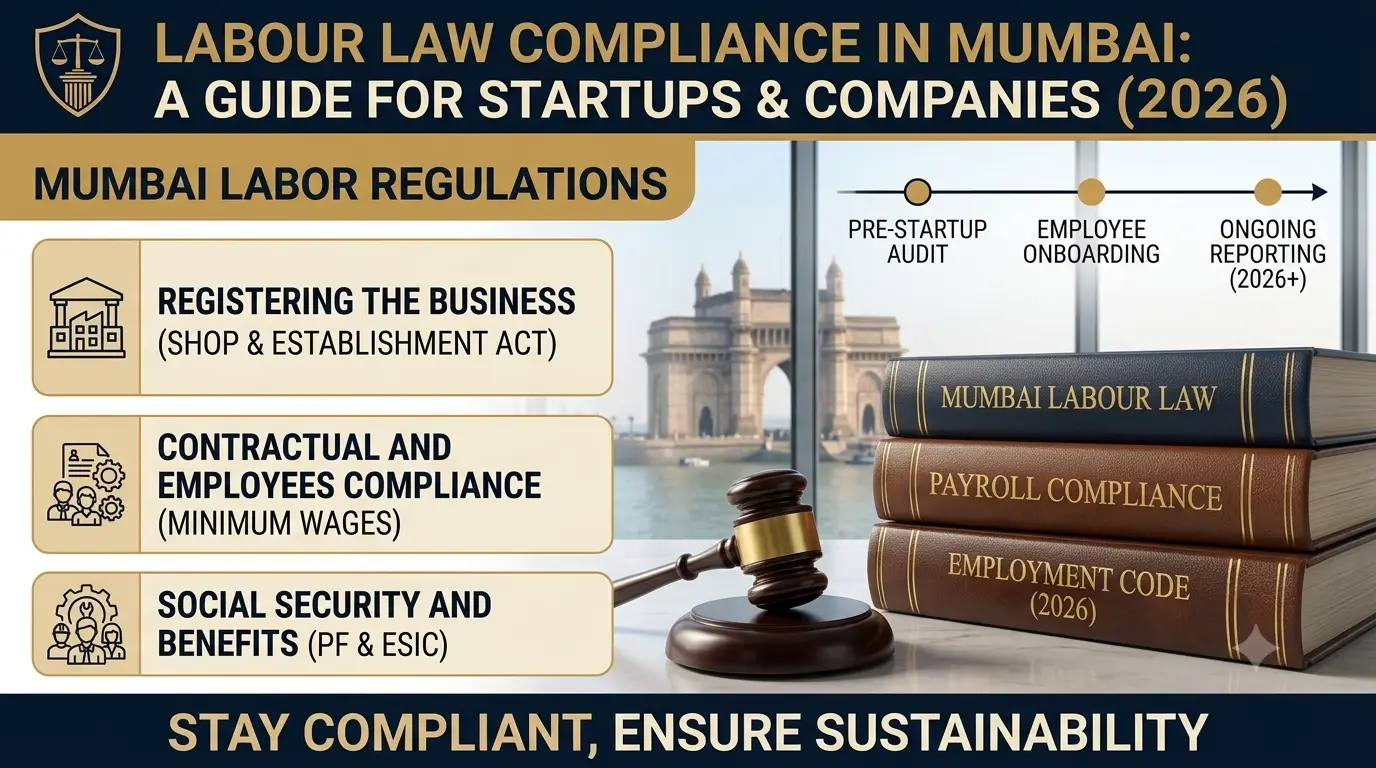
Labour Law Compliance in Mumbai: Complete Guide for Startups & Companies (2026)

Running a business in Mumbai? Whether you’re a bootstrapped startup in Andheri or an established enterprise in BKC, one thing is non-negotiable — labour law compliance. Non-compliance doesn’t just attract penalties; it can result in criminal liability, factory shutdowns, and reputational damage that no business can afford.

This 2026 guide by Elixir Legal Services — one of Mumbai’s leading law firms — walks you through every critical aspect of labour law compliance so your business stays protected, productive, and penalty-free.

Why Labour Law Compliance Matters More Than Ever in 2026

India’s labour law landscape has undergone sweeping changes. The consolidation of 29 central labour laws into 4 Labour Codes — covering wages, industrial relations, social security, and occupational safety — is transforming how businesses manage their workforce obligations.

For Mumbai-based businesses, compliance is especially critical because:

  • Maharashtra has its own state-specific amendments and rules layered on top of central laws.
  • Mumbai’s dense workforce and strong union culture means disputes escalate quickly.
  • Labour inspections and audits have intensified under Maharashtra’s enforcement directorates.
  • Employee awareness of rights is at an all-time high.

Working with an experienced employment lawyer in Mumbai is no longer a luxury — it is a strategic necessity.

The 4 Labour Codes: What Mumbai Businesses Must Know

The central government has enacted four Labour Codes that will eventually replace legacy legislation. While implementation timelines vary by state, businesses should start aligning their HR policies now.

1. Code on Wages, 2019

This code consolidates the Minimum Wages Act, Payment of Wages Act, Payment of Bonus Act, and Equal Remuneration Act. Key implications for Mumbai employers include:

  • Universal minimum wage floor for all workers, including those in the unorganised sector.
  • Mandatory timely wage payment — delays attract penalties.
  • Gender pay equity requirements across all categories of employment.
  • Annual bonus obligations based on a defined formula.

2. Industrial Relations Code, 2020

Replaces the Industrial Disputes Act, Trade Unions Act, and Industrial Employment (Standing Orders) Act. Critical changes:

  • Establishments with 300+ workers (up from 100) now need government permission for layoffs, retrenchment, or closure.
  • Mandatory standing orders for establishments with 300+ workers.
  • New dispute resolution mechanisms through conciliation, arbitration, and industrial tribunals.
  • Stricter regulations around strikes and lockouts.

3. Code on Social Security, 2020

Consolidates EPF, ESIC, Gratuity, Maternity Benefit, and other social security laws. Key points:

  • EPF and ESIC extended to gig workers and platform workers — a significant development for Mumbai’s tech and delivery sectors.
  • Gratuity eligibility may be extended to fixed-term contract workers.
  • Maternity benefits expanded to include commissioning mothers and adopting mothers.

4. Occupational Safety, Health and Working Conditions Code, 2020

Covers factories, construction, mines, and establishments. Important for Mumbai businesses:

  • Mandatory health and safety standards for all scheduled establishments.
  • Annual health check-ups for workers over 45 years of age.
  • Specific provisions for women workers — including night shift protections and welfare amenities.
  • Digital maintenance of employment records and registers.

Key Labour Laws Still Applicable in Maharashtra (2026)

Until the Labour Codes are fully notified with Maharashtra-specific rules, the following central and state laws remain in force. Compliance with these is mandatory today:

Shops and Establishments Act (Maharashtra)

Every commercial establishment, office, restaurant, or retail business in Mumbai must register under the Maharashtra Shops and Establishments Act. Key requirements:

  • Registration within 30 days of commencing business.
  • Display of registration certificate at the workplace.
  • Compliance with working hours (max 9 hours/day, 48 hours/week).
  • Mandatory weekly off, paid leaves (privilege, sick, casual), and overtime wages.
  • Restrictions on employing children and young persons.
  • Notice and compensation requirements before termination.

Employees’ Provident Fund (EPF) Act, 1952

  • Applicable to establishments with 20 or more employees.
  • Employee + Employer contribution: 12% of basic wages each.
  • Monthly PF challan to be deposited by the 15th of the following month.
  • Universal Account Number (UAN) must be generated and activated for every employee.
  • Annual returns and monthly ECR (Electronic Challan cum Return) filings mandatory.

Employees’ State Insurance (ESIC) Act, 1948

  • Applicable to establishments with 10+ employees (in certain categories) earning up to ₹21,000/month.
  • Employee contribution: 0.75% of wages; Employer contribution: 3.25% of wages.
  • Half-yearly contribution returns and monthly challan filings required.
  • ESIC registration for all covered employees is mandatory.

Payment of Gratuity Act, 1972

  • Applicable to establishments with 10+ employees.
  • Gratuity payable on completion of 5 years of continuous service.
  • Formula: 15 days’ wages × number of years of service.
  • Maximum gratuity ceiling: ₹20 lakh (subject to revision).
  • Gratuity must be paid within 30 days of it becoming payable.

Payment of Bonus Act, 1965

  • Applicable to establishments with 20+ employees.
  • Minimum bonus: 8.33% of annual salary or ₹100, whichever is higher.
  • Maximum bonus: 20% of salary.
  • Bonus to be paid within 8 months from the end of the accounting year.

Maternity Benefit Act, 1961 (Amended 2017)

  • Applicable to establishments with 10+ employees.
  • 26 weeks of paid maternity leave for the first two children; 12 weeks thereafter.
  • Crèche facility mandatory for establishments with 50+ employees.
  • Work from home option post-maternity leave (if nature of work permits).
  • No dismissal or adverse action during or on account of maternity leave.

Sexual Harassment of Women at Workplace (Prevention, Prohibition and Redressal) Act, 2013 (POSH)

  • Every establishment with 10+ employees must constitute an Internal Complaints Committee (ICC).
  • Mandatory annual report to the District Officer.
  • Awareness and sensitisation training for all employees.
  • Written POSH policy to be published and circulated.
  • Non-constitution of ICC is a criminal offence — a point many startups miss.

Contract Labour (Regulation and Abolition) Act, 1970

  • Establishments engaging 20+ contract workers must register as Principal Employers.
  • Contractors deploying 20+ workers need a licence.
  • Principal employer is jointly liable for contractor’s compliance failures — wage payments, PF, ESIC etc.
  • Maintaining Form XIII (register of contractors) and Form XIV (employment register) is mandatory.

Factories Act, 1948 (Maharashtra Rules)

Manufacturing units in Mumbai and surrounding industrial areas (Thane, Navi Mumbai, Bhiwandi) must comply with:

  • Registration and licensing under the Factories Act.
  • Health, safety, and welfare provisions (canteens, restrooms, crèches for 30+ women workers).
  • Working hours: maximum 48 hours/week, overtime at double rate.
  • Mandatory appointment of a Safety Officer (for factories with 1000+ workers).

Labour Law Compliance Checklist for Mumbai Startups (2026)

If you’re a startup or growing SME in Mumbai, here’s a practical compliance checklist to work through:

At Incorporation / Pre-Hiring Stage

  • ☐ Draft employment agreements compliant with current labour laws.
  • ☐ Prepare an employee handbook / HR policy document.
  • ☐ Draft a POSH policy and plan ICC constitution once you cross 10 employees.
  • ☐ Register under the Shops and Establishments Act (within 30 days of commencing business).
  • ☐ Obtain PT (Professional Tax) registration as an employer.

At 10 Employees

  • ☐ Constitute the Internal Complaints Committee (POSH).
  • ☐ Enrol under ESIC (if applicable).
  • ☐ Ensure compliance with Maternity Benefit Act.
  • ☐ Register under Payment of Gratuity Act.

At 20 Employees

  • ☐ Register under EPF (Employees’ Provident Fund).
  • ☐ Register under Payment of Bonus Act.
  • ☐ If engaging contract workers — register as Principal Employer under Contract Labour Act.

Ongoing Monthly Compliance

  • ☐ Deposit PF challan by 15th of every month.
  • ☐ Deposit ESIC challan by 15th of every month.
  • ☐ Deposit Professional Tax (PT) — monthly for employer, bi-annual for employees.
  • ☐ Maintain statutory registers (muster roll, wage register, overtime register, etc.).

Annual Compliance

  • ☐ File PF annual return.
  • ☐ File ESIC half-yearly returns.
  • ☐ Pay and file bonus within 8 months of year-end.
  • ☐ Submit POSH annual report.
  • ☐ Renew Shops & Establishments registration (if applicable).
  • ☐ Conduct labour law compliance audit.

Common Labour Law Violations by Mumbai Companies (And How to Avoid Them)

In our experience advising businesses across Mumbai, these are the most frequent compliance failures we encounter:

1. No POSH ICC Despite Having 10+ Employees

Many startups grow past the 10-employee threshold without noticing. Failing to constitute an ICC can result in fines up to ₹50,000 and cancellation of business licences on repeat offence.

2. Classifying Employees as “Consultants” to Avoid Statutory Dues

Misclassifying permanent employees as independent contractors to avoid PF, ESIC, and gratuity obligations is a common (and costly) mistake. Courts and labour authorities look at the substance of the relationship — not the label in the contract.

3. Not Registering Contract Labour

Businesses using housekeeping, security, or delivery contractors often believe compliance is the contractor’s problem. Under the law, the principal employer remains jointly liable.

4. Delayed or No Gratuity Payment

Gratuity must be paid within 30 days of the employee’s last working day. Delays attract interest, and disputes can result in recovery proceedings before the Controlling Authority.

5. Non-Maintenance of Statutory Registers

Labour inspectors regularly check registers including muster rolls, salary registers, overtime registers, and advance registers. Absence of these records — even if payroll compliance is otherwise intact — is a violation.

6. Not Updating Standing Orders

If your establishment is covered by the Industrial Employment (Standing Orders) Act (50+ workers in certain categories), your standing orders must reflect current policies and be certified by the Certifying Officer.

Employee Termination: Legal Safeguards in Mumbai

Termination is one of the highest-risk areas for non-compliance. Here’s what Mumbai employers must keep in mind:

  • Notice period: As per the employment contract and the Shops and Establishments Act — typically 30 days for employees with 3+ months of service.
  • No termination during maternity leave — this is absolutely prohibited.
  • Retrenchment compensation — for workmen covered under the Industrial Disputes Act, retrenchment requires 1 month’s notice (or pay in lieu) plus retrenchment compensation at 15 days’ wages per year of service.
  • Domestic enquiry — for misconduct-based dismissals, a fair domestic enquiry following principles of natural justice is mandatory before dismissal.
  • Full and final settlement — must include outstanding salary, leave encashment, gratuity (if eligible), bonus, and PF settlement initiation.

Disputes arising from improper termination can land businesses before the Labour Court or Industrial Tribunal in Mumbai — prolonged, expensive, and reputationally damaging. Our employment and labour law team helps businesses navigate terminations legally and without dispute.

Handling Labour Disputes in Mumbai: Forums and Timelines

When a dispute arises, it’s important to know the right forum and the applicable timelines:

Dispute Type Forum Typical Timeline
Wage disputes Labour Court / Payment of Wages Authority 3–12 months
Wrongful termination (workmen) Labour Court, Mumbai 1–3 years
PF / ESIC disputes PF Tribunal / ESIC Court 6–18 months
Gratuity disputes Controlling Authority (Asst. Labour Commissioner) 3–12 months
POSH complaints ICC (internal) → Local Complaints Committee → Civil Court 60–90 days internally
Industrial disputes (large scale) Industrial Tribunal, Mumbai 2–5 years

Early legal intervention — ideally before a formal dispute is filed — dramatically reduces litigation time and cost. If your business is facing a labour dispute, consult an experienced employment lawyer in Mumbai at the earliest opportunity.

Special Compliance Considerations for Specific Industries in Mumbai

IT & Startups

  • Software companies may be covered under the Shops & Establishments Act — not the Factories Act — but POSH, EPF, ESIC, and Gratuity obligations remain.
  • Flexible work arrangements and remote work policies must be documented carefully.
  • ESOPs and variable pay structures must be documented to avoid wage disputes.

Hospitality & Restaurants

  • High staff turnover means gratuity liability accumulates fast and must be tracked.
  • Working hours, split duties, and overtime for kitchen/service staff are heavily regulated under the Shops Act.
  • Seasonal hiring must comply with fixed-term contract provisions.

Manufacturing & Factories (Thane, Navi Mumbai, Bhiwandi)

  • Factories Act licensing, safety officer appointments, and accident reporting obligations apply.
  • Hazardous processes have additional notification and health surveillance requirements.
  • Contract labour compliance is critical given the scale of outsourced operations.

E-Commerce & Gig Economy

  • The Code on Social Security, 2020 brings gig and platform workers within the ambit of social security for the first time.
  • Companies must monitor state-level notification of rules for gig worker welfare boards.
  • Delivery partner agreements must be structured carefully to manage classification risk.

How Elixir Legal Services Helps Mumbai Businesses with Labour Law Compliance

At Elixir Legal Services, our Employment, Labour & Benefits practice provides end-to-end support for businesses across Mumbai and Maharashtra:

  • Labour Law Compliance Audits — Comprehensive review of all statutory obligations, identifying gaps and risk areas before an inspector does.
  • Employment Contracts & HR Policies — Drafting and reviewing employment agreements, offer letters, HR handbooks, and workplace policies that are legally compliant and business-friendly.
  • POSH Implementation — Setting up the ICC, drafting the POSH policy, conducting sensitisation training, and guiding inquiry procedures.
  • Labour Dispute Resolution — Representing employers before Labour Courts, Industrial Tribunals, PF/ESIC authorities, and Controlling Authorities for gratuity.
  • Termination & Retrenchment Advisory — Structuring legally sound separations, managing domestic enquiries, and negotiating settlements.
  • Retainer-Based Compliance Support — Monthly/quarterly compliance advisory ensuring you never miss a deadline or filing.
  • Due Diligence for M&A — Labour law due diligence for mergers, acquisitions, and investments involving Mumbai-based businesses.

Penalties for Labour Law Non-Compliance in India (2026)

The penalties for non-compliance are significant and, in many cases, criminal in nature:

Violation Penalty
Non-registration under Shops Act Fine up to ₹10,000 + ₹200/day of continuing default
Non-payment of EPF Interest @ 12% p.a. + damages up to 25% of arrears + prosecution
ESIC non-compliance Penalty + interest; directors may be personally liable
No POSH ICC (10+ employees) Fine up to ₹50,000; licence cancellation on repeat
Non-payment of gratuity Recovery + 10% interest; imprisonment up to 2 years in extreme cases
Contract Labour Act violations Fine up to ₹1,000 + imprisonment up to 3 months
Minimum Wages violation Fine up to ₹5,000 + imprisonment up to 6 months

Beyond financial penalties, repeat violations can result in blacklisting from government contracts and public procurement — a serious business consequence that many companies underestimate.

Frequently Asked Questions (FAQs)

Q: Is a startup with 5 employees required to comply with labour laws in Mumbai?

Yes. Several laws apply from the very first employee — including the Shops and Establishments Act, minimum wage requirements, Professional Tax deductions, and POSH obligations (once you cross 10 employees). Compliance must begin from day one.

Q: Do labour laws apply to remote or work-from-home employees in Mumbai?

Yes. The employment relationship is governed by Indian labour laws regardless of where the employee works. EPF, ESIC, Gratuity, Bonus, and POSH obligations remain unchanged for remote workers employed in India.

Q: What is the difference between a “workman” and a “non-workman” employee under Indian labour law?

The Industrial Disputes Act defines a “workman” as any person employed in a skilled, unskilled, manual, operational, supervisory, or technical capacity earning up to a specified threshold (and not engaged in a managerial or administrative role). Workmen have stronger statutory protections — particularly around termination and retrenchment — compared to non-workmen (managers, senior executives).

Q: Can we put all employees on fixed-term contracts to avoid gratuity and termination obligations?

Not advisable. Under the Code on Industrial Relations, fixed-term employees are entitled to gratuity on a pro-rata basis. Blanket use of fixed-term contracts to avoid statutory dues is increasingly challenged before Labour Courts and can amount to unfair labour practice.

Q: How often should a company do a labour law compliance audit?

We recommend a formal audit at least once a year, with an interim review mid-year. Growing companies should also trigger an audit when crossing key headcount thresholds (10, 20, 50 employees) or entering new business activities.

Q: Can Elixir Legal Services help with both compliance and disputes?

Absolutely. Our employment and labour law practice covers advisory, compliance, and dispute resolution — giving businesses a single point of contact for all workforce-related legal matters.

Conclusion: Build a Compliant, Litigation-Free Workplace in Mumbai

Labour law compliance in Mumbai is not a one-time checkbox — it’s an ongoing process that evolves with your business. The cost of getting it right upfront is always lower than the cost of a dispute, penalty, or prosecution later.

Whether you’re a founder setting up your first office, an HR head struggling to keep up with regulatory changes, or a CFO worried about the liability exposure in your labour practices — the right legal partner makes all the difference.

Elixir Legal Services brings decades of expertise in employment and labour law across Mumbai and Maharashtra. From compliance audits and policy drafting to dispute resolution and litigation — we’re with you at every step.

Disclaimer: This article is for informational purposes only and does not constitute legal advice. The Bar Council of India does not permit advertisement or solicitation by advocates. For legal advice specific to your business, please contact Elixir Legal Services directly.
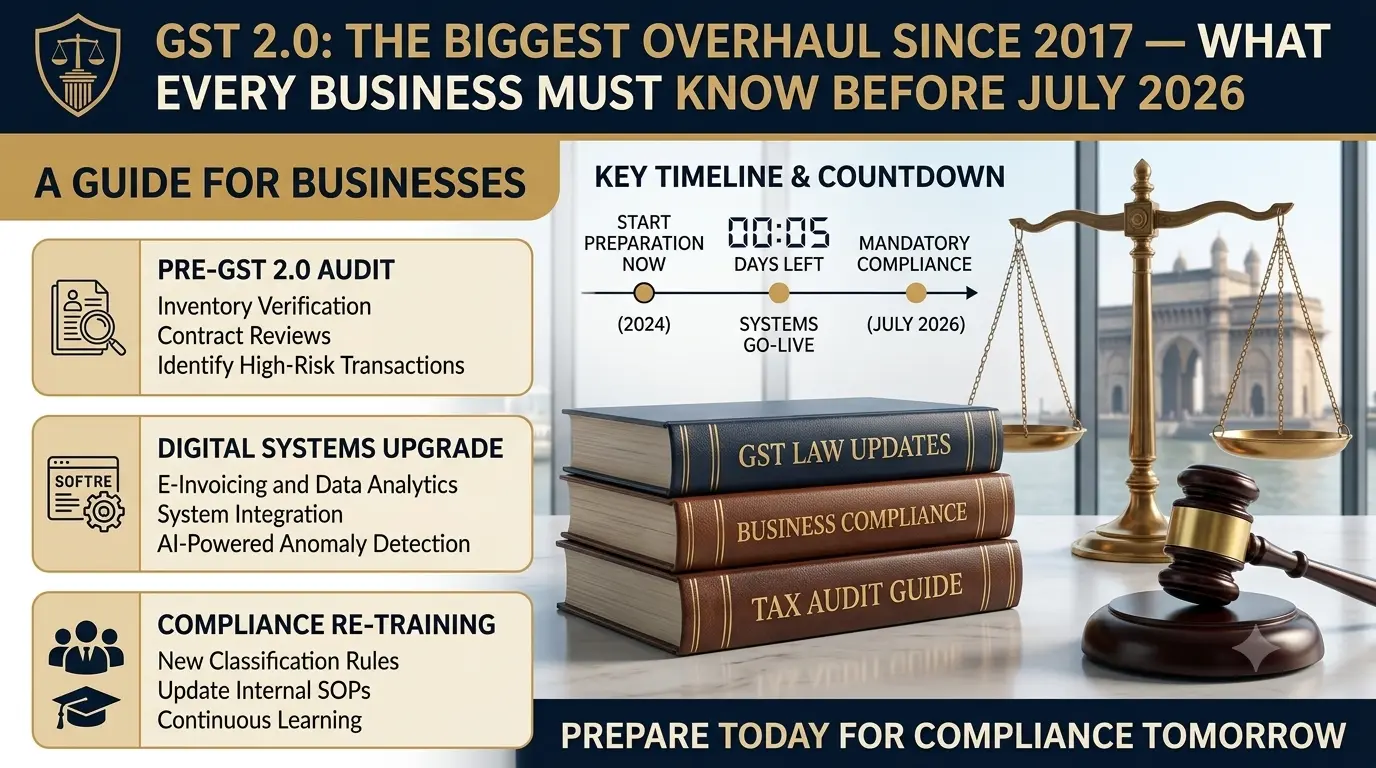
GST 2.0: The Biggest Overhaul Since 2017 — What Every Business Must Know Before July 2026

The 56th GST Council’s rate rationalisation, effective 22 September 2025, is now the operative framework for all GST filings in 2026. The 12% and 28% slabs have been scrapped. A new 40% luxury rate has been introduced. ITC rules are tighter than ever. And from December 2025, returns older than three years are permanently blocked. The Q1 FY 2026-27 filing deadline — July 13, 2026 — is your first full-quarter reckoning under the new rules.

The Big Picture

Why GST 2.0 Is Not Just Another Rate Revision

When GST was introduced in July 2017, it replaced over a dozen indirect taxes with a single, unified framework. That was a structural revolution. What happened in September 2025 — and what continues to roll out through mid-2026 — is the second revolution: a fundamental restructuring of how GST is calculated, reported, validated, and enforced.

The 56th GST Council didn’t just tinker with rates. It collapsed a messy five-slab system into a cleaner three-tier structure, killed the 12% slab entirely, moved hundreds of items, introduced a new 40% rate for luxury and sin goods, overhauled ITC validation from “provisional claim” to “hard match only,” and set hard statutory deadlines that permanently close off old compliance backlogs.

For businesses — particularly SMEs, CFOs managing multi-GSTIN operations, and business owners who’ve relied on accountants to “sort it out later” — the message from the government is unambiguous: the era of loose GST compliance is over.

2Primary slabs now (5% & 18%), down from 4 slabs
40%New luxury/sin rate replacing the 28% + cess structure
3 yrsHard deadline — older returns permanently blocked
18%Interest p.a. on wrongful ITC claims + potential 24% for excess
GST Rate Change 2026

The New GST Slab Structure — Fully Explained

The GST 2.0 rate rationalisation replaces the old 0%–5%–12%–18%–28% multi-slab structure with a streamlined four-tier framework. Here’s exactly what the new structure looks like and what falls where:

0%Exempt / Nil
  • Fresh fruits & vegetables
  • Unpacked food grains
  • Milk, bread, salt
  • Education services
  • Health services
  • Individual health & life insurance (new)
  • School supplies: notebooks, pencils, maps
5%Merit Rate
  • Packaged food items
  • Toothpaste, soap
  • Basic medicines
  • Healthcare services
  • Transport (economy class)
  • Packaged grains
18%Standard Rate
  • Consumer electronics
  • Cement & steel (moved from 28%)
  • IT & digital services
  • Restaurants (AC)
  • Compact cars & motorcycles
  • Most B2B services
40%Luxury / Sin
  • Tobacco & cigarettes
  • Pan masala
  • Aerated beverages
  • Premium luxury cars
  • High-end luxury goods
⚡ What Moved — Critical for Businesses

12% slab scrapped: Items either dropped to 5% or moved up to 18%. 28% slab largely scrapped: Most items moved to 18%; sin/luxury moved to 40%. Individual health & life insurance: Exempted entirely (was 18%) — suppliers now lose ITC on related inputs and must recalculate under Rules 42/43. Cement, electronics, capital goods: Now at 18% (was 28%) — cash flow improvement for manufacturers.

What This Means for Your Business Pricing

Every product and service your business sells that moved slabs on 22 September 2025 required an immediate HSN-code and billing-software update. Businesses that issued invoices at old rates after that date — even if they had pre-September purchase stock — are potentially exposed to GST mismatch notices. Inventory procured at old rates but sold post-rationalisation must follow time-of-supply rules precisely.

For buyers of cement, electronics, and capital goods: the reduction from 28% to 18% means less working capital blocked in input tax. This is a genuine cash-flow improvement — but only if your GSTR-2B reconciliation is clean and your ITC claims are correctly mapped to the new rate codes.

“The era of filing whenever is over. The hard ITC validation system and the three-year return filing bar mean that businesses can no longer treat GST compliance as a problem to be solved later — later no longer exists.”

— Elixir Legal Services · Tax & Business Compliance Practice · Mumbai
ITC — The Biggest Risk

The New ITC Hard Validation Rules: What Every CFO Must Understand

Input Tax Credit is the backbone of GST efficiency — it’s how businesses avoid paying tax on tax. In 2026, the rules governing who can claim ITC, when, and how much have been tightened to a degree that many businesses are only now discovering. Here’s what changed:

1. GSTR-2B Is Now the Only Basis for ITC Claims

The GST portal has moved to a hard validation system for ITC. This means: if your supplier has not uploaded an invoice, or has made an error in your GSTIN, that invoice will not appear in your GSTR-2B. GSTR-2B is a static, once-generated monthly statement — and it is now the only document the government recognises for ITC eligibility. Your internal purchase register is irrelevant. Your payment confirmation is irrelevant. Only what appears in GSTR-2B counts.

⛔ High-Risk Zone

Claiming ITC that doesn’t appear in GSTR-2B — even on a genuine, paid invoice — triggers an automated demand for reversal with 18–24% interest. If the system detects a mismatch between your GSTR-3B claim and your GSTR-2B, it generates an automatic demand. No notice required.

2. Rule 37A — Supplier Non-Filing Reversal

Rule 37A is now one of the most operationally damaging provisions for businesses with large vendor bases. It mandates that you must reverse ITC if your supplier fails to file GSTR-3B — even if you have already paid the supplier in full. If your office landlord, freight vendor, or raw material supplier skips their GST filing, you absorb the hit. You can reclaim the credit only after the supplier eventually files, creating a cash-flow crater in the interim.

3. ITC Deadline — October 2026 Cut-Off for FY 2025-26

ITC on any invoice from FY 2025-26 must be claimed no later than the due date of filing GSTR-3B for September 2026 (i.e., 20 October 2026) or the date of filing GSTR-9 for FY 2025-26 — whichever is earlier. ITC claimed after this date is ineligible and must be reversed with 18% interest. This is a hard statutory deadline — there is no extension mechanism.

4. Rule 86B — Minimum 1% Cash Payment

Businesses with monthly taxable turnover exceeding ₹50 lakh must pay at least 1% of total GST liability in cash (from the cash ledger, not ITC). Violation attracts a penalty of ₹10,000 or the amount of ITC used in excess — whichever is higher. The GST portal will restrict GSTR-3B filing if this rule is breached.

5. Section 17(5) — Blocked Credits Still Apply

Even a perfectly reconciled GSTR-2B claim can be denied if the underlying expense falls under Section 17(5) blocked credits. Common examples businesses routinely get wrong: motor vehicles and related services, food and beverages for employees, membership of clubs, personal use items. The Invoice Management System (IMS) “Deemed Accepted” status does not validate a blocked credit — auditors will reverse it with interest.

✓ Best Practice for CFOs in 2026

Implement monthly GSTR-2B reconciliation as a non-negotiable close process. Tag all purchases at entry with eligibility status (Eligible / Ineligible under 17(5) / Pending GSTR-2B). For high-value suppliers, include a GST compliance warranty clause in contracts — if a supplier’s non-filing results in your ITC reversal, you have a contractual basis for recovery.

Return Filing Deadline

The Three-Year Return Filing Bar — Act Now or Lose Forever

From 1 December 2025, the GST portal enforces a hard three-year filing bar: any GST return that is more than three years past its original due date cannot be filed — permanently. There is no amnesty extension. There is no manual override. The system simply blocks the filing.

What this means in practice: if your business has unfiled returns for any period in FY 2022-23 or earlier, and you haven’t filed them by their three-year anniversary, those returns are gone forever. The compliance gap is permanent. And a permanent compliance gap means:

  • Potential retrospective tax demand for the unreconciled period
  • Loss of any ITC that would have been claimable in those periods
  • Risk of GSTIN cancellation for prolonged non-filing
  • Disqualification from GST tenders, government contracts, and lender due diligence
  • Director-level exposure for companies where non-filing was intentional
⛔ Immediate Action Required

If your business has any unfiled GST returns for periods in FY 2022-23 (April 2022 – March 2023), the window to file them closes on a rolling basis through March 2026. Do not wait for a notice. A proactive DRC-03 voluntary payment with interest is significantly less expensive — legally and financially — than a departmental audit, demand order, and penalty proceedings.

E-Invoicing & IRN

E-Invoicing Mandate: Your Invoice Is Legally Void Without an IRN

If your Aggregate Annual Turnover (AATO) is ₹5 crore or above, every B2B invoice you issue in 2026 must be uploaded to the Invoice Registration Portal (IRP) to generate a unique Invoice Reference Number (IRN). Without the IRN, the invoice is not legally valid for ITC purposes.

For businesses near the ₹10 crore threshold: from that level onwards, invoices must be reported within 30 days of the invoice date to generate a valid IRN. Missing this window means the invoice cannot be registered, your buyer loses ITC, and you face potential penalties.

Non-Compliance Type
Penalty / Consequence
Trigger
Invoice without IRN (e-invoicing applicable)
Buyer loses ITC; GST notice under Sec. 122 up to ₹25,000 per error
Any B2B invoice issued without IRP registration
Late GSTR-1 / GSTR-3B filing
₹50/day capped at ₹5,000; ₹20/day for NIL returns + 18% interest on tax due
Filing after due date (11th / 20th respectively)
Wrongful ITC claim (Rule 86B / 2B mismatch)
18% interest + ₹10,000 or ITC amount — whichever is higher; GSTR-3B filing blocked
Automated system detection
ITC on blocked credits (Sec. 17(5))
Reversal with 24% interest + potential Sec. 74 proceedings for “suppression”
Departmental audit or AI-triggered scrutiny
Non-registration despite threshold breach
10% of tax due or ₹10,000 (non-fraud); 100% of tax due (fraud)
GSTN system detection or third-party data match
Returns older than 3 years unfiled
Permanent filing block; GSTIN cancellation risk; retrospective demand
Rolling deadline from December 2025
Action Plan

GST 2026 Compliance Checklist: 10 Things Every Business Must Do Before July

The Q1 FY 2026-27 return cycle (April–June 2026) closes on 13 July 2026 (GSTR-1) and 20 July 2026 (GSTR-3B). This is the first full quarter under the GST 2.0 framework. Here is your action checklist:

  1. Update Your HSN / SAC Rate Master in Billing Software

    Every product and service must be mapped to the correct rate under the new structure. Invoices issued at the wrong rate after 22 September 2025 create GSTR-1 mismatches that cascade into your buyers’ GSTR-2B and trigger notices for both parties.

  2. Run a GSTR-2B Reconciliation for All Months Since October 2025

    Pull your GSTR-2B for October 2025 through May 2026. Match every line against your purchase register. Flag any invoices missing from GSTR-2B — these represent ITC you cannot claim until the supplier files. Do not claim them in GSTR-3B until they appear.

  3. Audit Your Vendor Base for GSTR-3B Compliance (Rule 37A)

    Identify your top 20 vendors by invoice value. Check whether they filed GSTR-3B for each month since October 2025. Non-filing suppliers are a live ITC risk. Consider adding a GST compliance warranty clause to vendor contracts for FY 2026-27 renewals.

  4. Clear All Pending Returns from FY 2022-23 Immediately

    The three-year rolling bar is live. For any unfiled period in FY 2022-23 whose three-year anniversary falls before June 2026, file now with voluntary DRC-03 interest payment. Do not wait for a notice — the window is closing month by month.

  5. Review Section 17(5) Blocked Credit Exposure

    Ask your accounting team to audit all ITC claimed in the last 12 months against the Section 17(5) blocked credit list. If any blocked credits were claimed (e.g. on company cars, employee food, club memberships), file a voluntary DRC-03 before the department raises a demand — the interest rate drops significantly on voluntary reversal vs. detected reversal.

  6. Verify E-Invoicing Compliance for Your AATO Threshold

    If your FY 2024-25 AATO crossed ₹5 crore, every B2B invoice since then needed an IRN. If you’re above ₹10 crore AATO, you additionally have the 30-day IRN reporting window. Non-IRN invoices are legally void for ITC — your buyers will start raising this in vendor audits.

  7. Check Rule 86B Cash Ledger Compliance

    If your monthly taxable turnover exceeds ₹50 lakh, confirm that at least 1% of GST liability each month was paid from the cash ledger, not fully offset by ITC. Review each month since April 2025 for potential violations.

  8. Reassess Composition Scheme Eligibility

    The 2026 rules clarify that composition dealers cannot supply through e-commerce platforms. If you’re a composition dealer selling on Amazon, Flipkart, or any marketplace, you may be in inadvertent violation. Seek advice on whether to migrate to regular GSTIN.

  9. Enable Multi-Factor Authentication (MFA) on Your GSTIN

    GSTN has made MFA mandatory for high-risk GSTIN categories and is expanding it. Ensure all authorised signatories for your GSTIN have MFA enabled. Failure to comply can block return filing access at the worst possible time.

  10. Book a Comprehensive GST Compliance Review Before July 13

    The July 2026 filing cycle closes your Q1 FY 2026-27 returns. A pre-filing compliance review with a qualified GST practitioner can identify and resolve mismatches, ITC gaps, and rate errors before they become automated demands. Prevention costs a fraction of cure under the GST 2.0 enforcement regime.

Sector Impact

How GST 2.0 Hits Different Businesses

Sector Key GST 2.0 Impact Urgency Level
Manufacturers (cement, electronics, capital goods) Rate drop from 28% to 18% = cash flow boost on inputs. But ITC reversal risk on old inventory transition period (Sept–Oct 2025 purchases) requires careful time-of-supply analysis. Positive — review ITC mapping
Insurance & Financial Services Individual health & life insurance now NIL-rated. Suppliers lose ITC on related inputs — full proportional reversal under Rules 42/43 mandatory. Mixed-supply businesses need new ITC apportionment calculations. High — ITC recalculation urgent
Real Estate Developers Construction materials at 18% (previously 28%). Improved input cost economics. But RERA-registered projects with pre-September contracts must reconcile old vs new rate on ongoing invoices carefully. Beneficial — verify contract billing
E-Commerce Sellers TCS at 0.5% (revised from 1%). Composition dealers blocked from e-commerce platforms. All B2B invoices from platforms need IRN — ensure your integrations are updated. High — platform compliance check
IT / SaaS / Digital Services Stays at 18%. ITC on software subscriptions, cloud services, and digital marketing is eligible — but hard GSTR-2B validation means your vendor’s filing speed directly affects your cash flow. Moderate — vendor audit needed
Hotels & Restaurants Rate rationalisation of hospitality services under the new 18% standard bracket. AC restaurants consolidated. ITC on food and beverages for employees remains blocked under Section 17(5). Moderate — review rate applicability
SMEs (turnover ₹1–5 Cr) QRMP scheme filers: Q1 GSTR-1 due July 13. Three-year filing bar is the biggest risk — many SMEs have old pending returns. ITC mismatch from unverified vendors is the second biggest risk. High — compliance backlog review
Common Questions

GST 2026 — Business FAQs

The 12% slab has been scrapped — but some of my products used to attract 12%. What rate applies now?
Items that were at 12% either moved down to 5% (typically essential goods) or up to 18% (most services and goods). The exact classification depends on your specific HSN code. There is no universal rule — you need to check the revised rate notification against your product’s HSN. Billing at the wrong rate after 22 September 2025 is a compliance breach regardless of intent. Your accountant should have a rate-change impact list specific to your product/service catalogue.
My supplier didn’t file GSTR-3B. Do I really have to reverse my ITC even though I paid them?
Yes — this is Rule 37A in practice. If your supplier fails to file GSTR-3B by the 30th of September following the end of the financial year in which the invoice was issued, you must reverse the ITC. You can reclaim it only when the supplier subsequently files. This creates a genuine cash-flow timing risk. Your mitigation options are: (a) contractual clause requiring suppliers to file on time or compensate you for the ITC reversal, and (b) monthly GSTR-2B monitoring to identify non-filing suppliers before the reversal deadline hits.
Is the GST Amnesty Scheme 2026 still available for old compliance gaps?
The GST Amnesty Scheme 2026 provides a window for settling old Section 73/74 demands (for tax periods up to FY 2023-24) with reduced penalties and a waiver of interest in certain categories. However, it does not override the three-year return filing bar — if a return is permanently blocked, the amnesty cannot undo that. For businesses with pending demands rather than unfiled returns, the amnesty window should be assessed carefully with a tax consultant to quantify the benefit before the scheme’s expiry.
My business AATO is ₹4 crore. Do I need e-invoicing?
The current e-invoicing threshold for mandatory IRN generation is ₹5 crore AATO. At ₹4 crore, you are currently below the threshold. However, the government has consistently reduced this threshold over time — it started at ₹500 crore and has progressively come down. Many industry observers expect it to reach ₹1 crore in the next 12–18 months. Voluntarily adopting e-invoicing now (it is permitted below the threshold) future-proofs your billing infrastructure and makes you more credible to larger B2B buyers who do require IRN-backed invoices from their vendors.
GSTR-9 (Annual Return) for FY 2025-26 — when is it due and what changes?
GSTR-9 for FY 2025-26 will typically be due by 31 December 2026. Under the GST 2.0 framework, the annual return for this year will be the first to reflect the mid-year rate rationalisation — meaning you’ll need to carefully reconcile figures for the April–September 2025 period (old rates) against October 2025 – March 2026 (new rates). Businesses with significant inventory at the cut-off date will need detailed time-of-supply documentation to support their GSTR-9 positions.

Is Your Business GST 2.0 Ready Before July 2026?

Elixir Legal Services advises SMEs, CFOs, and business owners on GST compliance, ITC audits, notice responses, and GSTIN structuring across Mumbai and Maharashtra.

Book a GST Compliance Review

GST Notices · ITC Audits · GSTR Filing · E-Invoicing · Amnesty Scheme

ℹ Legal Disclaimer

This article is for general informational purposes only and does not constitute legal or tax advice. GST rules described reflect the position as of May 2026 following the 56th GST Council’s rationalisation (effective 22 September 2025) and subsequent notifications. Tax positions are fact-specific. Consult a qualified GST practitioner before taking any compliance action.