Labour Law Compliance in Mumbai (2026): The Complete Guide for Businesses
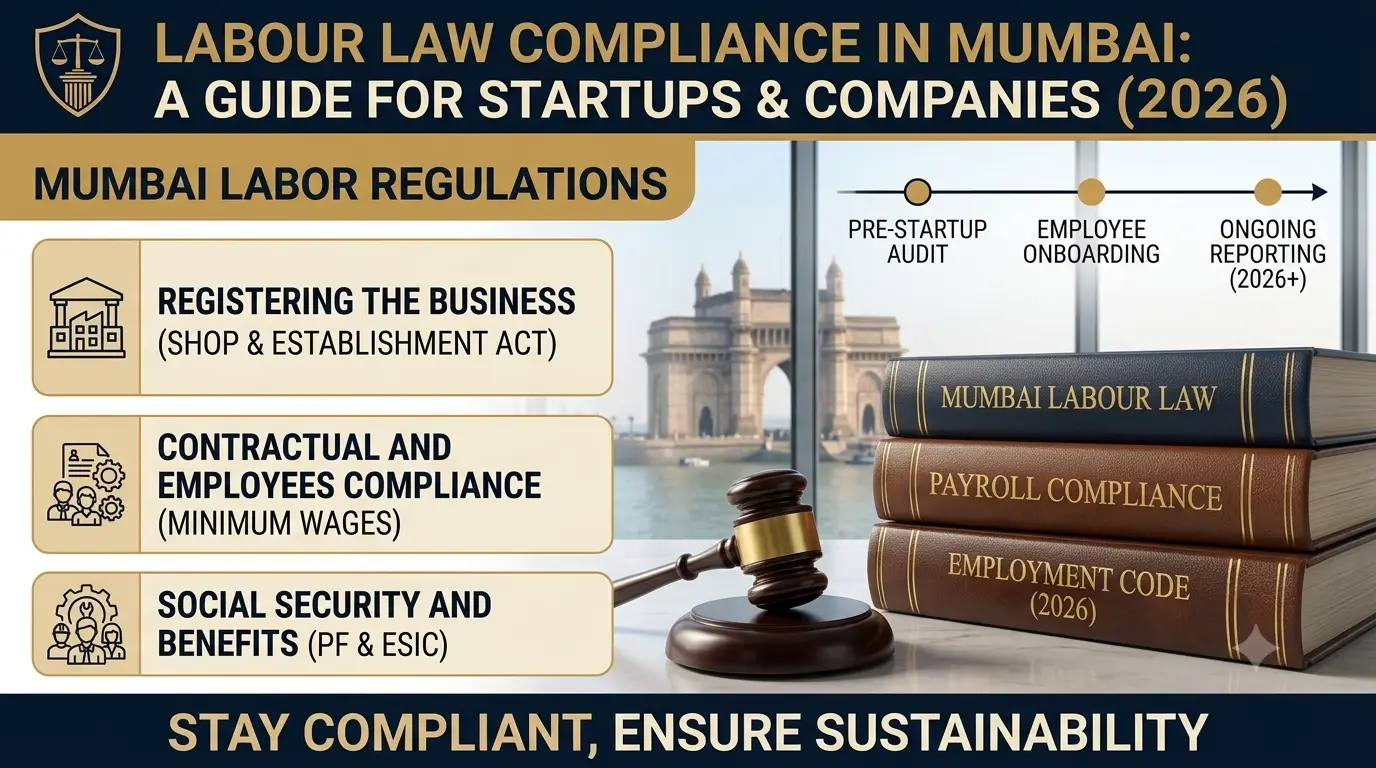
Running a business in Mumbai? Whether you’re a bootstrapped startup in Andheri or an established enterprise in BKC, one thing is non-negotiable — labour law compliance. Non-compliance doesn’t just attract penalties; it can result in criminal liability, factory shutdowns, and reputational damage that no business can afford.
This 2026 guide by Elixir Legal Services — one of Mumbai’s leading law firms — walks you through every critical aspect of labour law compliance so your business stays protected, productive, and penalty-free.
Why Labour Law Compliance Matters More Than Ever in 2026
India’s labour law landscape has undergone sweeping changes. The consolidation of 29 central labour laws into 4 Labour Codes — covering wages, industrial relations, social security, and occupational safety — is transforming how businesses manage their workforce obligations.
For Mumbai-based businesses, compliance is especially critical because:
- Maharashtra has its own state-specific amendments and rules layered on top of central laws.
- Mumbai’s dense workforce and strong union culture means disputes escalate quickly.
- Labour inspections and audits have intensified under Maharashtra’s enforcement directorates.
- Employee awareness of rights is at an all-time high.
Working with an experienced employment lawyer in Mumbai is no longer a luxury — it is a strategic necessity.
The 4 Labour Codes: What Mumbai Businesses Must Know
The central government has enacted four Labour Codes that will eventually replace legacy legislation. While implementation timelines vary by state, businesses should start aligning their HR policies now.
1. Code on Wages, 2019
This code consolidates the Minimum Wages Act, Payment of Wages Act, Payment of Bonus Act, and Equal Remuneration Act. Key implications for Mumbai employers include:
- Universal minimum wage floor for all workers, including those in the unorganised sector.
- Mandatory timely wage payment — delays attract penalties.
- Gender pay equity requirements across all categories of employment.
- Annual bonus obligations based on a defined formula.
2. Industrial Relations Code, 2020
Replaces the Industrial Disputes Act, Trade Unions Act, and Industrial Employment (Standing Orders) Act. Critical changes:
- Establishments with 300+ workers (up from 100) now need government permission for layoffs, retrenchment, or closure.
- Mandatory standing orders for establishments with 300+ workers.
- New dispute resolution mechanisms through conciliation, arbitration, and industrial tribunals.
- Stricter regulations around strikes and lockouts.
3. Code on Social Security, 2020
Consolidates EPF, ESIC, Gratuity, Maternity Benefit, and other social security laws. Key points:
- EPF and ESIC extended to gig workers and platform workers — a significant development for Mumbai’s tech and delivery sectors.
- Gratuity eligibility may be extended to fixed-term contract workers.
- Maternity benefits expanded to include commissioning mothers and adopting mothers.
4. Occupational Safety, Health and Working Conditions Code, 2020
Covers factories, construction, mines, and establishments. Important for Mumbai businesses:
- Mandatory health and safety standards for all scheduled establishments.
- Annual health check-ups for workers over 45 years of age.
- Specific provisions for women workers — including night shift protections and welfare amenities.
- Digital maintenance of employment records and registers.
Key Labour Laws Still Applicable in Maharashtra (2026)
Until the Labour Codes are fully notified with Maharashtra-specific rules, the following central and state laws remain in force. Compliance with these is mandatory today:
Shops and Establishments Act (Maharashtra)
Every commercial establishment, office, restaurant, or retail business in Mumbai must register under the Maharashtra Shops and Establishments Act. Key requirements:
- Registration within 30 days of commencing business.
- Display of registration certificate at the workplace.
- Compliance with working hours (max 9 hours/day, 48 hours/week).
- Mandatory weekly off, paid leaves (privilege, sick, casual), and overtime wages.
- Restrictions on employing children and young persons.
- Notice and compensation requirements before termination.
Employees’ Provident Fund (EPF) Act, 1952
- Applicable to establishments with 20 or more employees.
- Employee + Employer contribution: 12% of basic wages each.
- Monthly PF challan to be deposited by the 15th of the following month.
- Universal Account Number (UAN) must be generated and activated for every employee.
- Annual returns and monthly ECR (Electronic Challan cum Return) filings mandatory.
Employees’ State Insurance (ESIC) Act, 1948
- Applicable to establishments with 10+ employees (in certain categories) earning up to ₹21,000/month.
- Employee contribution: 0.75% of wages; Employer contribution: 3.25% of wages.
- Half-yearly contribution returns and monthly challan filings required.
- ESIC registration for all covered employees is mandatory.
Payment of Gratuity Act, 1972
- Applicable to establishments with 10+ employees.
- Gratuity payable on completion of 5 years of continuous service.
- Formula: 15 days’ wages × number of years of service.
- Maximum gratuity ceiling: ₹20 lakh (subject to revision).
- Gratuity must be paid within 30 days of it becoming payable.
Payment of Bonus Act, 1965
- Applicable to establishments with 20+ employees.
- Minimum bonus: 8.33% of annual salary or ₹100, whichever is higher.
- Maximum bonus: 20% of salary.
- Bonus to be paid within 8 months from the end of the accounting year.
Maternity Benefit Act, 1961 (Amended 2017)
- Applicable to establishments with 10+ employees.
- 26 weeks of paid maternity leave for the first two children; 12 weeks thereafter.
- Crèche facility mandatory for establishments with 50+ employees.
- Work from home option post-maternity leave (if nature of work permits).
- No dismissal or adverse action during or on account of maternity leave.
Sexual Harassment of Women at Workplace (Prevention, Prohibition and Redressal) Act, 2013 (POSH)
- Every establishment with 10+ employees must constitute an Internal Complaints Committee (ICC).
- Mandatory annual report to the District Officer.
- Awareness and sensitisation training for all employees.
- Written POSH policy to be published and circulated.
- Non-constitution of ICC is a criminal offence — a point many startups miss.
Contract Labour (Regulation and Abolition) Act, 1970
- Establishments engaging 20+ contract workers must register as Principal Employers.
- Contractors deploying 20+ workers need a licence.
- Principal employer is jointly liable for contractor’s compliance failures — wage payments, PF, ESIC etc.
- Maintaining Form XIII (register of contractors) and Form XIV (employment register) is mandatory.
Factories Act, 1948 (Maharashtra Rules)
Manufacturing units in Mumbai and surrounding industrial areas (Thane, Navi Mumbai, Bhiwandi) must comply with:
- Registration and licensing under the Factories Act.
- Health, safety, and welfare provisions (canteens, restrooms, crèches for 30+ women workers).
- Working hours: maximum 48 hours/week, overtime at double rate.
- Mandatory appointment of a Safety Officer (for factories with 1000+ workers).
Labour Law Compliance Checklist for Mumbai Startups (2026)
If you’re a startup or growing SME in Mumbai, here’s a practical compliance checklist to work through:
At Incorporation / Pre-Hiring Stage
- ☐ Draft employment agreements compliant with current labour laws.
- ☐ Prepare an employee handbook / HR policy document.
- ☐ Draft a POSH policy and plan ICC constitution once you cross 10 employees.
- ☐ Register under the Shops and Establishments Act (within 30 days of commencing business).
- ☐ Obtain PT (Professional Tax) registration as an employer.
At 10 Employees
- ☐ Constitute the Internal Complaints Committee (POSH).
- ☐ Enrol under ESIC (if applicable).
- ☐ Ensure compliance with Maternity Benefit Act.
- ☐ Register under Payment of Gratuity Act.
At 20 Employees
- ☐ Register under EPF (Employees’ Provident Fund).
- ☐ Register under Payment of Bonus Act.
- ☐ If engaging contract workers — register as Principal Employer under Contract Labour Act.
Ongoing Monthly Compliance
- ☐ Deposit PF challan by 15th of every month.
- ☐ Deposit ESIC challan by 15th of every month.
- ☐ Deposit Professional Tax (PT) — monthly for employer, bi-annual for employees.
- ☐ Maintain statutory registers (muster roll, wage register, overtime register, etc.).
Annual Compliance
- ☐ File PF annual return.
- ☐ File ESIC half-yearly returns.
- ☐ Pay and file bonus within 8 months of year-end.
- ☐ Submit POSH annual report.
- ☐ Renew Shops & Establishments registration (if applicable).
- ☐ Conduct labour law compliance audit.
Common Labour Law Violations by Mumbai Companies (And How to Avoid Them)
In our experience advising businesses across Mumbai, these are the most frequent compliance failures we encounter:
1. No POSH ICC Despite Having 10+ Employees
Many startups grow past the 10-employee threshold without noticing. Failing to constitute an ICC can result in fines up to ₹50,000 and cancellation of business licences on repeat offence.
2. Classifying Employees as “Consultants” to Avoid Statutory Dues
Misclassifying permanent employees as independent contractors to avoid PF, ESIC, and gratuity obligations is a common (and costly) mistake. Courts and labour authorities look at the substance of the relationship — not the label in the contract.
3. Not Registering Contract Labour
Businesses using housekeeping, security, or delivery contractors often believe compliance is the contractor’s problem. Under the law, the principal employer remains jointly liable.
4. Delayed or No Gratuity Payment
Gratuity must be paid within 30 days of the employee’s last working day. Delays attract interest, and disputes can result in recovery proceedings before the Controlling Authority.
5. Non-Maintenance of Statutory Registers
Labour inspectors regularly check registers including muster rolls, salary registers, overtime registers, and advance registers. Absence of these records — even if payroll compliance is otherwise intact — is a violation.
6. Not Updating Standing Orders
If your establishment is covered by the Industrial Employment (Standing Orders) Act (50+ workers in certain categories), your standing orders must reflect current policies and be certified by the Certifying Officer.
Employee Termination: Legal Safeguards in Mumbai
Termination is one of the highest-risk areas for non-compliance. Here’s what Mumbai employers must keep in mind:
- Notice period: As per the employment contract and the Shops and Establishments Act — typically 30 days for employees with 3+ months of service.
- No termination during maternity leave — this is absolutely prohibited.
- Retrenchment compensation — for workmen covered under the Industrial Disputes Act, retrenchment requires 1 month’s notice (or pay in lieu) plus retrenchment compensation at 15 days’ wages per year of service.
- Domestic enquiry — for misconduct-based dismissals, a fair domestic enquiry following principles of natural justice is mandatory before dismissal.
- Full and final settlement — must include outstanding salary, leave encashment, gratuity (if eligible), bonus, and PF settlement initiation.
Disputes arising from improper termination can land businesses before the Labour Court or Industrial Tribunal in Mumbai — prolonged, expensive, and reputationally damaging. Our employment and labour law team helps businesses navigate terminations legally and without dispute.
Handling Labour Disputes in Mumbai: Forums and Timelines
When a dispute arises, it’s important to know the right forum and the applicable timelines:
| Dispute Type |
Forum |
Typical Timeline |
| Wage disputes |
Labour Court / Payment of Wages Authority |
3–12 months |
| Wrongful termination (workmen) |
Labour Court, Mumbai |
1–3 years |
| PF / ESIC disputes |
PF Tribunal / ESIC Court |
6–18 months |
| Gratuity disputes |
Controlling Authority (Asst. Labour Commissioner) |
3–12 months |
| POSH complaints |
ICC (internal) → Local Complaints Committee → Civil Court |
60–90 days internally |
| Industrial disputes (large scale) |
Industrial Tribunal, Mumbai |
2–5 years |
Early legal intervention — ideally before a formal dispute is filed — dramatically reduces litigation time and cost. If your business is facing a labour dispute, consult an experienced employment lawyer in Mumbai at the earliest opportunity.
Special Compliance Considerations for Specific Industries in Mumbai
IT & Startups
- Software companies may be covered under the Shops & Establishments Act — not the Factories Act — but POSH, EPF, ESIC, and Gratuity obligations remain.
- Flexible work arrangements and remote work policies must be documented carefully.
- ESOPs and variable pay structures must be documented to avoid wage disputes.
Hospitality & Restaurants
- High staff turnover means gratuity liability accumulates fast and must be tracked.
- Working hours, split duties, and overtime for kitchen/service staff are heavily regulated under the Shops Act.
- Seasonal hiring must comply with fixed-term contract provisions.
Manufacturing & Factories (Thane, Navi Mumbai, Bhiwandi)
- Factories Act licensing, safety officer appointments, and accident reporting obligations apply.
- Hazardous processes have additional notification and health surveillance requirements.
- Contract labour compliance is critical given the scale of outsourced operations.
E-Commerce & Gig Economy
- The Code on Social Security, 2020 brings gig and platform workers within the ambit of social security for the first time.
- Companies must monitor state-level notification of rules for gig worker welfare boards.
- Delivery partner agreements must be structured carefully to manage classification risk.
How Elixir Legal Services Helps Mumbai Businesses with Labour Law Compliance
At Elixir Legal Services, our Employment, Labour & Benefits practice provides end-to-end support for businesses across Mumbai and Maharashtra:
- Labour Law Compliance Audits — Comprehensive review of all statutory obligations, identifying gaps and risk areas before an inspector does.
- Employment Contracts & HR Policies — Drafting and reviewing employment agreements, offer letters, HR handbooks, and workplace policies that are legally compliant and business-friendly.
- POSH Implementation — Setting up the ICC, drafting the POSH policy, conducting sensitisation training, and guiding inquiry procedures.
- Labour Dispute Resolution — Representing employers before Labour Courts, Industrial Tribunals, PF/ESIC authorities, and Controlling Authorities for gratuity.
- Termination & Retrenchment Advisory — Structuring legally sound separations, managing domestic enquiries, and negotiating settlements.
- Retainer-Based Compliance Support — Monthly/quarterly compliance advisory ensuring you never miss a deadline or filing.
- Due Diligence for M&A — Labour law due diligence for mergers, acquisitions, and investments involving Mumbai-based businesses.
Penalties for Labour Law Non-Compliance in India (2026)
The penalties for non-compliance are significant and, in many cases, criminal in nature:
| Violation |
Penalty |
| Non-registration under Shops Act |
Fine up to ₹10,000 + ₹200/day of continuing default |
| Non-payment of EPF |
Interest @ 12% p.a. + damages up to 25% of arrears + prosecution |
| ESIC non-compliance |
Penalty + interest; directors may be personally liable |
| No POSH ICC (10+ employees) |
Fine up to ₹50,000; licence cancellation on repeat |
| Non-payment of gratuity |
Recovery + 10% interest; imprisonment up to 2 years in extreme cases |
| Contract Labour Act violations |
Fine up to ₹1,000 + imprisonment up to 3 months |
| Minimum Wages violation |
Fine up to ₹5,000 + imprisonment up to 6 months |
Beyond financial penalties, repeat violations can result in blacklisting from government contracts and public procurement — a serious business consequence that many companies underestimate.
Frequently Asked Questions (FAQs)
Q: Is a startup with 5 employees required to comply with labour laws in Mumbai?
Yes. Several laws apply from the very first employee — including the Shops and Establishments Act, minimum wage requirements, Professional Tax deductions, and POSH obligations (once you cross 10 employees). Compliance must begin from day one.
Q: Do labour laws apply to remote or work-from-home employees in Mumbai?
Yes. The employment relationship is governed by Indian labour laws regardless of where the employee works. EPF, ESIC, Gratuity, Bonus, and POSH obligations remain unchanged for remote workers employed in India.
Q: What is the difference between a “workman” and a “non-workman” employee under Indian labour law?
The Industrial Disputes Act defines a “workman” as any person employed in a skilled, unskilled, manual, operational, supervisory, or technical capacity earning up to a specified threshold (and not engaged in a managerial or administrative role). Workmen have stronger statutory protections — particularly around termination and retrenchment — compared to non-workmen (managers, senior executives).
Q: Can we put all employees on fixed-term contracts to avoid gratuity and termination obligations?
Not advisable. Under the Code on Industrial Relations, fixed-term employees are entitled to gratuity on a pro-rata basis. Blanket use of fixed-term contracts to avoid statutory dues is increasingly challenged before Labour Courts and can amount to unfair labour practice.
Q: How often should a company do a labour law compliance audit?
We recommend a formal audit at least once a year, with an interim review mid-year. Growing companies should also trigger an audit when crossing key headcount thresholds (10, 20, 50 employees) or entering new business activities.
Q: Can Elixir Legal Services help with both compliance and disputes?
Absolutely. Our employment and labour law practice covers advisory, compliance, and dispute resolution — giving businesses a single point of contact for all workforce-related legal matters.
Conclusion: Build a Compliant, Litigation-Free Workplace in Mumbai
Labour law compliance in Mumbai is not a one-time checkbox — it’s an ongoing process that evolves with your business. The cost of getting it right upfront is always lower than the cost of a dispute, penalty, or prosecution later.
Whether you’re a founder setting up your first office, an HR head struggling to keep up with regulatory changes, or a CFO worried about the liability exposure in your labour practices — the right legal partner makes all the difference.
Elixir Legal Services brings decades of expertise in employment and labour law across Mumbai and Maharashtra. From compliance audits and policy drafting to dispute resolution and litigation — we’re with you at every step.
Disclaimer: This article is for informational purposes only and does not constitute legal advice. The Bar Council of India does not permit advertisement or solicitation by advocates. For legal advice specific to your business, please contact Elixir Legal Services directly.