9:30 - 19:30

Our Opening Hours Mon. - Sat.

+91 9137045481

Call Us For Consultation


Author: Admin

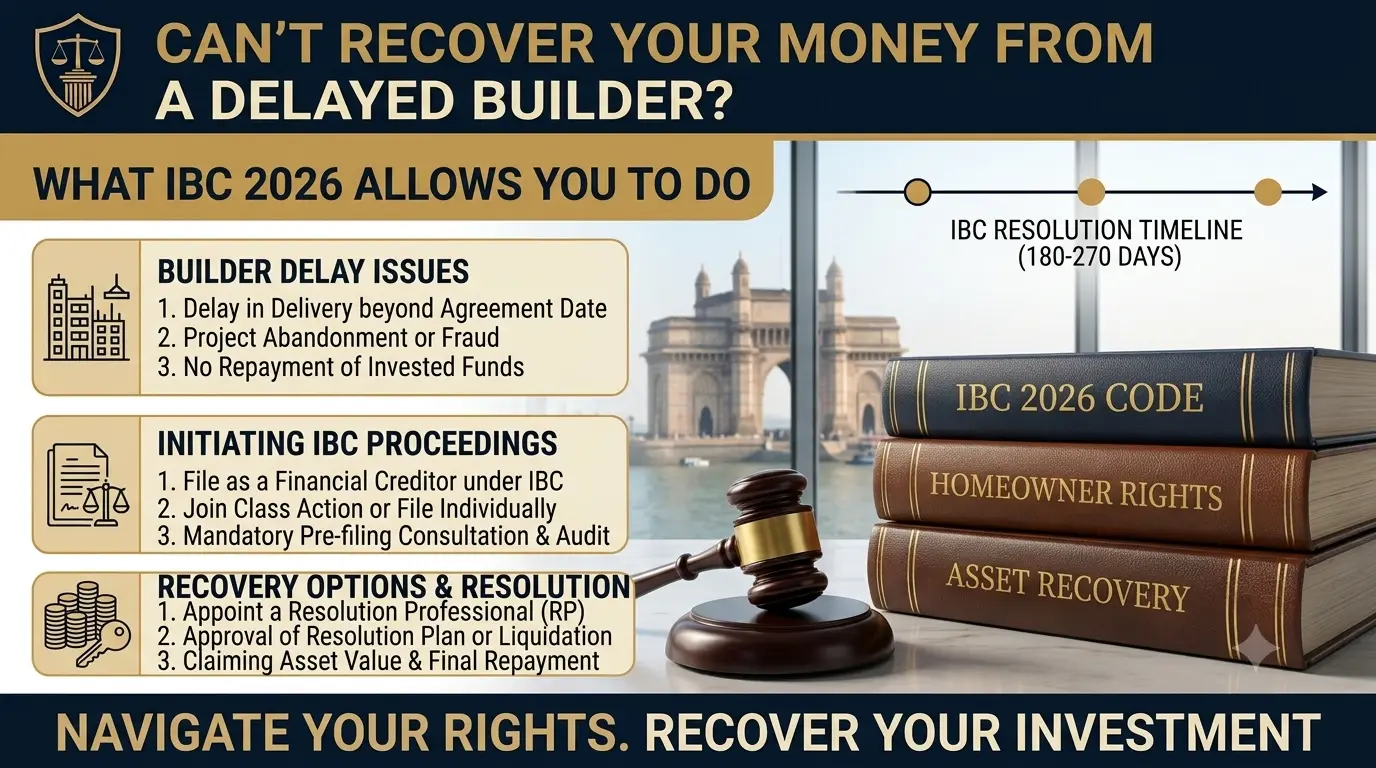
Can’t Recover Your Money from a Delayed Builder? Here’s What IBC 2026 Allows You to Do

IBC Amendment Act 2026: New Homebuyer Rights Against Defaulting Builders


Thousands of Indian homebuyers are sitting on stalled projects. The law just changed — and it changed in your favour.

Elixir Legal Services · Real Estate & Insolvency · May 2026 | 10 min read


⚖ Breaking Law Update: The Insolvency and Bankruptcy Code (Amendment) Act, 2026 received Presidential assent on 6 April 2026 and is now in force. Combined with the IBBI Committee’s 155-point recommendation report (7 April 2026), this is the most significant overhaul of homebuyer insolvency rights since 2018. If your builder has defaulted or delayed possession, your legal options are stronger today than they have ever been.


Your Builder Has Gone Silent. Your Money Is Stuck. What Now?


You paid in full — or close to it — for a flat that was supposed to be delivered two, three, maybe five years ago. The builder is either missing deadlines, citing “market conditions,” or has quietly stopped construction altogether. Your emails go unanswered. Your RERA complaint is pending. The bank EMI keeps coming.

This is not a niche problem. According to industry data, over 4.5 lakh housing units across India’s top eight cities are stuck in stalled or severely delayed projects. Many of these builders are technically insolvent — they’ve diverted homebuyer funds, overextended on land acquisition, or simply collapsed under debt.

The good news: the Insolvency and Bankruptcy Code (IBC), as amended in April 2026, gives homebuyers sharper, faster legal tools to recover their money or force project completion. Here’s exactly what changed — and how to use it.

  • 4.5L+ housing units stalled or severely delayed across India’s top 8 cities
  • ₹1 Cr minimum joint default threshold to file a Section 7 NCLT petition
  • 330 maximum CIRP days (including litigation) under the IBC framework
  • 155 recommendations in the IBBI Committee Report (7 April 2026) impacting homebuyers

What the IBC Amendment Act 2026 Actually Changes for Homebuyers


The IBC Amendment Act, 2026 is not cosmetic. It introduces structural reforms that directly affect how homebuyer claims are handled inside insolvency proceedings. Here are the most critical changes:

1. Mandatory Admission When Default Is Proved


This is arguably the most powerful change for homebuyers. The Supreme Court clarified in Elegna Co-operative Housing Society v. Edelweiss Asset Reconstruction (January 2026) that once a financial debt and default are established, admission of a Section 7 petition is mandatory — the NCLT has no discretion to reject it citing project viability or construction status. The 2026 Amendment codifies this principle into statute, ending the “Vidarbha discretion” debate once and for all.

What this means for you: If your builder owes you money and has defaulted, the NCLT cannot dismiss your petition because the project is “almost complete” or because admission would harm other buyers. Default = admission. Period.

✓ Win for Homebuyers: The Supreme Court has firmly held that project viability, homebuyer interest, or alleged misuse of IBC are not threshold defences at the admission stage. Issues of feasibility and project completion are for the Committee of Creditors — not the court’s admission filter.

2. Creditor-Initiated Insolvency Resolution Process (CIIRP)


A brand-new mechanism under the 2026 Amendment: the Creditor-Initiated Insolvency Resolution Process (CIIRP). Unlike the standard CIRP, this route allows creditor groups — including organised homebuyer associations — to initiate and actively drive the resolution process with greater control over timelines and outcomes. The CoC approval threshold for certain CIIRP decisions has been lowered from 66% to 51%, making it easier for homebuyer blocs to push through resolution plans.

3. Project-Wise Resolution and Possession During CIRP


One of the most practically significant insertions: the 2026 Act now codifies project-wise resolution. This means a builder with multiple projects can have each project ring-fenced and resolved independently — so a failed commercial tower doesn’t drag down your half-built residential complex. The new law also includes provisions allowing possession handover to allottees during CIRP itself, in appropriate circumstances, rather than waiting for the entire process to conclude.

4. Expanded Look-Back Period for Avoidance Transactions


The Amendment expands the “look-back” window for challenging preferential and fraudulent transactions to two years. If your builder transferred assets, created sham charges, or paid off connected parties to strip the company of value, the Resolution Professional can now challenge a wider set of transactions — potentially recovering funds that flow back to homebuyer creditors.

5. IBBI Committee Report — 155 Recommendations


Filed on 7 April 2026 pursuant to Supreme Court directions in Mansi Brar Fernandes v. Shubha Sharma, the IBBI Committee examined 55 critical structural issues in real estate insolvency and made 155 recommendations. This report signals how the NCLT, IRP firms, and CoCs will be expected to operate going forward — including stronger transparency obligations to allottees and mandatory written reasons when the CoC recommends liquidation over completion.

“Once the existence of a financial debt and occurrence of default are established, admission under Section 7 is mandatory. Issues of project viability or completion status are squarely within the domain of the Committee of Creditors — not a threshold admission test.”

— Supreme Court of India, January 2026 · Elegna Co-operative Housing Society v. Edelweiss ARC

RERA vs IBC vs Consumer Court: Which Route Should You Take?


This is the most searched question among homebuyers facing builder default — and the honest answer is: it depends on your specific situation. Here’s a head-to-head breakdown of your three primary legal routes.

Factor RERA IBC (Section 7 NCLT) Consumer Court (NCDRC)
Best For Solvent builder causing delay; seeking possession or delay compensation Insolvent or near-insolvent builder; recovering principal amount Delay compensation + mental agony damages; small or mid-ticket cases
Can You File Alone? Yes — individual complaint No — requires 100 allottees OR 10% of total project allottees (whichever is less), jointly Yes — individual complaint
Minimum Default Amount No minimum ₹1 crore (joint aggregate) No minimum
Execution of Orders Historically weak — builder can delay enforcement Strong — NCLT has direct enforcement powers; moratorium freezes assets Moderate — can be enforced but builders often appeal
Compensation Available Delay interest at MCLR + 2%; refund with interest Full principal recovery via Resolution Plan; CoC-negotiated ₹1–10 lakh mental agony + 12–18% interest (NCDRC 2026 trend)
Builder Uses to Delay Builder often uses IBC moratorium to stay RERA orders CIRP moratorium can pause RERA execution Less affected by IBC moratorium
Timeline (Ideal) 6–18 months for adjudication CIRP: 180 days + 90 days extension (330 days max with litigation) 1–3 years (can be faster with strong evidence)
Post-IBC Amendment 2026 RERA remains primary route for solvent builders Stronger — mandatory admission, project-wise resolution, possession during CIRP Concurrent with RERA; not displaced by IBC

ℹ Strategic Note — The “Two Forum” Play: Many experienced lawyers now advise homebuyers to file RERA first (cheaper, individual, no minimum threshold) to establish the default record — and simultaneously organise a homebuyer group for a Section 7 IBC filing if the builder is clearly insolvent. The Supreme Court in Pioneer Urban Land v. Union of India confirmed that RERA and IBC are not mutually exclusive. Filing one does not bar the other.


How to File a Section 7 IBC Petition Against Your Builder — In 2026


Filing under Section 7 of the IBC requires meeting specific procedural and numerical thresholds. Here’s the current process:

  1. Establish your financial creditor status. Every homebuyer who has paid money under an allotment agreement is a “financial creditor” under IBC. Your payment constitutes a “financial debt” — this was confirmed by the Supreme Court in Chitra Sharma v. Union of India (2018) and has been upheld consistently since.
  2. Organise your homebuyer group — meet the threshold. You need either 100 allottees or 10% of the total allottees in your project (whichever is fewer) to jointly sign the petition. For a 500-unit project, that means getting 50 buyers on board. Homebuyer WhatsApp groups, RWAs, and housing society organisations are your starting points. A lawyer can help structure the coalition and prepare a joint application.
  3. Confirm the aggregate default exceeds ₹1 crore. The combined amount owed to your group (principal + delay interest) must cross ₹1 crore. With 50+ buyers, this is typically not a problem, but ensure each member’s default is documented — allotment letters, payment receipts, demand letters, RERA complaint copies.
  4. File the Section 7 petition at the relevant NCLT bench. In Mumbai, filings go to the NCLT Mumbai Bench (Bandra Kurla Complex). Under the 2026 Amendment, once debt and default are proved, admission is mandatory. The builder cannot use project viability as a defence at this stage. A Resolution Professional (IRP) is then appointed by the NCLT.
  5. Moratorium kicks in — builder’s assets are frozen. Upon admission, a moratorium under Section 14 IBC is imposed. No debt enforcement against the builder, no asset transfers, no new legal proceedings against the company — everything freezes. The RERA authority cannot execute its own orders against the builder during this period. This is actually a double-edged sword: it protects the company’s assets for collective resolution.
  6. File your claim with the IRP and participate in the CoC. Once the IRP takes over, all creditors — including homebuyers — must file their individual claims. Homebuyers form part of the Committee of Creditors (CoC) and can vote on resolution plans. Under the 2026 Amendment, the Information Memorandum must now mandatorily disclose details of all allottees, ensuring homebuyers have visibility into the full claim pool.
  7. Resolution plan or liquidation — your outcome. The CoC votes on a Resolution Plan submitted by a Resolution Applicant (typically a new developer or investor). Under the 2026 Act, project-wise resolution means your specific residential project can be separated and resolved independently. If no plan is viable, liquidation proceeds — in which case homebuyers participate in asset distribution as financial creditors.

⚠ Critical Warning: Do not miss the IRP’s claim deadline. Once a CIRP is admitted, the IRP issues a public announcement setting a deadline (usually 30 days) for all creditors to submit claims. If you miss this window, your claim may not be admitted in the resolution plan — even if you are a genuine allottee. Monitor filings for your builder’s CIRP at ibbi.gov.in.


Homebuyer FAQs — Builder Default & IBC 2026


My builder is not yet officially “insolvent.” Can I still file under Section 7 IBC?


Yes. You don’t need a court declaration of insolvency before filing. What you need is proof of a “financial debt” (your payments under an allotment agreement) and proof of “default” (non-delivery of possession by the contracted date, or a formal demand that went unpaid). The builder’s solvency status is assessed during CIRP — not before admission.

My builder filed for insolvency themselves. What happens to my flat?


If the builder (Corporate Debtor) is already in CIRP, you must immediately file your claim with the Interim Resolution Professional (IRP). Your allotment agreement qualifies as a financial debt. Homebuyers as a class form part of the CoC and can vote on whether a new developer takes over the project. Under the 2026 Amendment, possession handover provisions during CIRP can protect your rights even before final resolution.

I have a MahaRERA order in my favour but the builder isn’t paying. Does IBC help?


Yes — but with a caveat. If your builder is in CIRP, the IBC moratorium pauses execution of your RERA order. However, your RERA-adjudicated amount is recognised as a financial debt and you can file your claim in the CIRP. If the builder is not in CIRP, you can use MahaRERA’s enforcement mechanism (penalty of ₹5,000/day for non-compliance) or initiate a separate IBC petition if you meet the threshold requirements.

RERA vs IBC — which gives me money back faster?


RERA adjudication can be faster (months, not years) for a straightforward delay compensation case where the builder is still operational. However, RERA’s execution mechanism has historically been weak — getting the order is one thing; getting paid is another. IBC’s CIRP, while longer (up to 330 days), creates a moratorium that prevents asset stripping and puts a court-supervised professional in charge. For insolvent builders, IBC is the more effective tool for actual recovery. For solvent builders who are merely delaying, RERA + Consumer Court is often the faster and cheaper route.

Can I approach Consumer Court even if there is a RERA forum available?


Yes. The Supreme Court has confirmed that the Consumer Protection Act is a beneficial legislation whose remedies are in addition to — not in derogation of — RERA. Section 79 of RERA bars civil courts, not Consumer Courts. In 2026, NCDRC has been awarding 12–18% interest plus ₹1–10 lakh in mental agony compensation. This is often higher than RERA’s fixed-rate formula. An experienced lawyer can advise on which forum gives you the best outcome for your specific default quantum and facts.

I only have 30 buyers in our project willing to fight. Can we still file an IBC petition?


You need either 100 allottees or 10% of the total project allottees — whichever is less. So for a project with 200 flats, 10% means 20 buyers — which means 30 buyers is enough. For a project with 500+ units, you’d need 50. Our team can help you identify the exact threshold for your project and structure the joint petition.


The 2026 Legal Moment Homebuyers Cannot Afford to Ignore


The convergence of the IBC Amendment Act 2026, the Supreme Court’s January 2026 mandatory-admission ruling, and the IBBI Committee’s 155-recommendation reform report is not coincidence. It reflects a broader judicial and legislative consensus: homebuyers are genuine financial creditors whose rights have been structurally under-protected, and the law must catch up.

The regulatory overlap between RERA and IBC has historically been exploited by defaulting builders — using IBC moratoriums to stay RERA orders, or using RERA complaints to argue against IBC admission. The 2026 framework closes several of these loopholes, particularly through mandatory admission and project-wise resolution codification.

What this creates is a narrow but real enforcement window. If your builder is genuinely insolvent or has diverted funds, acting now — before a lender-driven CIRP is initiated without homebuyer coordination — means you enter the process with organised claim documentation, a seat at the CoC table, and the ability to influence the resolution plan outcome.

Waiting means entering the process late, scrambling to file claims after deadlines, and potentially watching secured lenders shape a resolution plan that leaves homebuyers with a fraction of what they’re owed.


Speak to a Real Estate Insolvency Lawyer in Mumbai


Elixir Legal Services advises homebuyers, housing societies, and investors on RERA complaints, Section 7 IBC petitions, and CoC participation strategy across Mumbai and Maharashtra.

Request a Free Initial Consultation

RERA · IBC / NCLT · Consumer Court · MahaRERA Enforcement


Legal Disclaimer: This article is for general informational purposes only and does not constitute legal advice. The law described reflects the IBC Amendment Act 2026 and judicial developments as of May 2026. Every case is fact-specific. You should consult a qualified insolvency or real estate lawyer before taking any legal action.


Elixir Legal Services · Mumbai, Maharashtra

Real Estate & Insolvency | NCLT Filings | MahaRERA Representation | CoC Advisory

© 2026 Elixir Legal Services. All rights reserved. This content is protected under applicable copyright law.


Labour Law Compliance in Mumbai: Complete Guide for Startups & Companies (2026)

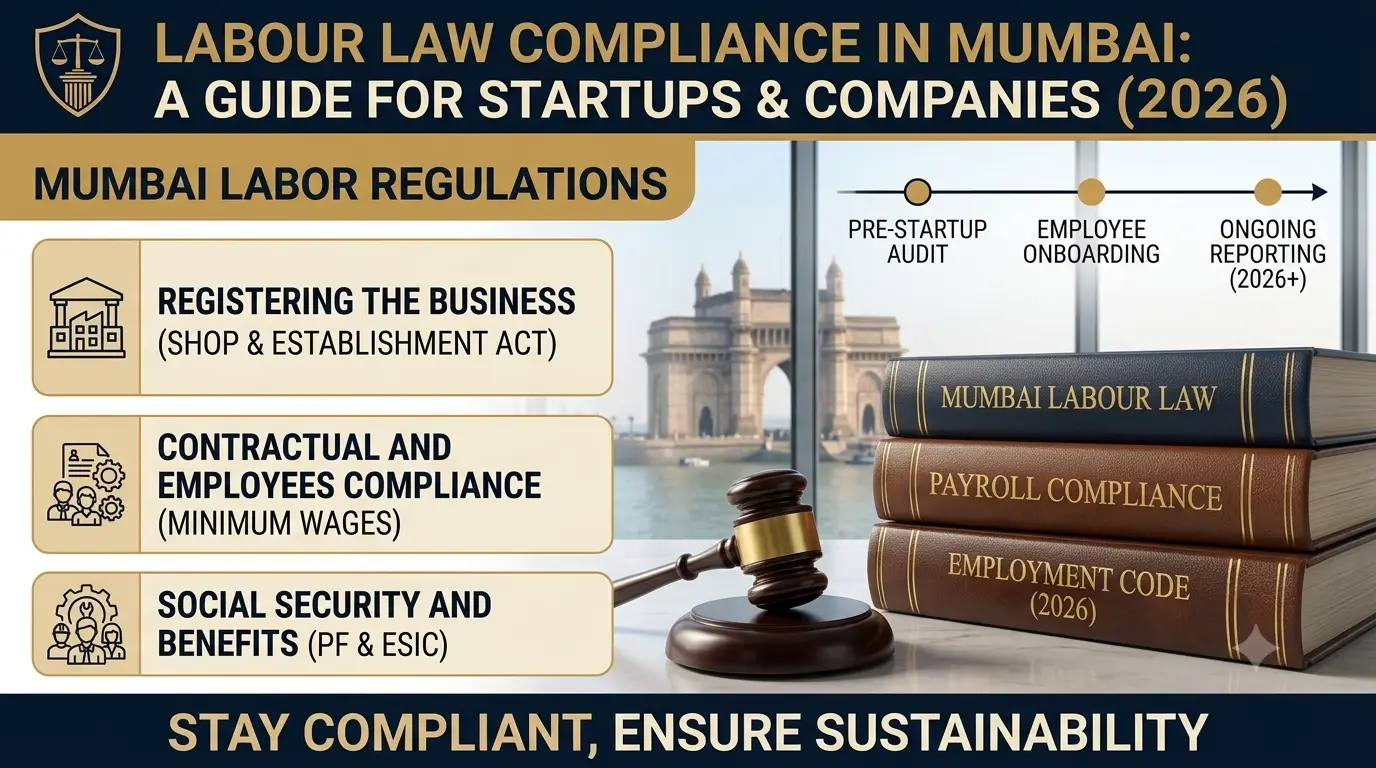
Labour Law Compliance in Mumbai (2026): The Complete Guide for Businesses


Running a business in Mumbai? Whether you’re a bootstrapped startup in Andheri or an established enterprise in BKC, one thing is non-negotiable — labour law compliance. Non-compliance doesn’t just attract penalties; it can result in criminal liability, factory shutdowns, and reputational damage that no business can afford.

This 2026 guide by Elixir Legal Services — one of Mumbai’s leading law firms — walks you through every critical aspect of labour law compliance so your business stays protected, productive, and penalty-free.


Why Labour Law Compliance Matters More Than Ever in 2026


India’s labour law landscape has undergone sweeping changes. The consolidation of 29 central labour laws into 4 Labour Codes — covering wages, industrial relations, social security, and occupational safety — is transforming how businesses manage their workforce obligations.

For Mumbai-based businesses, compliance is especially critical because:

  • Maharashtra has its own state-specific amendments and rules layered on top of central laws.
  • Mumbai’s dense workforce and strong union culture means disputes escalate quickly.
  • Labour inspections and audits have intensified under Maharashtra’s enforcement directorates.
  • Employee awareness of rights is at an all-time high.

Working with an experienced employment lawyer in Mumbai is no longer a luxury — it is a strategic necessity.


The 4 Labour Codes: What Mumbai Businesses Must Know


The central government has enacted four Labour Codes that will eventually replace legacy legislation. While implementation timelines vary by state, businesses should start aligning their HR policies now.

1. Code on Wages, 2019


This code consolidates the Minimum Wages Act, Payment of Wages Act, Payment of Bonus Act, and Equal Remuneration Act. Key implications for Mumbai employers include:

  • Universal minimum wage floor for all workers, including those in the unorganised sector.
  • Mandatory timely wage payment — delays attract penalties.
  • Gender pay equity requirements across all categories of employment.
  • Annual bonus obligations based on a defined formula.

2. Industrial Relations Code, 2020


Replaces the Industrial Disputes Act, Trade Unions Act, and Industrial Employment (Standing Orders) Act. Critical changes:

  • Establishments with 300+ workers (up from 100) now need government permission for layoffs, retrenchment, or closure.
  • Mandatory standing orders for establishments with 300+ workers.
  • New dispute resolution mechanisms through conciliation, arbitration, and industrial tribunals.
  • Stricter regulations around strikes and lockouts.

3. Code on Social Security, 2020


Consolidates EPF, ESIC, Gratuity, Maternity Benefit, and other social security laws. Key points:

  • EPF and ESIC extended to gig workers and platform workers — a significant development for Mumbai’s tech and delivery sectors.
  • Gratuity eligibility may be extended to fixed-term contract workers.
  • Maternity benefits expanded to include commissioning mothers and adopting mothers.

4. Occupational Safety, Health and Working Conditions Code, 2020


Covers factories, construction, mines, and establishments. Important for Mumbai businesses:

  • Mandatory health and safety standards for all scheduled establishments.
  • Annual health check-ups for workers over 45 years of age.
  • Specific provisions for women workers — including night shift protections and welfare amenities.
  • Digital maintenance of employment records and registers.

Key Labour Laws Still Applicable in Maharashtra (2026)


Until the Labour Codes are fully notified with Maharashtra-specific rules, the following central and state laws remain in force. Compliance with these is mandatory today:

Shops and Establishments Act (Maharashtra)


Every commercial establishment, office, restaurant, or retail business in Mumbai must register under the Maharashtra Shops and Establishments Act. Key requirements:

  • Registration within 30 days of commencing business.
  • Display of registration certificate at the workplace.
  • Compliance with working hours (max 9 hours/day, 48 hours/week).
  • Mandatory weekly off, paid leaves (privilege, sick, casual), and overtime wages.
  • Restrictions on employing children and young persons.
  • Notice and compensation requirements before termination.

Employees’ Provident Fund (EPF) Act, 1952


  • Applicable to establishments with 20 or more employees.
  • Employee + Employer contribution: 12% of basic wages each.
  • Monthly PF challan to be deposited by the 15th of the following month.
  • Universal Account Number (UAN) must be generated and activated for every employee.
  • Annual returns and monthly ECR (Electronic Challan cum Return) filings mandatory.

Employees’ State Insurance (ESIC) Act, 1948


  • Applicable to establishments with 10+ employees (in certain categories) earning up to ₹21,000/month.
  • Employee contribution: 0.75% of wages; Employer contribution: 3.25% of wages.
  • Half-yearly contribution returns and monthly challan filings required.
  • ESIC registration for all covered employees is mandatory.

Payment of Gratuity Act, 1972


  • Applicable to establishments with 10+ employees.
  • Gratuity payable on completion of 5 years of continuous service.
  • Formula: 15 days’ wages × number of years of service.
  • Maximum gratuity ceiling: ₹20 lakh (subject to revision).
  • Gratuity must be paid within 30 days of it becoming payable.

Payment of Bonus Act, 1965


  • Applicable to establishments with 20+ employees.
  • Minimum bonus: 8.33% of annual salary or ₹100, whichever is higher.
  • Maximum bonus: 20% of salary.
  • Bonus to be paid within 8 months from the end of the accounting year.

Maternity Benefit Act, 1961 (Amended 2017)


  • Applicable to establishments with 10+ employees.
  • 26 weeks of paid maternity leave for the first two children; 12 weeks thereafter.
  • Crèche facility mandatory for establishments with 50+ employees.
  • Work from home option post-maternity leave (if nature of work permits).
  • No dismissal or adverse action during or on account of maternity leave.

Sexual Harassment of Women at Workplace (Prevention, Prohibition and Redressal) Act, 2013 (POSH)


  • Every establishment with 10+ employees must constitute an Internal Complaints Committee (ICC).
  • Mandatory annual report to the District Officer.
  • Awareness and sensitisation training for all employees.
  • Written POSH policy to be published and circulated.
  • Non-constitution of ICC is a criminal offence — a point many startups miss.

Contract Labour (Regulation and Abolition) Act, 1970


  • Establishments engaging 20+ contract workers must register as Principal Employers.
  • Contractors deploying 20+ workers need a licence.
  • Principal employer is jointly liable for contractor’s compliance failures — wage payments, PF, ESIC etc.
  • Maintaining Form XIII (register of contractors) and Form XIV (employment register) is mandatory.

Factories Act, 1948 (Maharashtra Rules)


Manufacturing units in Mumbai and surrounding industrial areas (Thane, Navi Mumbai, Bhiwandi) must comply with:

  • Registration and licensing under the Factories Act.
  • Health, safety, and welfare provisions (canteens, restrooms, crèches for 30+ women workers).
  • Working hours: maximum 48 hours/week, overtime at double rate.
  • Mandatory appointment of a Safety Officer (for factories with 1000+ workers).

Labour Law Compliance Checklist for Mumbai Startups (2026)


If you’re a startup or growing SME in Mumbai, here’s a practical compliance checklist to work through:

At Incorporation / Pre-Hiring Stage


  • ☐ Draft employment agreements compliant with current labour laws.
  • ☐ Prepare an employee handbook / HR policy document.
  • ☐ Draft a POSH policy and plan ICC constitution once you cross 10 employees.
  • ☐ Register under the Shops and Establishments Act (within 30 days of commencing business).
  • ☐ Obtain PT (Professional Tax) registration as an employer.

At 10 Employees


  • ☐ Constitute the Internal Complaints Committee (POSH).
  • ☐ Enrol under ESIC (if applicable).
  • ☐ Ensure compliance with Maternity Benefit Act.
  • ☐ Register under Payment of Gratuity Act.

At 20 Employees


  • ☐ Register under EPF (Employees’ Provident Fund).
  • ☐ Register under Payment of Bonus Act.
  • ☐ If engaging contract workers — register as Principal Employer under Contract Labour Act.

Ongoing Monthly Compliance


  • ☐ Deposit PF challan by 15th of every month.
  • ☐ Deposit ESIC challan by 15th of every month.
  • ☐ Deposit Professional Tax (PT) — monthly for employer, bi-annual for employees.
  • ☐ Maintain statutory registers (muster roll, wage register, overtime register, etc.).

Annual Compliance


  • ☐ File PF annual return.
  • ☐ File ESIC half-yearly returns.
  • ☐ Pay and file bonus within 8 months of year-end.
  • ☐ Submit POSH annual report.
  • ☐ Renew Shops & Establishments registration (if applicable).
  • ☐ Conduct labour law compliance audit.

Common Labour Law Violations by Mumbai Companies (And How to Avoid Them)


In our experience advising businesses across Mumbai, these are the most frequent compliance failures we encounter:

1. No POSH ICC Despite Having 10+ Employees


Many startups grow past the 10-employee threshold without noticing. Failing to constitute an ICC can result in fines up to ₹50,000 and cancellation of business licences on repeat offence.

2. Classifying Employees as “Consultants” to Avoid Statutory Dues


Misclassifying permanent employees as independent contractors to avoid PF, ESIC, and gratuity obligations is a common (and costly) mistake. Courts and labour authorities look at the substance of the relationship — not the label in the contract.

3. Not Registering Contract Labour


Businesses using housekeeping, security, or delivery contractors often believe compliance is the contractor’s problem. Under the law, the principal employer remains jointly liable.

4. Delayed or No Gratuity Payment


Gratuity must be paid within 30 days of the employee’s last working day. Delays attract interest, and disputes can result in recovery proceedings before the Controlling Authority.

5. Non-Maintenance of Statutory Registers


Labour inspectors regularly check registers including muster rolls, salary registers, overtime registers, and advance registers. Absence of these records — even if payroll compliance is otherwise intact — is a violation.

6. Not Updating Standing Orders


If your establishment is covered by the Industrial Employment (Standing Orders) Act (50+ workers in certain categories), your standing orders must reflect current policies and be certified by the Certifying Officer.


Employee Termination: Legal Safeguards in Mumbai


Termination is one of the highest-risk areas for non-compliance. Here’s what Mumbai employers must keep in mind:

  • Notice period: As per the employment contract and the Shops and Establishments Act — typically 30 days for employees with 3+ months of service.
  • No termination during maternity leave — this is absolutely prohibited.
  • Retrenchment compensation — for workmen covered under the Industrial Disputes Act, retrenchment requires 1 month’s notice (or pay in lieu) plus retrenchment compensation at 15 days’ wages per year of service.
  • Domestic enquiry — for misconduct-based dismissals, a fair domestic enquiry following principles of natural justice is mandatory before dismissal.
  • Full and final settlement — must include outstanding salary, leave encashment, gratuity (if eligible), bonus, and PF settlement initiation.

Disputes arising from improper termination can land businesses before the Labour Court or Industrial Tribunal in Mumbai — prolonged, expensive, and reputationally damaging. Our employment and labour law team helps businesses navigate terminations legally and without dispute.


Handling Labour Disputes in Mumbai: Forums and Timelines


When a dispute arises, it’s important to know the right forum and the applicable timelines:

Dispute Type Forum Typical Timeline
Wage disputes Labour Court / Payment of Wages Authority 3–12 months
Wrongful termination (workmen) Labour Court, Mumbai 1–3 years
PF / ESIC disputes PF Tribunal / ESIC Court 6–18 months
Gratuity disputes Controlling Authority (Asst. Labour Commissioner) 3–12 months
POSH complaints ICC (internal) → Local Complaints Committee → Civil Court 60–90 days internally
Industrial disputes (large scale) Industrial Tribunal, Mumbai 2–5 years

Early legal intervention — ideally before a formal dispute is filed — dramatically reduces litigation time and cost. If your business is facing a labour dispute, consult an experienced employment lawyer in Mumbai at the earliest opportunity.


Special Compliance Considerations for Specific Industries in Mumbai


IT & Startups


  • Software companies may be covered under the Shops & Establishments Act — not the Factories Act — but POSH, EPF, ESIC, and Gratuity obligations remain.
  • Flexible work arrangements and remote work policies must be documented carefully.
  • ESOPs and variable pay structures must be documented to avoid wage disputes.

Hospitality & Restaurants


  • High staff turnover means gratuity liability accumulates fast and must be tracked.
  • Working hours, split duties, and overtime for kitchen/service staff are heavily regulated under the Shops Act.
  • Seasonal hiring must comply with fixed-term contract provisions.

Manufacturing & Factories (Thane, Navi Mumbai, Bhiwandi)


  • Factories Act licensing, safety officer appointments, and accident reporting obligations apply.
  • Hazardous processes have additional notification and health surveillance requirements.
  • Contract labour compliance is critical given the scale of outsourced operations.

E-Commerce & Gig Economy


  • The Code on Social Security, 2020 brings gig and platform workers within the ambit of social security for the first time.
  • Companies must monitor state-level notification of rules for gig worker welfare boards.
  • Delivery partner agreements must be structured carefully to manage classification risk.

How Elixir Legal Services Helps Mumbai Businesses with Labour Law Compliance


At Elixir Legal Services, our Employment, Labour & Benefits practice provides end-to-end support for businesses across Mumbai and Maharashtra:

  • Labour Law Compliance Audits — Comprehensive review of all statutory obligations, identifying gaps and risk areas before an inspector does.
  • Employment Contracts & HR Policies — Drafting and reviewing employment agreements, offer letters, HR handbooks, and workplace policies that are legally compliant and business-friendly.
  • POSH Implementation — Setting up the ICC, drafting the POSH policy, conducting sensitisation training, and guiding inquiry procedures.
  • Labour Dispute Resolution — Representing employers before Labour Courts, Industrial Tribunals, PF/ESIC authorities, and Controlling Authorities for gratuity.
  • Termination & Retrenchment Advisory — Structuring legally sound separations, managing domestic enquiries, and negotiating settlements.
  • Retainer-Based Compliance Support — Monthly/quarterly compliance advisory ensuring you never miss a deadline or filing.
  • Due Diligence for M&A — Labour law due diligence for mergers, acquisitions, and investments involving Mumbai-based businesses.

Penalties for Labour Law Non-Compliance in India (2026)


The penalties for non-compliance are significant and, in many cases, criminal in nature:

Violation Penalty
Non-registration under Shops Act Fine up to ₹10,000 + ₹200/day of continuing default
Non-payment of EPF Interest @ 12% p.a. + damages up to 25% of arrears + prosecution
ESIC non-compliance Penalty + interest; directors may be personally liable
No POSH ICC (10+ employees) Fine up to ₹50,000; licence cancellation on repeat
Non-payment of gratuity Recovery + 10% interest; imprisonment up to 2 years in extreme cases
Contract Labour Act violations Fine up to ₹1,000 + imprisonment up to 3 months
Minimum Wages violation Fine up to ₹5,000 + imprisonment up to 6 months

Beyond financial penalties, repeat violations can result in blacklisting from government contracts and public procurement — a serious business consequence that many companies underestimate.


Frequently Asked Questions (FAQs)


Q: Is a startup with 5 employees required to comply with labour laws in Mumbai?


Yes. Several laws apply from the very first employee — including the Shops and Establishments Act, minimum wage requirements, Professional Tax deductions, and POSH obligations (once you cross 10 employees). Compliance must begin from day one.

Q: Do labour laws apply to remote or work-from-home employees in Mumbai?


Yes. The employment relationship is governed by Indian labour laws regardless of where the employee works. EPF, ESIC, Gratuity, Bonus, and POSH obligations remain unchanged for remote workers employed in India.

Q: What is the difference between a “workman” and a “non-workman” employee under Indian labour law?


The Industrial Disputes Act defines a “workman” as any person employed in a skilled, unskilled, manual, operational, supervisory, or technical capacity earning up to a specified threshold (and not engaged in a managerial or administrative role). Workmen have stronger statutory protections — particularly around termination and retrenchment — compared to non-workmen (managers, senior executives).

Q: Can we put all employees on fixed-term contracts to avoid gratuity and termination obligations?


Not advisable. Under the Code on Industrial Relations, fixed-term employees are entitled to gratuity on a pro-rata basis. Blanket use of fixed-term contracts to avoid statutory dues is increasingly challenged before Labour Courts and can amount to unfair labour practice.

Q: How often should a company do a labour law compliance audit?


We recommend a formal audit at least once a year, with an interim review mid-year. Growing companies should also trigger an audit when crossing key headcount thresholds (10, 20, 50 employees) or entering new business activities.

Q: Can Elixir Legal Services help with both compliance and disputes?


Absolutely. Our employment and labour law practice covers advisory, compliance, and dispute resolution — giving businesses a single point of contact for all workforce-related legal matters.


Conclusion: Build a Compliant, Litigation-Free Workplace in Mumbai


Labour law compliance in Mumbai is not a one-time checkbox — it’s an ongoing process that evolves with your business. The cost of getting it right upfront is always lower than the cost of a dispute, penalty, or prosecution later.

Whether you’re a founder setting up your first office, an HR head struggling to keep up with regulatory changes, or a CFO worried about the liability exposure in your labour practices — the right legal partner makes all the difference.

Elixir Legal Services brings decades of expertise in employment and labour law across Mumbai and Maharashtra. From compliance audits and policy drafting to dispute resolution and litigation — we’re with you at every step.

Disclaimer: This article is for informational purposes only and does not constitute legal advice. The Bar Council of India does not permit advertisement or solicitation by advocates. For legal advice specific to your business, please contact Elixir Legal Services directly.


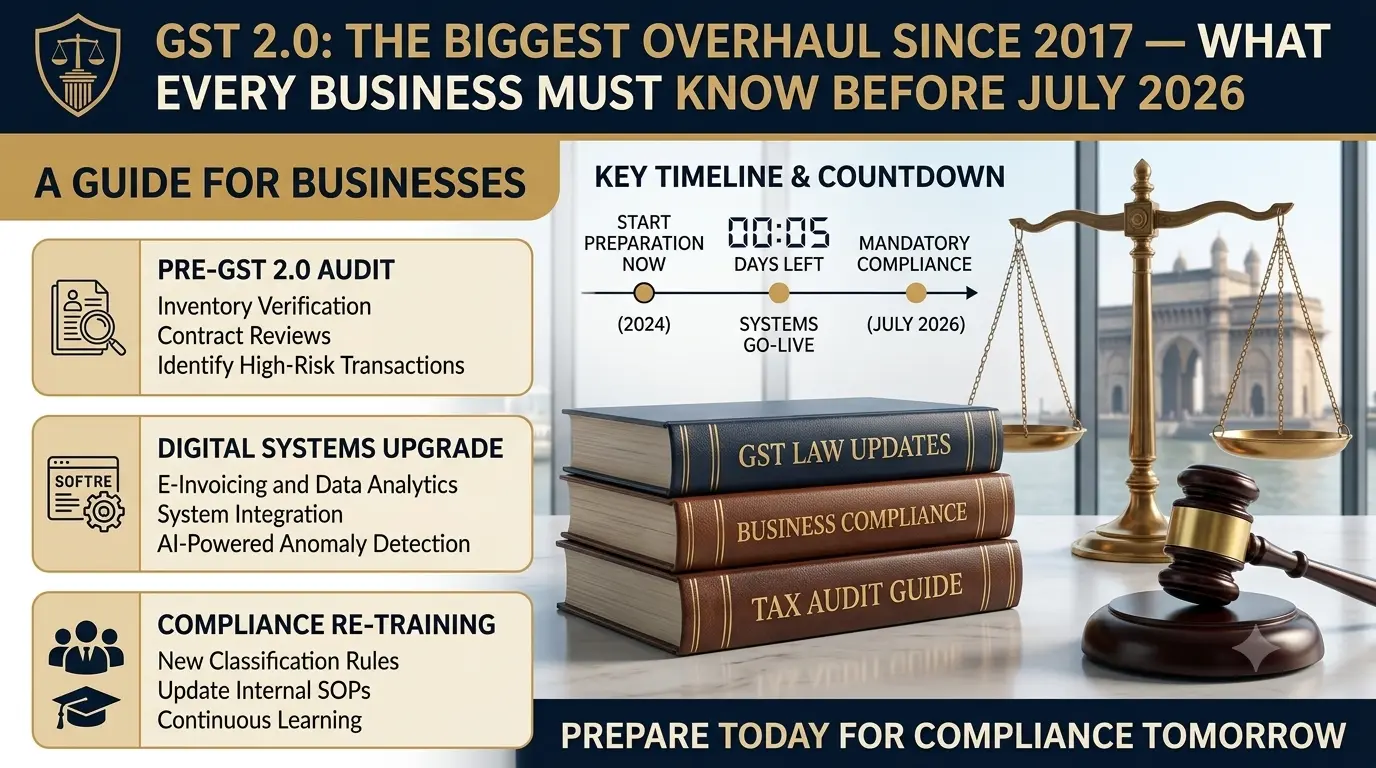
GST 2.0: The Biggest Overhaul Since 2017 — What Every Business Must Know Before July 2026

GST 2.0 Compliance Guide 2026: New Slabs, ITC Rules & Filing Deadlines Every Business Must Know


The 56th GST Council’s rate rationalisation, effective 22 September 2025, is now the operative framework for all GST filings in 2026. The 12% and 28% slabs have been scrapped. A new 40% luxury rate has been introduced. ITC rules are tighter than ever. And from December 2025, returns older than three years are permanently blocked. The Q1 FY 2026-27 filing deadline — July 13, 2026 — is your first full-quarter reckoning under the new rules.


Why GST 2.0 Is Not Just Another Rate Revision


When GST was introduced in July 2017, it replaced over a dozen indirect taxes with a single, unified framework. That was a structural revolution. What happened in September 2025 — and what continues to roll out through mid-2026 — is the second revolution: a fundamental restructuring of how GST is calculated, reported, validated, and enforced.

The 56th GST Council didn’t just tinker with rates. It collapsed a messy five-slab system into a cleaner three-tier structure, killed the 12% slab entirely, moved hundreds of items, introduced a new 40% rate for luxury and sin goods, overhauled ITC validation from “provisional claim” to “hard match only,” and set hard statutory deadlines that permanently close off old compliance backlogs.

For businesses — particularly SMEs, CFOs managing multi-GSTIN operations, and business owners who’ve relied on accountants to “sort it out later” — the message from the government is unambiguous: the era of loose GST compliance is over.

  • 2 primary slabs now (5% & 18%), down from 4 slabs
  • 40% new luxury/sin rate replacing the 28% + cess structure
  • 3-year hard deadline — older returns permanently blocked
  • 18% interest p.a. on wrongful ITC claims, up to 24% for excess claims

The New GST Slab Structure — Fully Explained


The GST 2.0 rate rationalisation replaces the old 0%–5%–12%–18%–28% multi-slab structure with a streamlined four-tier framework. Here’s exactly what the new structure looks like and what falls where:

0% — Exempt / Nil


  • Fresh fruits & vegetables
  • Unpacked food grains
  • Milk, bread, salt
  • Education services
  • Health services
  • Individual health & life insurance (new)
  • School supplies: notebooks, pencils, maps

5% — Merit Rate


  • Packaged food items
  • Toothpaste, soap
  • Basic medicines
  • Healthcare services
  • Transport (economy class)
  • Packaged grains

18% — Standard Rate


  • Consumer electronics
  • Cement & steel (moved from 28%)
  • IT & digital services
  • Restaurants (AC)
  • Compact cars & motorcycles
  • Most B2B services

40% — Luxury / Sin


  • Tobacco & cigarettes
  • Pan masala
  • Aerated beverages
  • Premium luxury cars
  • High-end luxury goods

What Moved — Critical for Businesses


12% slab scrapped: Items either dropped to 5% or moved up to 18%. 28% slab largely scrapped: Most items moved to 18%; sin/luxury moved to 40%. Individual health & life insurance: Exempted entirely (was 18%) — suppliers now lose ITC on related inputs and must recalculate under Rules 42/43. Cement, electronics, capital goods: Now at 18% (was 28%) — cash flow improvement for manufacturers.

What This Means for Your Business Pricing


Every product and service your business sells that moved slabs on 22 September 2025 required an immediate HSN-code and billing-software update. Businesses that issued invoices at old rates after that date — even if they had pre-September purchase stock — are potentially exposed to GST mismatch notices. Inventory procured at old rates but sold post-rationalisation must follow time-of-supply rules precisely.

For buyers of cement, electronics, and capital goods: the reduction from 28% to 18% means less working capital blocked in input tax. This is a genuine cash-flow improvement — but only if your GSTR-2B reconciliation is clean and your ITC claims are correctly mapped to the new rate codes.

“The era of filing whenever is over. The hard ITC validation system and the three-year return filing bar mean that businesses can no longer treat GST compliance as a problem to be solved later — later no longer exists.”

— Elixir Legal Services · Tax & Business Compliance Practice · Mumbai

The New ITC Hard Validation Rules: What Every CFO Must Understand


Input Tax Credit is the backbone of GST efficiency — it’s how businesses avoid paying tax on tax. In 2026, the rules governing who can claim ITC, when, and how much have been tightened to a degree that many businesses are only now discovering. Here’s what changed:

1. GSTR-2B Is Now the Only Basis for ITC Claims


The GST portal has moved to a hard validation system for ITC. This means: if your supplier has not uploaded an invoice, or has made an error in your GSTIN, that invoice will not appear in your GSTR-2B. GSTR-2B is a static, once-generated monthly statement — and it is now the only document the government recognises for ITC eligibility. Your internal purchase register is irrelevant. Your payment confirmation is irrelevant. Only what appears in GSTR-2B counts.

High-Risk Zone: Claiming ITC that doesn’t appear in GSTR-2B — even on a genuine, paid invoice — triggers an automated demand for reversal with 18–24% interest. If the system detects a mismatch between your GSTR-3B claim and your GSTR-2B, it generates an automatic demand. No notice required.

2. Rule 37A — Supplier Non-Filing Reversal


Rule 37A is now one of the most operationally damaging provisions for businesses with large vendor bases. It mandates that you must reverse ITC if your supplier fails to file GSTR-3B — even if you have already paid the supplier in full. If your office landlord, freight vendor, or raw material supplier skips their GST filing, you absorb the hit. You can reclaim the credit only after the supplier eventually files, creating a cash-flow crater in the interim.

3. ITC Deadline — October 2026 Cut-Off for FY 2025-26


ITC on any invoice from FY 2025-26 must be claimed no later than the due date of filing GSTR-3B for September 2026 (i.e., 20 October 2026) or the date of filing GSTR-9 for FY 2025-26 — whichever is earlier. ITC claimed after this date is ineligible and must be reversed with 18% interest. This is a hard statutory deadline — there is no extension mechanism.

4. Rule 86B — Minimum 1% Cash Payment


Businesses with monthly taxable turnover exceeding ₹50 lakh must pay at least 1% of total GST liability in cash (from the cash ledger, not ITC). Violation attracts a penalty of ₹10,000 or the amount of ITC used in excess — whichever is higher. The GST portal will restrict GSTR-3B filing if this rule is breached.

5. Section 17(5) — Blocked Credits Still Apply


Even a perfectly reconciled GSTR-2B claim can be denied if the underlying expense falls under Section 17(5) blocked credits. Common examples businesses routinely get wrong: motor vehicles and related services, food and beverages for employees, membership of clubs, personal use items. The Invoice Management System (IMS) “Deemed Accepted” status does not validate a blocked credit — auditors will reverse it with interest.

Best Practice for CFOs in 2026: Implement monthly GSTR-2B reconciliation as a non-negotiable close process. Tag all purchases at entry with eligibility status (Eligible / Ineligible under 17(5) / Pending GSTR-2B). For high-value suppliers, include a GST compliance warranty clause in contracts — if a supplier’s non-filing results in your ITC reversal, you have a contractual basis for recovery.


The Three-Year Return Filing Bar — Act Now or Lose Forever


From 1 December 2025, the GST portal enforces a hard three-year filing bar: any GST return that is more than three years past its original due date cannot be filed — permanently. There is no amnesty extension. There is no manual override. The system simply blocks the filing.

What this means in practice: if your business has unfiled returns for any period in FY 2022-23 or earlier, and you haven’t filed them by their three-year anniversary, those returns are gone forever. The compliance gap is permanent. And a permanent compliance gap means:

  • Potential retrospective tax demand for the unreconciled period
  • Loss of any ITC that would have been claimable in those periods
  • Risk of GSTIN cancellation for prolonged non-filing
  • Disqualification from GST tenders, government contracts, and lender due diligence
  • Director-level exposure for companies where non-filing was intentional

Immediate Action Required: If your business has any unfiled GST returns for periods in FY 2022-23 (April 2022 – March 2023), the window to file them closes on a rolling basis through March 2026. Do not wait for a notice. A proactive DRC-03 voluntary payment with interest is significantly less expensive — legally and financially — than a departmental audit, demand order, and penalty proceedings.


E-Invoicing Mandate: Your Invoice Is Legally Void Without an IRN


If your Aggregate Annual Turnover (AATO) is ₹5 crore or above, every B2B invoice you issue in 2026 must be uploaded to the Invoice Registration Portal (IRP) to generate a unique Invoice Reference Number (IRN). Without the IRN, the invoice is not legally valid for ITC purposes.

For businesses near the ₹10 crore threshold: from that level onwards, invoices must be reported within 30 days of the invoice date to generate a valid IRN. Missing this window means the invoice cannot be registered, your buyer loses ITC, and you face potential penalties.

GST Penalties & Consequences at a Glance


Non-Compliance Type Penalty / Consequence Trigger
Invoice without IRN (e-invoicing applicable) Buyer loses ITC; GST notice under Sec. 122 up to ₹25,000 per error Any B2B invoice issued without IRP registration
Late GSTR-1 / GSTR-3B filing ₹50/day capped at ₹5,000; ₹20/day for NIL returns + 18% interest on tax due Filing after due date (11th / 20th respectively)
Wrongful ITC claim (Rule 86B / 2B mismatch) 18% interest + ₹10,000 or ITC amount — whichever is higher; GSTR-3B filing blocked Automated system detection
ITC on blocked credits (Sec. 17(5)) Reversal with 24% interest + potential Sec. 74 proceedings for “suppression” Departmental audit or AI-triggered scrutiny
Non-registration despite threshold breach 10% of tax due or ₹10,000 (non-fraud); 100% of tax due (fraud) GSTN system detection or third-party data match
Returns older than 3 years unfiled Permanent filing block; GSTIN cancellation risk; retrospective demand Rolling deadline from December 2025

GST 2026 Compliance Checklist: 10 Things Every Business Must Do Before July


The Q1 FY 2026-27 return cycle (April–June 2026) closes on 13 July 2026 (GSTR-1) and 20 July 2026 (GSTR-3B). This is the first full quarter under the GST 2.0 framework. Here is your action checklist:

  1. Update your HSN / SAC rate master in billing software. Every product and service must be mapped to the correct rate under the new structure. Invoices issued at the wrong rate after 22 September 2025 create GSTR-1 mismatches that cascade into your buyers’ GSTR-2B and trigger notices for both parties.
  2. Run a GSTR-2B reconciliation for all months since October 2025. Pull your GSTR-2B for October 2025 through May 2026. Match every line against your purchase register. Flag any invoices missing from GSTR-2B — these represent ITC you cannot claim until the supplier files. Do not claim them in GSTR-3B until they appear.
  3. Audit your vendor base for GSTR-3B compliance (Rule 37A). Identify your top 20 vendors by invoice value. Check whether they filed GSTR-3B for each month since October 2025. Non-filing suppliers are a live ITC risk. Consider adding a GST compliance warranty clause to vendor contracts for FY 2026-27 renewals.
  4. Clear all pending returns from FY 2022-23 immediately. The three-year rolling bar is live. For any unfiled period in FY 2022-23 whose three-year anniversary falls before June 2026, file now with voluntary DRC-03 interest payment. Do not wait for a notice — the window is closing month by month.
  5. Review Section 17(5) blocked credit exposure. Ask your accounting team to audit all ITC claimed in the last 12 months against the Section 17(5) blocked credit list. If any blocked credits were claimed (e.g. on company cars, employee food, club memberships), file a voluntary DRC-03 before the department raises a demand — the interest rate drops significantly on voluntary reversal vs. detected reversal.
  6. Verify e-invoicing compliance for your AATO threshold. If your FY 2024-25 AATO crossed ₹5 crore, every B2B invoice since then needed an IRN. If you’re above ₹10 crore AATO, you additionally have the 30-day IRN reporting window. Non-IRN invoices are legally void for ITC — your buyers will start raising this in vendor audits.
  7. Check Rule 86B cash ledger compliance. If your monthly taxable turnover exceeds ₹50 lakh, confirm that at least 1% of GST liability each month was paid from the cash ledger, not fully offset by ITC. Review each month since April 2025 for potential violations.
  8. Reassess composition scheme eligibility. The 2026 rules clarify that composition dealers cannot supply through e-commerce platforms. If you’re a composition dealer selling on Amazon, Flipkart, or any marketplace, you may be in inadvertent violation. Seek advice on whether to migrate to regular GSTIN.
  9. Enable multi-factor authentication (MFA) on your GSTIN. GSTN has made MFA mandatory for high-risk GSTIN categories and is expanding it. Ensure all authorised signatories for your GSTIN have MFA enabled. Failure to comply can block return filing access at the worst possible time.
  10. Book a comprehensive GST compliance review before July 13. The July 2026 filing cycle closes your Q1 FY 2026-27 returns. A pre-filing compliance review with a qualified GST practitioner can identify and resolve mismatches, ITC gaps, and rate errors before they become automated demands. Prevention costs a fraction of cure under the GST 2.0 enforcement regime.

How GST 2.0 Hits Different Business Sectors


Sector Key GST 2.0 Impact Urgency Level
Manufacturers (cement, electronics, capital goods) Rate drop from 28% to 18% = cash flow boost on inputs. But ITC reversal risk on old inventory transition period (Sept–Oct 2025 purchases) requires careful time-of-supply analysis. Positive — review ITC mapping
Insurance & Financial Services Individual health & life insurance now NIL-rated. Suppliers lose ITC on related inputs — full proportional reversal under Rules 42/43 mandatory. Mixed-supply businesses need new ITC apportionment calculations. High — ITC recalculation urgent
Real Estate Developers Construction materials at 18% (previously 28%). Improved input cost economics. But RERA-registered projects with pre-September contracts must reconcile old vs new rate on ongoing invoices carefully. Beneficial — verify contract billing
E-Commerce Sellers TCS at 0.5% (revised from 1%). Composition dealers blocked from e-commerce platforms. All B2B invoices from platforms need IRN — ensure your integrations are updated. High — platform compliance check
IT / SaaS / Digital Services Stays at 18%. ITC on software subscriptions, cloud services, and digital marketing is eligible — but hard GSTR-2B validation means your vendor’s filing speed directly affects your cash flow. Moderate — vendor audit needed
Hotels & Restaurants Rate rationalisation of hospitality services under the new 18% standard bracket. AC restaurants consolidated. ITC on food and beverages for employees remains blocked under Section 17(5). Moderate — review rate applicability
SMEs (turnover ₹1–5 Cr) QRMP scheme filers: Q1 GSTR-1 due July 13. Three-year filing bar is the biggest risk — many SMEs have old pending returns. ITC mismatch from unverified vendors is the second biggest risk. High — compliance backlog review

GST 2026 Business FAQs


The 12% slab has been scrapped — but some of my products used to attract 12%. What rate applies now?


Items that were at 12% either moved down to 5% (typically essential goods) or up to 18% (most services and goods). The exact classification depends on your specific HSN code. There is no universal rule — you need to check the revised rate notification against your product’s HSN. Billing at the wrong rate after 22 September 2025 is a compliance breach regardless of intent. Your accountant should have a rate-change impact list specific to your product/service catalogue.

My supplier didn’t file GSTR-3B. Do I really have to reverse my ITC even though I paid them?


Yes — this is Rule 37A in practice. If your supplier fails to file GSTR-3B by the 30th of September following the end of the financial year in which the invoice was issued, you must reverse the ITC. You can reclaim it only when the supplier subsequently files. This creates a genuine cash-flow timing risk. Your mitigation options are: (a) contractual clause requiring suppliers to file on time or compensate you for the ITC reversal, and (b) monthly GSTR-2B monitoring to identify non-filing suppliers before the reversal deadline hits.

Is the GST Amnesty Scheme 2026 still available for old compliance gaps?


The GST Amnesty Scheme 2026 provides a window for settling old Section 73/74 demands (for tax periods up to FY 2023-24) with reduced penalties and a waiver of interest in certain categories. However, it does not override the three-year return filing bar — if a return is permanently blocked, the amnesty cannot undo that. For businesses with pending demands rather than unfiled returns, the amnesty window should be assessed carefully with a tax consultant to quantify the benefit before the scheme’s expiry.

My business AATO is ₹4 crore. Do I need e-invoicing?


The current e-invoicing threshold for mandatory IRN generation is ₹5 crore AATO. At ₹4 crore, you are currently below the threshold. However, the government has consistently reduced this threshold over time — it started at ₹500 crore and has progressively come down. Many industry observers expect it to reach ₹1 crore in the next 12–18 months. Voluntarily adopting e-invoicing now (it is permitted below the threshold) future-proofs your billing infrastructure and makes you more credible to larger B2B buyers who do require IRN-backed invoices from their vendors.

GSTR-9 (Annual Return) for FY 2025-26 — when is it due and what changes?


GSTR-9 for FY 2025-26 will typically be due by 31 December 2026. Under the GST 2.0 framework, the annual return for this year will be the first to reflect the mid-year rate rationalisation — meaning you’ll need to carefully reconcile figures for the April–September 2025 period (old rates) against October 2025 – March 2026 (new rates). Businesses with significant inventory at the cut-off date will need detailed time-of-supply documentation to support their GSTR-9 positions.


Is Your Business GST 2.0 Ready Before July 2026?


Elixir Legal Services advises SMEs, CFOs, and business owners on GST compliance, ITC audits, notice responses, and GSTIN structuring across Mumbai and Maharashtra.

Book a GST Compliance Review

GST Notices · ITC Audits · GSTR Filing · E-Invoicing · Amnesty Scheme


Legal Disclaimer: This article is for general informational purposes only and does not constitute legal or tax advice. GST rules described reflect the position as of May 2026 following the 56th GST Council’s rationalisation (effective 22 September 2025) and subsequent notifications. Tax positions are fact-specific. Consult a qualified GST practitioner before taking any compliance action.


What to Do When You or or your near one is Arrested in Mumbai?

A Complete Guide to Criminal Defense Rights in India

Category: Criminal Law | Reading Time: 9 min | Word Count: ~1200

Introduction

Getting arrested — or having a family member arrested — is one of the most terrifying experiences a person can go through. The panic, confusion, and fear that set in during those first hours can cause people to make critical mistakes that damage their case before they’ve even spoken to a lawyer.

In India, the law provides every accused person with specific, non-negotiable rights — rights that are frequently violated, misunderstood, or simply not exercised because people don’t know they exist.

At Elixir Legal Services, one of Mumbai’s most trusted criminal defense law firms, we’ve represented clients across a wide spectrum of criminal matters — from white-collar crimes and financial fraud to serious criminal litigation. Time and again, we’ve seen how early legal intervention changes outcomes.

This blog is a practical, plain-language guide to what happens when you or someone you know is arrested in India, what your rights are, and why having the right criminal defense lawyer from the first moment matters enormously.

Understanding Arrest Under Indian Law

Under the Code of Criminal Procedure (CrPC), an arrest is the act of legally detaining a person suspected of committing an offence. There are two types of arrests:

Arrest with a warrant: A magistrate issues a warrant after reviewing evidence. The police present this warrant before arresting you.

Arrest without a warrant: Police can arrest without a warrant for cognizable offences — serious crimes like murder, robbery, rape, and certain financial crimes — where immediate action is necessary.

In both cases, your rights remain the same.

Your Fundamental Rights Upon Arrest

The Indian Constitution and the CrPC guarantee every arrested person the following rights:

1. The Right to Know the Grounds of Arrest Under Article 22(1) of the Constitution and Section 50 of the CrPC, you must be informed of the reason for your arrest immediately. Police cannot detain you without telling you why. If they refuse, this is a legal violation you can challenge.

2. The Right to Consult a Lawyer This is one of the most important rights — and one of the most frequently violated. Article 22(1) guarantees you the right to consult a legal practitioner of your choice. You can and should ask for a lawyer immediately upon arrest. Do not answer questions, sign documents, or make statements without legal counsel present.

3. The Right Against Self-Incrimination Under Article 20(3) of the Constitution, no person accused of an offence shall be compelled to be a witness against themselves. This means you have the absolute right to remain silent. Anything you say to police without a lawyer present can and will be used against you.

4. The Right to Be Produced Before a Magistrate Within 24 Hours Under Section 57 of the CrPC, the police must produce you before a magistrate within 24 hours of arrest (excluding travel time). If this doesn’t happen, your detention becomes illegal and your lawyer can seek immediate release.

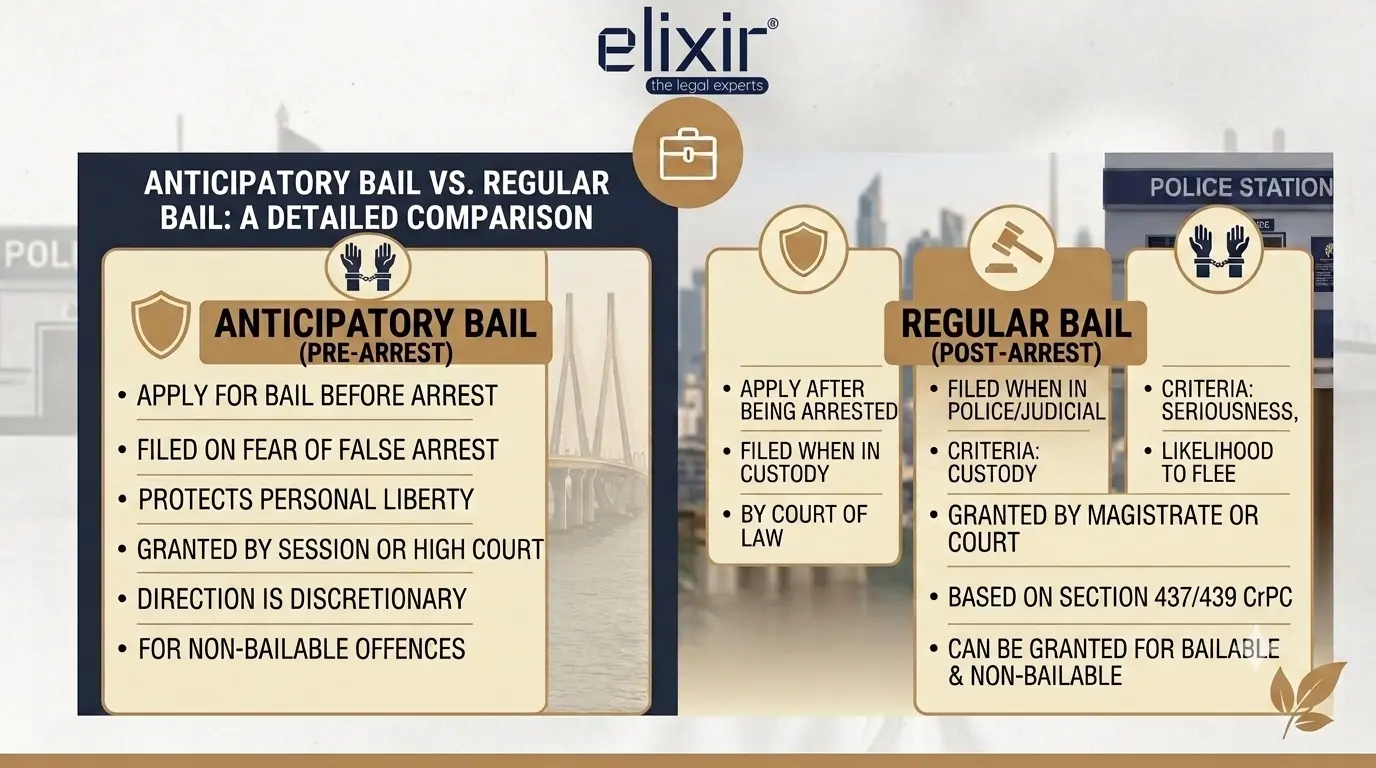
5. The Right to Bail For bailable offences, you are entitled to bail as a matter of right. For non-bailable offences, bail is at the court’s discretion. An experienced criminal lawyer can file for anticipatory bail (before arrest) or regular bail and make the strongest possible case for your release.

6. The Right to Inform a Family Member or Friend Under Section 50A of the CrPC (introduced by the 2009 amendment), the police are legally required to inform a nominated person about your arrest without delay.

What You Should NOT Do After Arrest

Many people unknowingly compromise their own defense in the hours after arrest:

Do not make any statements to police without a lawyer. Even a seemingly innocent clarification can be twisted and used against you in court.

Do not sign any documents you haven’t read and understood. Police sometimes ask arrested persons to sign statements or confessions under pressure. Anything signed without legal counsel can be challenged but creates unnecessary complications.

Do not resist arrest physically. Even if you believe the arrest is unlawful, physical resistance can result in additional charges. Challenge the legality of the arrest through your lawyer in court.

Do not trust verbal assurances from police. “Just come with us for questioning, you’ll be home by evening” is a scenario that has led to overnight detentions and worse. Get legal representation before complying with any police request.

Types of Criminal Cases Elixir Legal Services Handles

Mumbai’s diverse and high-pressure business environment generates a complex range of criminal matters. Elixir Legal Services has deep expertise in:

  • White-Collar Crime — Financial fraud, cheque bounce matters (Section 138 NI Act), corporate fraud, and money laundering
  • Cyber Crimes — Online fraud, data theft, identity fraud
  • Property-Related Criminal Cases — Land grabbing, fraudulent property transactions
  • Criminal Intimidation and Extortion
  • Bail Applications — Anticipatory bail and regular bail across all sessions and high courts
  • Criminal Appeals — Challenging convictions and sentences in appellate courts

Why Early Legal Intervention Changes Everything

The first 24 to 72 hours after arrest are the most critical window in any criminal case. This is when:

  • Bail applications must be filed before the right courts
  • Evidence is being collected (and can be preserved or contested)
  • Statements are being recorded (and can be given strategically or declined)
  • Charges are being framed (which a skilled lawyer can influence at the outset)

Clients who reach out to Elixir Legal Services immediately upon arrest consistently achieve better outcomes — faster bail, weaker prosecution cases, and stronger defenses — compared to those who wait days before engaging counsel.

The Elixir Legal Services Edge

With over 35 years of law practice experience including courts in the USA, Elixir Legal Services brings a rare combination of international legal perspective and deep understanding of Mumbai’s courts, procedures, and judicial culture. Our criminal litigation team is known for:

  • Aggressive bail advocacy
  • Thorough evidence analysis and challenge
  • Clear, honest communication with clients and families
  • Zero tolerance for exploitation of clients during vulnerable moments
  • A track record of results in Mumbai’s Sessions Courts, Bombay High Court, and beyond

We understand that a criminal case isn’t just a legal matter — it’s a life-altering event. We treat every client’s case with the urgency, attention, and confidentiality it deserves.

Conclusion

An arrest does not mean a conviction. In India’s legal system, you are innocent until proven guilty — and you have powerful rights that protect you from the moment of arrest. But those rights only work if you exercise them, and exercising them effectively requires a skilled criminal defense lawyer by your side.

If you or a family member is facing arrest or has been arrested in Mumbai, do not wait. Contact Elixir Legal Services immediately. We offer swift, confidential consultations and can mobilize our criminal defense team at short notice.

Connect with Elixir Legal Services for Criminal Offense

Disclaimer: This blog is for informational purposes only and does not constitute legal advice. Please consult a qualified lawyer for advice specific to your situation.
Frequently Asked Questions

Q1. Can police arrest me without showing an arrest warrant? A: Yes, for cognizable offences (serious crimes), police can arrest without a warrant. However, they must still inform you of the grounds of your arrest immediately, and your rights remain fully intact.

Q2. What is anticipatory bail and when should I apply for it? A: Anticipatory bail is a pre-arrest bail obtained from the Sessions Court or High Court when you have reason to believe you may be arrested. If you suspect you’re under investigation or likely to be arrested, contact Elixir Legal Services immediately to file for anticipatory bail before any arrest occurs.

Q3. Can I be detained for more than 24 hours without being produced before a magistrate? A: No. The police must produce you before a magistrate within 24 hours of arrest (excluding travel time). If they fail to do so, a lawyer can file for your immediate release on the grounds of illegal detention.

Q4. What happens if I can’t afford a lawyer? A: Under Article 39A of the Constitution, the state is obligated to provide free legal aid to persons who cannot afford representation. You can request a legal aid lawyer through the Maharashtra State Legal Services Authority.

Q5. How quickly can Elixir Legal Services respond to a criminal emergency? A: Our team is available for urgent criminal matters and can be reached at +91 9137045481. We prioritize emergency bail applications and can appear in court on the same day or the next available hearing date in most cases.

Property Registration Process – A 2026 Practical Handbook

Property Registration in Mumbai

Complete Guide to Property Registration Process in Mumbai, Maharashtra (2026 Legal & Practical Handbook)

Introduction: Why Property Registration in Mumbai Matters More Than Ever

Buying property in Mumbai is one of the biggest financial decisions a person or business makes. Whether it is a homebuyer purchasing an apartment, an investor acquiring commercial property, or a family buying a redevelopment flat, the property registration process in Mumbai is what legally secures ownership.

Many people assume that signing a sale agreement or paying the builder is enough. In reality, legal ownership is recognized only after the property is registered with the government under the defined laws of Maharashtra. Without proper registration, ownership remains incomplete and vulnerable to disputes, legal complications, or financial loss.

The property registration process in Mumbai Maharashtra is governed by strict legal rules and procedures designed to protect buyers, sellers, and financial institutions. Understanding the legal process, documents, compliance requirements, and verification steps helps homebuyers avoid costly mistakes and ensures a smooth transfer of property title.

This guide explains the property registration process in Mumbai step by step, in simple terms, combining legal clarity with practical understanding.

Legal Framework Governing Property Registration in Mumbai

The property registration process in Mumbai legal process is structured under a well-defined legal framework in Maharashtra. Property registration is not just a formality; it is a statutory requirement that creates legal proof of ownership.

The process is primarily governed by:

  • Registration Act, 1908 (mandatory registration of property transactions)
  • Maharashtra Stamp Act (stamp duty and registration compliance)
  • Real Estate (Regulation and Development) Act (RERA)
  • IGR Maharashtra (Inspector General of Registration)
  • Local municipal and society regulations

Under these laws, any property transfer, agreement, or ownership change must be registered with the Sub-Registrar Office. This ensures transparency, prevents fraud, and creates a permanent government record of ownership.

The property registration process in Mumbai rules are designed to protect both buyers and sellers and ensure legal compliance at every stage.

Property Registration Process in Mumbai Step by Step

Understanding the property registration process in Mumbai step by step helps buyers navigate the system confidently.

Step 1: Property Title Verification

Before starting the registration process, the buyer must verify the property title.

This includes checking:

  • Ownership history
  • Encumbrance records
  • Society and builder approvals
  • RERA registration
  • Municipal records

This property registration process in Mumbai verification step ensures that the property is legally transferable and free from disputes.

Step 2: Drafting the Sale Agreement

The next step is preparing the sale agreement.

This property registration process in Mumbai agreement includes:

  • Buyer and seller details
  • Property details
  • Payment terms
  • Possession timeline
  • Legal clauses
  • Stamp duty calculation

The agreement draft must follow the correct property registration process in Mumbai format and comply with Maharashtra laws.

A properly drafted agreement protects both parties and reduces future legal risks.

Step 3: Stamp Duty Payment

Stamp duty is a mandatory part of the property registration process in Mumbai stamp duty compliance.

Stamp duty represents the government tax on property transactions and must be paid before registration.

The property registration process in Mumbai cost includes:

  • Stamp duty (approx range depending on property type and location)
  • Registration charges
  • Documentation costs

The property registration process in Mumbai charges vary based on property value and category, but typically fall within a standard government-defined range.

Stamp duty payment generates the legal basis for registration.

Step 4: Online Data Entry Through IGR Maharashtra

The property registration process in Mumbai online is managed through the IGR Maharashtra portal.

This includes:

  • Online data entry
  • Property details submission
  • Agreement upload
  • Payment verification
  • Appointment booking

The property registration process in Mumbai IGR system ensures transparency and reduces paperwork.

Buyers and sellers must complete this digital step before visiting the Sub-Registrar Office.

Step 5: Sub-Registrar Office Visit

Both parties must visit the Sub-Registrar Office for biometric verification.

This includes:

  • Identity verification
  • Signature confirmation
  • Document submission
  • Witness presence
  • Final registration approval

This step completes the property registration process in Mumbai procedure and officially records the property transfer.

Step 6: Index II Certificate Issuance

After registration, the government issues the Index II certificate.

The property registration process in Mumbai Index II document serves as official proof of registration and ownership.

It contains:

  • Property details
  • Owner details
  • Registration number
  • Transaction information

The property registration process in Mumbai certificate confirms that the property is legally registered.

Property Registration Process in Mumbai Documents List

The property registration process in Mumbai documents list is crucial for smooth registration.

Key documents include:

  • Sale agreement
  • Identity proof
  • PAN card
  • Address proof
  • Property title documents
  • Tax receipts
  • Builder or society NOC
  • RERA registration details
  • Payment receipts

Having a proper property registration process in Mumbai checklist reduces delays and ensures compliance.

Property Registration Process in Mumbai Timeline

The property registration process in Mumbai timeline is usually structured but can vary.

Typical timeline includes:

  • Document verification
  • Agreement drafting
  • Stamp duty payment
  • Online registration
  • Sub-Registrar appointment
  • Index II issuance

In most cases, the process is completed within a few days to a few weeks depending on documentation and verification.

Delays usually occur due to incomplete paperwork or compliance issues.

Builder, Society, and Redevelopment Considerations

Mumbai properties often involve builders, housing societies, or redevelopment projects.

The property registration process in Mumbai builder transactions require RERA compliance and project approval verification.

The property registration process in Mumbai society properties require:

  • Society NOC
  • Share certificate
  • Maintenance clearance

In redevelopment projects, ownership transfer and legal compliance must be carefully reviewed.

The property registration process in Mumbai redevelopment cases require additional due diligence to avoid disputes.

Leave and License and Rental Registration

Not all property registrations involve ownership transfer.

The property registration process in Mumbai leave and license applies to rental agreements as well.

Rental registration ensures:

  • Legal tenancy
  • Rental compliance
  • Dispute protection
  • Legal documentation

The property registration process in Mumbai rent agreements must be registered to avoid future legal complications.

Penalties, Complaints, and Legal Risks

Failure to follow the property registration process in Mumbai compliance rules can lead to serious consequences.

Common risks include:

  • Registration delay
  • Legal disputes
  • Title issues
  • Penalty for late registration
  • Court cases
  • Ownership conflicts

The property registration process in Mumbai penalty may apply if registration is delayed or improperly executed.

Buyers can file a property registration process in Mumbai complaint if builders or sellers fail to comply with legal obligations.

In extreme cases, disputes may escalate to property registration process in Mumbai court case proceedings.

Latest Update in Property Registration Process in Mumbai 2026

The property registration process in Mumbai 2026 is becoming more digital and transparent.

Key developments include:

  • Increased online registration through IGR
  • Better RERA compliance
  • Digital document verification
  • Faster Index II generation
  • Improved transparency

The property registration process in Mumbai latest update reflects the government’s focus on simplifying property transactions.

This reduces fraud and improves buyer confidence.

Why Legal Help Is Important in Property Registration

Many property disputes arise because buyers do not fully understand the legal process.

The property registration process in Mumbai legal help ensures:

  • Proper title verification
  • Agreement drafting
  • Compliance checks
  • Risk assessment
  • Legal protection

A professional property registration process in Mumbai lawyer can identify hidden risks and prevent costly mistakes.

Legal property registration process in Mumbai consultation ensures that the transaction is safe, compliant, and legally secure.

Final Checklist for Homebuyers in Mumbai

Before registering property, ensure:

  • Title verification completed
  • Agreement drafted correctly
  • Stamp duty paid
  • IGR registration done
  • Society or builder approvals verified
  • Index II received
  • Legal compliance checked

This property registration process in Mumbai guide helps buyers secure their property legally and safely.

FAQs

1. How to complete property registration process in Mumbai?

The property registration process in Mumbai involves title verification, agreement drafting, stamp duty payment, IGR registration, Sub-Registrar visit, and Index II issuance.

2. What documents are required for property registration in Mumbai?

Sale agreement, identity proof, PAN card, property title documents, tax receipts, builder or society NOC, and payment receipts are required.

3. What is Index II in property registration?

Index II is the official government certificate that confirms property registration and ownership.

4. Is online property registration available in Mumbai?

Yes, the IGR Maharashtra portal allows online data entry, stamp duty payment, and appointment booking.

5. Why is legal consultation important in property registration?

Legal consultation ensures title verification, compliance, risk protection, and proper documentation.

6. What happens if property is not registered?

Unregistered property may lead to legal disputes, penalties, and ownership issues.

Conclusion

Property registration in Mumbai is not just a paperwork process — it is a legal safeguard for your ownership and investment.

Any mistake in documentation, verification, compliance, or agreement drafting can lead to long-term legal and financial complications.

Elixir Legal Services provides legal consultation, title verification, agreement drafting, compliance checks, and end-to-end support for property registration in Mumbai and Maharashtra.

If you are planning to buy, sell, transfer, or register property, professional legal guidance ensures your transaction is secure, compliant, and risk-free.

Connect with Elixir Legal Services for expert property registration legal support in Mumbai and Maharashtra.

Corporate Law in India Is No Longer About Compliance — It Is About Business Survival and Strategic Power

Corporate Law

The Silent Shift in Corporate Law

For decades, corporate law in India was treated as a backend function. Something that lived in files, contracts, compliance calendars, and annual filings. Something businesses approached only when required — at the time of company incorporation, contract disputes, or regulatory notices. Legal departments were often seen as cost centers, and law firms were brought in only when a problem appeared large enough to demand attention.

That mindset is quietly disappearing.

Across India’s evolving corporate ecosystem, a silent shift is taking place. Corporate law is no longer confined to documentation or compliance; it is increasingly shaping how businesses are structured, how investors evaluate opportunities, how partnerships are built, and how companies survive in uncertain environments.

Today, legal strategy has become deeply intertwined with business strategy.

Investors study legal frameworks before committing capital. Boards demand governance clarity before approving expansion. Global partners expect compliance transparency before signing agreements. Regulators are more vigilant than ever. Employees are more aware of their rights. Vendors demand contractual accountability. And markets punish companies that lack legal discipline.

Corporate law, in this environment, is not simply a regulatory requirement.

It is a strategic force that determines whether a company grows steadily or collapses under avoidable risks.


From Paperwork to Power: The Evolution of Corporate Law in India

India’s corporate landscape has transformed dramatically over the last two decades.

In the early 2000s, many businesses operated with minimal legal structuring. Contracts were simple, governance frameworks were basic, and compliance requirements were relatively limited. Corporate legal intervention was often reactive — responding to disputes, notices, or regulatory changes.

But as India integrated more deeply into global markets, the expectations changed.

The introduction of stricter corporate governance norms, the expansion of regulatory oversight, the rise of venture capital and private equity, and the growing importance of transparency pushed businesses toward more structured legal frameworks. Corporate law began to evolve from a procedural requirement into a strategic discipline.

Today, corporate legal frameworks influence:

  • How companies raise capital
  • How they structure ownership
  • How they protect intellectual property
  • How they manage partnerships
  • How they mitigate operational risks
  • How they build investor confidence
  • How they expand across borders

In essence, corporate law has become a tool of strategic power.

It shapes decision-making, strengthens governance, and ensures that growth does not come at the cost of stability.

The companies that understand this shift are building resilient structures that allow them to scale with confidence. Those that ignore it often discover the importance of legal discipline only when faced with costly consequences.


Why Legal Is No Longer a Backend Function

Modern businesses operate in a complex and interconnected environment.

A single business decision — entering a partnership, hiring a senior executive, launching a new product, or expanding into a new market — carries legal implications. These implications may not be visible immediately, but they shape long-term outcomes.

Consider a simple vendor agreement.

On the surface, it appears to be a routine document. But beneath it lie questions of liability, payment obligations, dispute resolution, confidentiality, and regulatory compliance. If these elements are not carefully structured, a minor disagreement can escalate into a legal and financial crisis.

Multiply this across hundreds of contracts, employees, investors, and operational decisions, and the importance of corporate law becomes clear.

Legal is no longer a department that reacts to problems.

It is a strategic function that anticipates them.

Companies that integrate legal thinking into their decision-making process operate differently. They evaluate risks before entering agreements. They structure partnerships carefully. They build governance frameworks that reduce uncertainty. They ensure that compliance is embedded in operations rather than treated as an afterthought.

This proactive approach transforms corporate law into a growth enabler rather than a regulatory burden.


The Invisible Risks Growing Inside Companies

One of the most dangerous aspects of weak corporate legal structures is that risks often remain invisible until they become critical.

A company may appear stable on the surface — steady revenue, growing team, expanding operations — but hidden beneath that growth could be legal vulnerabilities waiting to surface.

These vulnerabilities often include:

  • Poorly drafted shareholder agreements
  • Unclear ownership structures
  • Weak vendor contracts
  • Inadequate employment policies
  • Compliance gaps
  • Governance inconsistencies
  • Regulatory oversights

Individually, these issues may seem manageable. Collectively, they create structural instability.

The real danger is that businesses rarely notice these risks during periods of growth. It is only when an investor conducts due diligence, a dispute arises, or a regulatory notice arrives that the cracks begin to show.

By then, the cost of correction is often significantly higher than the cost of prevention.

Corporate law, when approached strategically, helps identify and eliminate these invisible risks before they threaten the business.


A Quiet Corporate Crisis:

A mid-sized company operating in India’s manufacturing sector had built a strong market presence over a decade.

The business was growing steadily, revenue was stable, and the leadership team was confident about entering the next phase of expansion. The company began discussions with a private investment group that showed strong interest in funding its growth.

At first glance, everything looked promising.

The company had a solid market reputation, a loyal customer base, and consistent financial performance. The investment seemed almost certain.

Then the due diligence process began.

As legal and financial experts started reviewing the company’s documentation, several issues surfaced. Shareholding structures were not clearly defined in early agreements. Some vendor contracts lacked enforceable clauses. Employment agreements were inconsistent across departments. Regulatory filings had minor irregularities. A few compliance deadlines had been missed in previous years.

None of these issues were catastrophic on their own.

But together, they created uncertainty.

The investors became cautious. They requested corrections, additional documentation, and restructuring of agreements. The process slowed down. Negotiations became complex. Legal risks began to outweigh financial attractiveness.

Eventually, the investment was delayed significantly, and the company lost valuable time in a competitive market.

The business did not fail. It continued operating and eventually stabilized its legal framework. But the opportunity cost was substantial. Growth slowed, expansion plans were postponed, and market momentum weakened.

The most striking part of this situation was that none of the issues were intentional.

They were simply the result of treating corporate law as a secondary function instead of a strategic one.


Lessons from the Case

This type of situation is more common than most businesses realize.

The lesson is not about failure. It is about awareness.

Strong businesses do not collapse because they lack ambition or market demand. They struggle because structural weaknesses prevent them from moving quickly when opportunities arise.

Corporate law plays a critical role in ensuring that businesses remain opportunity-ready.

The key lessons are clear:

  • Legal structuring must evolve with business growth
  • Governance must remain consistent and transparent
  • Contracts must be carefully drafted and maintained
  • Compliance must be proactive rather than reactive
  • Legal strategy must align with business strategy

When these elements are in place, companies operate with confidence. Investors trust them, partners collaborate more easily, and expansion becomes smoother.

Corporate law, in this sense, becomes a silent but powerful enabler of growth.


The Strategic Role of Corporate Legal Partners

As corporate law becomes more complex, the role of legal partners is also evolving.

Businesses are no longer looking for lawyers who simply draft documents. They are looking for legal partners who understand business dynamics, anticipate risks, and contribute to strategic decision-making.

This shift is transforming the legal industry itself.

Corporate legal partners today must think like business advisors. They must understand market realities, investor expectations, regulatory frameworks, and operational challenges. Their role extends beyond compliance into governance, risk management, and long-term planning.

In this environment, legal expertise is measured not only by knowledge of laws but by the ability to translate that knowledge into practical business solutions.

A strong corporate legal partner becomes part of the company’s strategic ecosystem — working alongside leadership, finance teams, and operational managers to ensure that legal strength supports business growth.


The Future of Corporate Law in India

India’s corporate environment is moving toward greater transparency, stronger governance, and stricter compliance.

Regulatory frameworks are becoming more detailed. Investors are demanding higher standards. Global partnerships require international compliance alignment. Corporate governance is under constant scrutiny.

In the future, companies will need legal frameworks that are:

  • Agile
  • Transparent
  • Scalable
  • Globally compliant
  • Strategically aligned

Corporate law will increasingly shape how businesses compete and survive.

Companies that invest in strong legal foundations today will find it easier to adapt to tomorrow’s challenges. Those that continue treating legal as a secondary function may struggle to keep pace with regulatory and market expectations.


A Quiet but Critical Role

In many ways, corporate legal partners operate behind the scenes.

They rarely appear in headlines or annual reports. Their work is often invisible to the public. Yet their influence is deeply embedded in the stability and success of the companies they support.

They ensure that contracts are secure, governance is strong, compliance is consistent, and risks are minimized.

This quiet but critical role defines the strength of modern corporate ecosystems.

We at Elixir Legal Services, under the leadership of Shweta Rathod, represent this evolving approach to corporate law — one that focuses not just on compliance, but on strategic legal partnership, governance clarity, and long-term business sustainability across India’s dynamic corporate landscape.

As Shweta Rathod often emphasizes:

“Corporate law should empower businesses, not restrict them. When legal frameworks are strong, companies gain the confidence to innovate, expand, and build lasting value.”


Conclusion: Legal Strength Defines Corporate Longevity

The conversation around corporate law in India is changing.

It is no longer about paperwork, filings, or regulatory obligations alone. It is about resilience, governance, and strategic power. It is about building companies that can withstand uncertainty, attract investors, and scale sustainably.

Corporate law, when approached thoughtfully, becomes a foundation for long-term success.

The strongest companies are not just those with innovative products or strong financial performance. They are the ones with solid legal frameworks that protect their vision and support their growth.

In a rapidly evolving business environment, legal strength is not a luxury.

It is a necessity.

And the businesses that recognize this reality today will be the ones leading India’s corporate future tomorrow.

Contract Law Explained Simply – How to Avoid Legal Disputes in Business

Contract Law

Introduction

Contracts define business relationships. Poorly drafted or unclear contracts are one of the main reasons businesses end up in legal disputes.

This guide explains contract law in simple terms for Indian businesses.


What Makes a Contract Valid?

A valid contract requires:

  • Offer and acceptance
  • Lawful consideration
  • Free consent
  • Legal purpose

If any element is missing, the contract may not be enforceable.


Common Contract Mistakes

  • Vague clauses
  • No dispute resolution mechanism
  • Unclear payment terms

These issues often lead to litigation.


Importance of Clear Drafting

Simple language, defined timelines, and exit clauses reduce misunderstandings and protect both parties.


Breach & Remedies

When contracts are breached, remedies may include:

  • Compensation
  • Specific performance
  • Legal enforcement

Why Contract Review Is Critical

Legal review ensures contracts align with Indian laws and business goals, reducing risk and disputes. Know more about our services on this link services

Why Every City Talks About Redevelopment Today  

redevelopment today

Cities grow, evolve, and change over time. As urban populations increase and infrastructure ages, redevelopment has become a common topic worldwide. It involves more than just tearing down and rebuilding. It focuses on rethinking spaces to meet modern needs, improve safety, and raise the overall quality of life.  

From housing societies in Mumbai to neighbourhoods in Bengaluru, the demand for redevelopment is stronger than ever. Old buildings, once sources of pride, now struggle to meet current expectations. Redevelopment connects the past with the future.  

Why Redevelopment Matters  


Redevelopment is more than just a trendy term; it brings significant benefits for both residents and cities.  

  • Stronger and safer homes: Many buildings built decades ago are no longer secure. Redevelopment ensures they meet modern safety standards.  
  • Lifestyle upgrades: New layouts, elevators, dedicated parking, green spaces, and recreational facilities provide comfort for residents.  
  • Efficient land use: With limited urban land available, redeveloping existing sites uses space better.  
  • Boost in property value: Redeveloped apartments typically see higher demand and better resale value in the real estate market.  

These advantages make redevelopment a powerful tool for urban growth and community well-being.  

Why Cities Are Talking About It  


In India, redevelopment is gaining traction for several reasons:  

  • Population density: Growing populations need more efficient housing.  
  • Ageing infrastructure: Buildings from the 1970s and 1980s often lack durability and need to be replaced urgently.  
  • Government initiatives: Policies that encourage redevelopment offer tax incentives and faster approvals.  
  • Modern aspirations: Families seek homes that cater to today’s lifestyle needs, including digital connectivity and sustainable features.  
  • Community renewal: Redevelopment projects not only upgrade homes but also improve surrounding neighbourhoods.  

In this way, redevelopment is more than just about buildings; it represents social change.  

The Role of Legal Guidance  

Redevelopment projects involve numerous stakeholders, including residents, developers, and government authorities. Agreements, regulations, and approvals can be overwhelming. Expert lawyers in Mumbai play a crucial role in this process. They provide clarity, ensure fair contracts, and protect residents from potential risks.  

Legal guidance ensures redevelopment is a secure journey, where everyone feels protected.  

Building Trust Through Transparency  


For families, redevelopment is a personal decision. Leaving a home filled with memories takes trust in the process. Developers also need to feel confident that projects will move forward without conflicts.  

Transparent agreements and solid legal frameworks build this trust. Housing societies often turn to the best real estate lawyers in Mumbai to ensure their rights are upheld, agreements are fair, and every clause serves the community’s interests.  

Redevelopment and Its Human Side  


Beyond numbers and contracts, redevelopment is about people. It involves temporarily leaving familiar places with the hope of returning to something better. Communities that embrace redevelopment gain improved infrastructure and strengthen their shared identity.  

When residents return to their new homes, they not only have better facilities but also renewed pride in their neighbourhoods. Responsible redevelopment strengthens, rather than weakens, community bonds.  

Looking Ahead  


With India focusing on smart cities and sustainable growth, redevelopment will keep shaping urban areas. It addresses housing shortages, boosts infrastructure safety, and ensures cities meet modern needs.  

For residents, it means living in safer, more valuable, and better-connected spaces. For cities, it signifies growth without uncontrolled sprawl. For communities, it offers a chance to build stronger, more vibrant neighbourhoods.  

Conclusion 


Every city is talking about redevelopment today because it provides a practical solution to major urban living challenges. It revitalises neighbourhoods, enhances safety, and ensures homes meet modern family aspirations.  

While the process can be complicated, the right professional support facilitates smooth execution. With legal experts assisting both residents and developers, redevelopment shifts from a challenge to an opportunity.

How Land Acquisition Laws Shape Redevelopment

Land acquisition laws for redevelopment

Redevelopment has become an essential part of urban growth, especially in metropolitan cities where space is limited and infrastructure is ageing. Whether it’s reviving dilapidated buildings or developing underutilised land, land acquisition forms the legal and operational backbone of any redevelopment initiative. Understanding how land acquisition laws influence these projects is vital for all stakeholders: residents, developers, legal advisors, and government agencies.

Understanding Land Acquisition in Redevelopment

Land acquisition refers to the process by which the government or a private developer acquires land from individual owners for a public or commercial purpose. In India, this process is primarily governed by the Right to Fair Compensation and Transparency in Land Acquisition, Rehabilitation and Resettlement Act, 2013 (LARR Act).

The Act ensures that landowners are fairly compensated, rehabilitated, and resettled when their land is acquired for development purposes. It also includes guidelines for obtaining consent from a majority of landowners, conducting social impact assessments, and determining compensation based on market value.

Legal Framework and Its Impact

The legal framework around land acquisition directly shapes how redevelopment projects are executed:

  • Consent Requirement: For private projects, consent from at least 70–80% of affected people is required. This ensures participatory decision-making but may also delay projects if not handled transparently.
  • Social Impact Assessment: Developers are obligated to assess how a project might affect the local community and environment. This step prevents misuse of land acquisition powers and encourages responsible development.
  • Fair Compensation: Landowners must be compensated fairly based on current market rates, including rehabilitation costs. This clause protects the interests of displaced individuals and avoids long-term legal conflicts.

In complex urban redevelopment projects, especially those involving cooperative housing societies or slum rehabilitation, legal clarity is essential. Often, stakeholders turn to the best law firm in Mumbai to manage the legal intricacies, documentation, and negotiations effectively.

Challenges in Land Acquisition for Redevelopment

Despite the legal safeguards, several challenges persist:

  • Disputed Titles and Encroachments: Urban land records may be outdated or unclear, leading to ownership disputes.
  • Inadequate Compensation Claims: Conflicts may arise when residents feel the compensation does not reflect the true value of their property.
  • Delays in Government Approvals: Bureaucratic hurdles can slow down the acquisition process, causing financial strain on developers.

In these scenarios, the involvement of experienced property dispute lawyers in Mumbai becomes critical. They help resolve title disputes, handle litigation if required, and ensure legal compliance throughout the redevelopment process.

Conclusion

Land acquisition laws are fundamental to shaping modern redevelopment projects. By ensuring fairness, transparency, and legal due diligence, these laws create a structure that protects individual rights while supporting urban renewal. As India’s cities continue to evolve, understanding and respecting the legal processes involved in land acquisition will be key to sustainable and inclusive redevelopment.

What Is Civil Litigation and Why Is It Crucial for Legal Disputes in India

Legal Disputes in India

Civil litigation is a fundamental part of the legal system that addresses disputes between private parties. These disputes can involve individuals, businesses, or organisations and typically revolve around issues such as contracts, property, family matters, and other non-criminal conflicts. Unlike criminal cases, which involve offences against the state, civil litigation seeks to resolve private disagreements and provide remedies through the courts.

Understanding Civil Litigation

At its core, civil litigation involves one party filing a lawsuit against another to seek compensation, enforcement of rights, or specific relief. The process is governed by procedural laws designed to ensure fairness, transparency, and due process for all involved. Cases can be resolved through various stages, including pleadings, evidence collection, hearings, and finally, a court judgment or settlement.

Civil litigation covers a wide array of cases, including but not limited to:

  • Disputes over property ownership and boundaries
  • Breach of contract claims
  • Claims related to business agreements and partnerships
  • Inheritance and succession conflicts
  • Defamation and personal injury claims

Each of these cases requires a clear understanding of legal principles and a strategic approach to effectively present facts and arguments in court.

Why Civil Litigation Is Essential in India

In a country with a vast and diverse population like India, civil litigation plays a crucial role in maintaining social order and justice. It offers individuals and entities a peaceful and legal method to resolve disputes, helping avoid self-help remedies or vigilantism.

Key Reasons Why Civil Litigation Matters

  • Protection of Legal Rights

Civil litigation enables parties to assert and protect their legal rights. Whether it’s enforcing a contract or safeguarding property ownership, the court’s intervention ensures that rights are upheld according to law.

  • Fair and Transparent Process

The judicial system follows strict procedural rules, guaranteeing that both parties have an opportunity to be heard, present evidence, and challenge opposing claims.

  • Legal Enforcement of Judgments

Unlike informal settlements, court orders resulting from civil litigation are legally enforceable, providing certainty and finality to disputes.

  • Promotion of Accountability

Knowing that legal recourse is available deters parties from breaching agreements or engaging in unfair practices, thereby encouraging compliance and good faith.

  • Support for Economic Stability

For businesses, civil litigation ensures that contracts and commercial transactions are honoured, which is vital for maintaining investor confidence and operational stability.

The Role of Experienced Legal Support

Engaging expert legal counsel is critical to successfully navigating the complexities of civil litigation. A knowledgeable civil litigation firm in Mumbai understands the intricacies of local court procedures and can craft tailored strategies to protect clients’ interests. Effective representation can reduce delays, manage costs, and increase the chances of a favourable outcome.

When clients seek the best law firm in Mumbai, they often look for proven expertise, reliability, and personalised service that aligns with their unique legal needs. Such firms combine legal knowledge with practical experience to guide clients through every stage of the litigation process.

Conclusion

Civil litigation remains an indispensable tool for resolving disputes and safeguarding rights within India’s legal framework. It provides a structured, fair, and enforceable avenue for individuals and businesses to seek justice. With the right legal guidance, parties can confidently approach civil litigation, knowing their interests are protected and their disputes are addressed through a system built on fairness and the rule of law.