
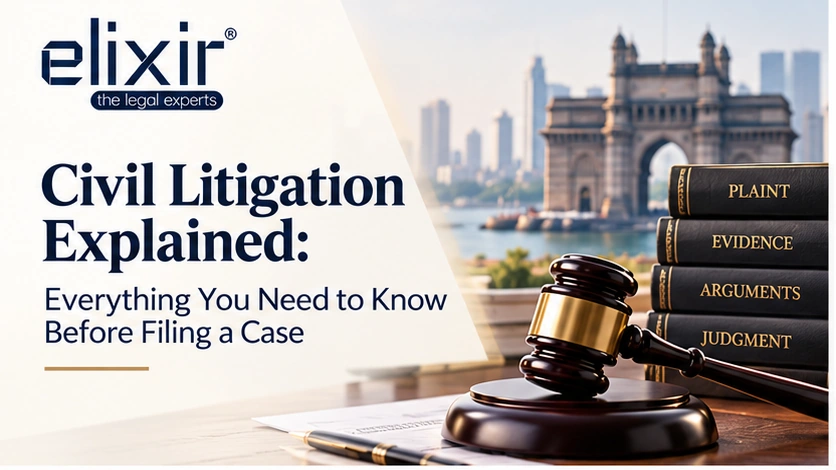
Civil Litigation Explained: Everything You Need to Know Before Filing a Case
Introduction: What Is Civil Litigation?
Legal disputes can arise in almost every aspect of life, from property ownership and contractual disagreements to unpaid dues, inheritance conflicts and business disputes. When such disputes require formal legal intervention, civil litigation may provide a way to protect legal rights and seek an appropriate remedy.
Civil litigation refers to legal proceedings used to resolve disputes concerning civil rights, obligations, property, contracts, money and other non-criminal matters. Depending on the nature of the dispute, the remedy may involve monetary compensation, recovery of property, enforcement of an agreement, a declaration of legal rights or a court order preventing a particular action.
In India, civil proceedings are governed by applicable laws, including the Code of Civil Procedure, 1908 (CPC), alongside substantive laws relevant to the dispute. The appropriate court and procedure depend on factors such as the nature of the claim, territorial and pecuniary jurisdiction, and any special statutory framework that applies. Read the Code of Civil Procedure, 1908.
Before filing a case, it is important to understand your legal position, gather supporting evidence, assess the likely costs and consider whether the dispute can be resolved without a full trial.
What Types of Cases Fall Under Civil Litigation?
Civil litigation covers a broad range of disputes involving individuals, businesses, property owners, tenants, housing societies and other entities.
1. Property and Real Estate Disputes
Property disputes are common in Mumbai, where ownership, redevelopment, inheritance and possession issues can become complicated.
Examples include:
- Disputes over ownership or title.
- Illegal possession or encroachment.
- Disagreements over sale agreements.
- Builder-buyer disputes and possession delays.
- Partition of jointly owned or inherited property.
- Redevelopment disputes involving housing societies or members.
- Landlord-tenant disagreements.
The appropriate remedy depends on the facts, documents and applicable property laws. In some cases, a party may seek an injunction, declaration of rights, possession or another legally available remedy.
Elixir Legal Services provides assistance with property dispute legal matters in Mumbai, including ownership, possession, inheritance and redevelopment-related disputes.
2. Contractual and Commercial Disputes
Contracts establish obligations between individuals and businesses. When one party fails to fulfil an obligation, a dispute may arise.
Common examples include:
- Breach of a commercial agreement.
- Failure to deliver goods or services.
- Disputes involving suppliers or vendors.
- Disagreements between business partners.
- Claims for damages arising from contractual breaches.
- Disputes over payment terms or contractual obligations.
Depending on the agreement, a dispute may need to be referred to arbitration rather than an ordinary civil court. Reviewing the dispute-resolution clause before taking action is therefore important.
3. Money Recovery and Debt Disputes
A person or business may need legal assistance when money owed under an agreement, loan, invoice or other obligation remains unpaid.
Potential claims include outstanding business payments, contractual dues, unpaid loans and other recoverable amounts.
Before proceeding, it is important to verify the underlying obligation, the amount claimed, available evidence and the applicable limitation period.
4. Inheritance and Family Property Disputes
Disagreements can arise among family members concerning inherited assets, wills, ownership interests or the division of jointly held property.
These disputes may involve questions relating to succession, title, entitlement, partition or the validity and interpretation of relevant documents.
A legal review can help identify the parties who may need to be involved and the appropriate remedy.
5. Injunctions and Declarations
Sometimes, a person needs more than monetary compensation.
An injunction may be sought to prevent or restrain certain conduct where the legal requirements are met. A declaration may be sought when a court needs to determine the legal status or rights of a party.
For example, a property owner facing a threatened unlawful interference with their rights may need to explore whether interim or permanent injunctive relief is available.
The availability of relief depends on the facts, applicable law and the court’s assessment.
When Should You Consider Filing a Civil Case?
Filing a civil suit may be appropriate when a legal right has been violated, a contractual obligation remains unfulfilled or a dispute cannot be resolved through reasonable discussions.
However, litigation should not be the automatic first step in every disagreement.
Before filing, consider the following questions:
- Do you have a legally enforceable claim?
- Can you support your position with documents or other evidence?
- Have you identified the correct party against whom the claim should be made?
- Is the proposed court legally competent to hear the matter?
- Is the claim within the applicable limitation period?
- Is there an arbitration clause or another mandatory dispute-resolution process?
- Would negotiation or mediation provide a practical alternative?
- Are the potential benefits proportionate to the likely costs and time involved?
A preliminary consultation with a civil litigation lawyer in Mumbai can help you assess these issues before committing to formal proceedings.
What Should You Do Before Filing a Civil Suit?
Preparation can make a significant difference to how a civil dispute is assessed and presented.
Step 1: Understand Your Legal Rights
Start by identifying exactly what has happened and how it affects your legal rights.
For example, a payment dispute may arise from a contract, while a property dispute may involve ownership documents, possession rights or an inheritance claim.
The legal basis of the claim determines the relief that may be available.
Step 2: Collect Relevant Documents and Evidence
Gather all documents connected to the dispute.
Depending on the matter, these may include:
- Contracts, agreements and deeds.
- Property title documents and sale agreements.
- Invoices, receipts and payment records.
- Bank statements and transaction records.
- Emails, letters and relevant messages.
- Legal notices and replies.
- Photographs, videos or inspection reports, where relevant.
- Witness details and other supporting material.
- Previous court orders or related proceedings.
Preserve original documents and maintain a clear record of relevant dates. Electronic evidence should also be preserved in its original form where possible, with applicable evidentiary requirements considered.
Step 3: Assess Whether a Legal Notice Is Appropriate
A legal notice can formally communicate a grievance, identify the relief being sought and give the other party an opportunity to respond or resolve the dispute.
Depending on the circumstances, a notice may be a useful step before filing a suit. However, it is not compulsory in every civil dispute, and some proceedings have specific statutory notice requirements.
For example, Section 80 of the CPC generally provides for advance notice before instituting certain suits against the Government or public officers in respect of official acts, subject to applicable exceptions.
Your lawyer can determine whether a notice is required, advisable or unnecessary in your particular case.
Step 4: Check the Limitation Period
Do not delay legal advice while attempting informal settlement discussions.
The Limitation Act, 1963 prescribes time limits for different types of suits and proceedings. The applicable period depends on the nature of the claim and when the relevant cause of action arose, among other legal considerations.
Section 3 provides that a suit instituted after the prescribed limitation period is generally liable to be dismissed, even if the opposing party has not raised limitation as a defence. Read the Limitation Act, 1963.
There is no single limitation period that applies to every civil case. Have the deadline assessed specifically for your claim.
Step 5: Identify the Correct Court or Forum
A civil dispute must be filed before a court or forum with the necessary jurisdiction.
This assessment may involve:
- Territorial jurisdiction: Where the defendant resides or carries on business, where the cause of action arose, or where the property is situated, depending on the applicable rules.
- Pecuniary jurisdiction: Whether the value of the claim falls within the court’s financial jurisdiction.
- Subject-matter jurisdiction: Whether the court is authorised to hear that category of dispute.
- Special statutory jurisdiction: Whether legislation requires the dispute to be taken to a designated authority, tribunal or other forum.
For instance, certain commercial disputes, tenancy matters, consumer disputes and property-related claims may be subject to specialised procedures or jurisdictional rules.
Filing in the wrong forum can cause delay and additional expense, so jurisdiction should be reviewed before proceedings begin.
How to File a Civil Case in India: Step-by-Step Process
The precise process varies by case type and court. An ordinary civil suit commonly follows these broad stages.
Step 1: Initial Legal Consultation
The lawyer reviews the facts, documents, legal rights, potential defences and objectives.
At this stage, it is useful to discuss the likely remedies, possible risks, estimated expenses and alternatives to litigation.
Step 2: Drafting the Plaint
A civil suit is ordinarily instituted by presenting a plaint, in accordance with Section 26 of the CPC and the applicable procedural rules.
The plaint generally sets out the material facts, the cause of action, the parties involved, the court’s jurisdiction and the relief sought. The relevant procedural requirements must be followed, including applicable verification and affidavit requirements.
Accuracy is important. Missing facts, incorrect party details or an unclear statement of the relief sought can create avoidable complications.
Step 3: Filing and Payment of Applicable Court Fees
The plaint and supporting documents are filed before the appropriate court in accordance with its filing procedures.
Applicable court fees, process fees and other filing requirements must be assessed under the relevant central and state laws, court rules and case-specific requirements.
In Maharashtra, court fees should be checked against the applicable state legislation and the nature and valuation of the relief claimed. Costs cannot be reliably estimated without knowing the specific dispute.
Step 4: Scrutiny and Issuance of Summons
After filing, the court registry may scrutinise the papers and identify procedural defects that need correction.
Once the matter proceeds in accordance with the applicable procedure, summons or other directions may be issued to the defendant.
Step 5: Written Statement and Preliminary Proceedings
The defendant is given an opportunity to respond to the claim in accordance with the applicable procedural rules.
The defendant may raise legal objections, dispute the facts, present a defence or pursue a counterclaim where legally available.
The court may then identify the questions requiring determination and issue appropriate directions for the next stages.
Step 6: Evidence and Trial
If the matter proceeds to trial, the parties may be required to present documentary and oral evidence, examine witnesses and respond to the opposing party’s evidence.
The precise sequence depends on the applicable procedure and the nature of the case.
Step 7: Arguments and Judgment
After considering the pleadings, evidence and legal submissions, the court delivers its decision.
Depending on the claim and findings, the court may grant or refuse the relief sought, award damages where legally justified or issue other appropriate directions.
Step 8: Execution or Appeal, Where Applicable
A favourable judgment does not always result in immediate practical relief. Execution proceedings may be required to enforce a decree.
Depending on the law and circumstances, a party may also have a right to appeal or pursue another permitted remedy within the applicable time limit.
How Long Does a Civil Litigation Case Take?
There is no universal timeline for civil litigation in India.
Some disputes may settle relatively early, while contested cases involving multiple parties, extensive evidence, interim applications or complex legal issues can take considerably longer.
Factors affecting duration include:
- Complexity of the facts and law.
- Number of parties involved.
- Availability and quality of evidence.
- Court workload and scheduling.
- Service of summons.
- Interim applications and procedural disputes.
- Willingness of the parties to negotiate.
- Appeals and execution proceedings.
A lawyer can provide a more realistic assessment after reviewing the documents and identifying the likely procedural steps. Any estimate should be treated as indicative rather than a guarantee.
What Are the Costs of Filing a Civil Case?
The cost depends on the nature and value of the dispute, the court or forum involved, the work required and the length of the proceedings.
Potential expenses include:
- Lawyer’s professional fees.
- Court fees.
- Drafting and documentation expenses.
- Process and service fees.
- Expert or valuation fees, where required.
- Costs associated with evidence and witnesses.
- Expenses for interim applications, appeals or execution proceedings.
Ask for a clear explanation of the fee structure and which stages or expenses are included.
A cost-benefit assessment is especially important in recovery matters, where the amount sought should be considered alongside the realistic prospects of enforcement.
Can a Civil Dispute Be Resolved Without Going to Court?
Yes. Depending on the dispute, parties may be able to resolve the matter through negotiation, mediation, conciliation or arbitration.
Negotiation
The parties discuss possible terms directly or through their lawyers. This can be useful when both sides are open to a practical settlement.
Mediation
A neutral mediator helps the parties explore a mutually acceptable resolution. Mediation may preserve relationships and reduce the need for prolonged contested proceedings.
Arbitration
Where a valid arbitration agreement applies, disputes within its scope may need to be referred to arbitration in accordance with the agreement and applicable law.
Settlement During Litigation
Even after a civil suit has been filed, parties may be able to settle the dispute, subject to applicable legal requirements and court procedure.
The right approach depends on the dispute, urgency, contractual terms and the relief required. A settlement should be properly documented so that its terms and consequences are clear.
Common Mistakes to Avoid Before Filing a Civil Suit
Avoiding preventable errors can help reduce procedural problems and unnecessary expense.
1. Ignoring Limitation Periods
Waiting too long can jeopardise a claim. Obtain advice promptly about the deadline that applies to your particular dispute.
2. Filing Without Sufficient Documentation
A claim needs a proper factual and evidentiary foundation. Collect relevant records before proceedings begin wherever possible.
3. Choosing the Wrong Court
Jurisdiction is a legal requirement, not a matter of convenience alone.
4. Overlooking Contractual Dispute-Resolution Clauses
An agreement may contain arbitration or other dispute-resolution provisions that affect the appropriate procedure.
5. Seeking an Unclear or Inappropriate Remedy
The relief requested should match the legal right asserted and the facts supporting the claim.
6. Underestimating Costs and Time
Litigation requires planning, resources and ongoing attention. Discuss the likely stages and costs with your lawyer before proceeding.
7. Treating Every Dispute as a Court Matter
Negotiation or mediation may be suitable in some cases, while urgent protection of legal rights may require court intervention. The choice should be based on the circumstances rather than a fixed rule.
How Can a Civil Litigation Lawyer Help?
An experienced civil litigation lawyer can assist with more than courtroom representation.
Depending on the matter, legal support may include:
- Reviewing documents and assessing the merits of a claim.
- Identifying the appropriate legal remedy.
- Evaluating jurisdiction and limitation issues.
- Drafting legal notices and pleadings.
- Preparing and filing the suit.
- Advising on interim relief.
- Representing the client at hearings and trial.
- Assessing settlement options.
- Advising on execution and appeals where appropriate.
For individuals and businesses facing complex disputes, early legal advice can help clarify available options and identify potential risks before they escalate.
Elixir Legal Services assists clients with civil disputes involving contracts, commercial disagreements, money recovery, property, tenancy, inheritance and other civil matters. Learn more about its civil litigation practice or explore its civil attorney services in Mumbai.
Why Choose Elixir Legal Services for Civil Litigation in Mumbai?
Choosing legal representation is an important decision. Clients should look for a team that understands the relevant law, reviews the evidence carefully and explains the practical implications of the available options.
Elixir Legal Services handles civil litigation matters involving individuals, businesses and institutions, including contractual disputes, property claims, recovery matters, succession issues and other civil proceedings.
Its approach includes assessing the legal and financial considerations of a claim, identifying possible remedies and developing a strategy based on the circumstances of the case.
If you are considering filing a civil suit or need to respond to an existing claim, you can visit Elixir Legal Services to learn more about its legal services or contact the firm to discuss your matter.
Frequently Asked Questions About Civil Litigation
1. What is civil litigation in simple terms?
Civil litigation is the legal process for resolving non-criminal disputes involving matters such as contracts, property, money, inheritance and other civil rights or obligations.
2. How do I file a civil case in India?
The usual first steps are to assess the legal claim, collect supporting evidence, check limitation and jurisdiction, identify the appropriate remedy and prepare the required pleadings. An ordinary civil suit is generally instituted by presenting a plaint, subject to the applicable procedural rules.
3. What documents are required to file a civil suit?
Requirements vary by case. Common documents include agreements, property records, invoices, payment proof, correspondence, legal notices and other evidence supporting the claim.
4. Is sending a legal notice compulsory before filing a civil case?
Not in every case. Whether a notice is required depends on the type of dispute, applicable law and any relevant contractual or statutory requirements.
5. What is the limitation period for a civil case in India?
There is no single limitation period for all civil suits. The applicable period depends on the nature of the claim, the relevant legal provision and when the cause of action arose. A lawyer should assess the specific deadline.
6. How much does it cost to file a civil case?
Costs vary according to the claim, applicable court fees, legal fees, documentation and the length and complexity of the proceedings. Obtain a case-specific estimate before filing.
7. Can I settle a civil dispute after filing a case?
Yes, a settlement may be possible during proceedings, subject to applicable law and procedural requirements. The terms should be recorded appropriately.
8. How long does a civil case take?
The duration depends on complexity, evidence, court workload, procedural issues and whether the parties settle. No fixed timeline can be guaranteed.
9. Can I file a civil case without a lawyer?
The rules and practical requirements vary by forum and case type. Although some litigants may represent themselves, professional legal advice can help with jurisdiction, pleadings, evidence and procedural compliance.
10. How do I choose a civil litigation lawyer in Mumbai?
Consider relevant experience, familiarity with the type of dispute, communication, approach to case strategy, fee transparency and the ability to explain the risks and possible remedies clearly.
Conclusion
Civil litigation can provide a formal legal route to resolve disputes, enforce obligations and protect civil rights. However, filing a case requires more than submitting paperwork. Understanding the claim, preserving evidence, identifying the right forum and complying with limitation periods are all important parts of preparation.
Before taking legal action, evaluate the potential remedies, costs, risks and possibility of settlement. A clear strategy at the outset can help you make more informed decisions throughout the process.
If you are facing a property dispute, contractual disagreement, recovery claim or another civil matter in Mumbai, Elixir Legal Services can help you understand the legal process and assess the options available for your situation.
Legal disclaimer: This article is for general informational purposes only and does not constitute legal advice. The appropriate procedure, limitation period, court fees and available remedies depend on the facts and applicable law. Obtain advice from a qualified lawyer before taking action in a specific matter.