
Dispute Resolution in India — Litigation vs. Arbitration vs. Mediation: What’s Right for You?
Litigation, Arbitration, or Mediation: The Right Way for You
Category: Dispute Resolution & Civil Litigation | Reading Time: 9 min | Word Count: ~1150
When a business deal goes wrong, a contract is breached, a property dispute erupts, or a partnership collapses — the first question everyone asks is: “How do I resolve this?”
In India, there are multiple pathways to resolving disputes — each with its own timelines, costs, enforceability, and strategic implications. Choosing the wrong pathway can mean years of wasted time, enormous expense, and a frustrating outcome. Choosing the right one — with expert legal guidance — can mean efficient resolution, preserved relationships, and a clear legal outcome.
At Elixir Legal Services, our dispute resolution practice covers civil litigation, arbitration, and mediation across Mumbai’s courts and arbitral institutions. This blog explains the key differences between these pathways and helps you understand which is right for your specific situation.
The Problem with Disputes in India: The Backlog Reality
India’s judicial system faces one of the most significant case backlogs in the world — with over 5 crore cases pending across district courts, high courts, and the Supreme Court as of recent estimates. In Mumbai’s courts, even a straightforward civil matter can take 5 to 10 years to reach a final judgment at the trial court level, with appeals potentially extending that timeline further.
This reality is not a reason to despair — it’s a reason to plan. Understanding your dispute resolution options and choosing strategically can dramatically reduce the time and cost of resolving your matter.
Option 1: Civil Litigation — The Courts
Civil litigation is the process of resolving disputes through India’s court system — from City Civil Courts at the district level, to the Bombay High Court, and ultimately the Supreme Court for matters of national legal importance.
When Civil Litigation is Appropriate:
- When there is no arbitration clause in your contract
- When you need interim relief urgently (injunctions, asset freezing orders, attachment before judgment)
- When the matter involves questions of public law or constitutional rights
- When you need the enforcement mechanisms of a court decree (civil arrest, court-supervised execution)
- Property disputes, succession matters, and civil wrongs (torts)
Advantages of Civil Litigation:
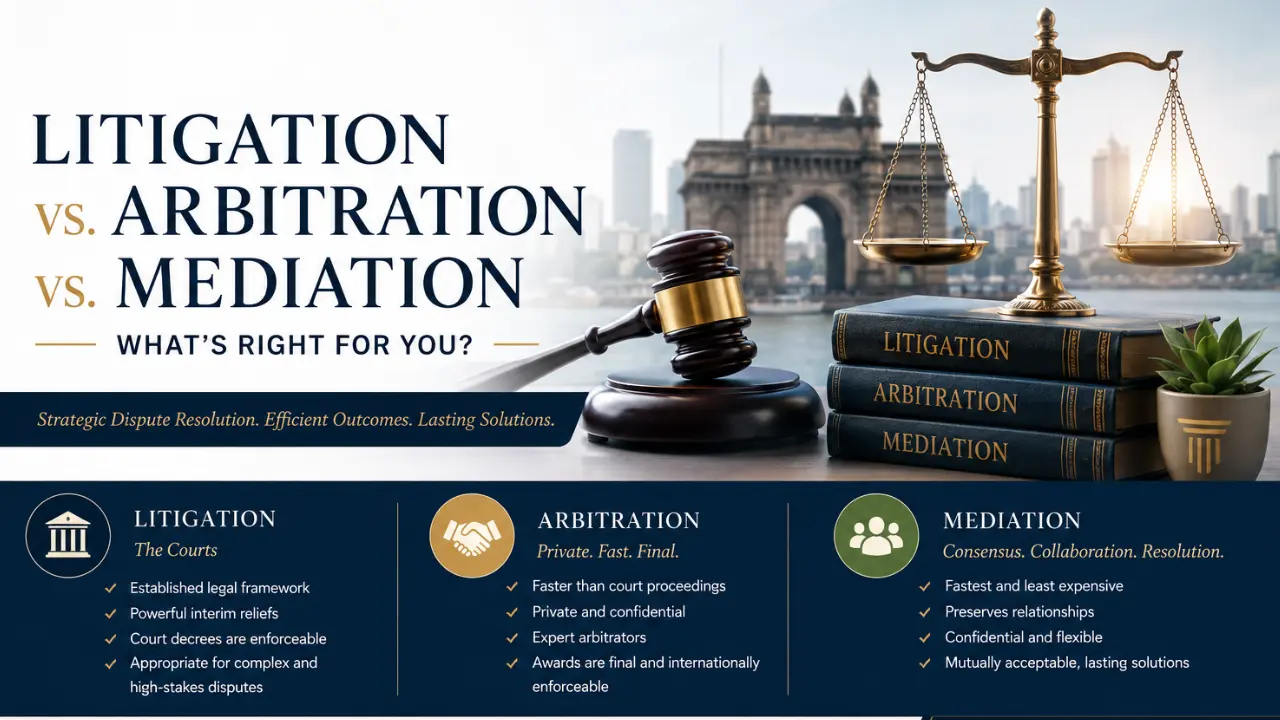
- Established procedural framework with appeal rights
- Court decrees are directly enforceable
- Judges can grant powerful interim reliefs
- Binding precedent creates legal certainty over time
Disadvantages:
- Significant delays in most Indian courts
- Relatively less confidentiality (court proceedings are largely public)
- Adversarial process can damage business relationships permanently
- Costs accumulate over long timelines
Elixir Legal Services in Civil Litigation: Our civil litigation team is experienced in filing, defending, and prosecuting civil suits before Mumbai’s City Civil Court, Bombay High Court, and Debt Recovery Tribunals. We are known for aggressive interim relief applications and strategically efficient case management.
Option 2: Arbitration — Faster, Private, and Internationally Recognized
Arbitration is a private dispute resolution process where parties agree (typically through an arbitration clause in their contract) to resolve disputes before a neutral arbitrator or panel of arbitrators instead of through court.
The Arbitration and Conciliation Act, 1996 (as amended in 2015 and 2019) governs arbitration in India and has progressively aligned Indian arbitration with international standards.
When Arbitration is Appropriate:
- When your contract contains an arbitration clause (in which case it is typically mandatory)
- For high-value commercial disputes where speed and confidentiality are valued
- For international commercial disputes where a neutral, internationally recognized forum is preferred
- Disputes involving technical matters where subject-matter expert arbitrators can be appointed
- Construction and infrastructure disputes, joint venture disputes, licensing disputes
Advantages of Arbitration:
- Significantly faster than court proceedings (typically 12 to 18 months for domestic arbitration)
- Private and confidential — proceedings and awards are not public record
- Parties choose their arbitrators — allowing for subject-matter expertise
- Arbitral awards are final and binding with very limited grounds for challenge
- International arbitral awards are enforceable in India under the New York Convention
Disadvantages:
- Can be expensive (arbitrator fees, institutional fees, legal costs)
- Limited interim relief mechanisms (though improved by 2015 amendments)
- Awards can still be challenged in courts, causing delay
Key Arbitral Institutions in India:
- Mumbai Centre for International Arbitration (MCIA) — Mumbai’s premier arbitral institution
- Indian Council of Arbitration (ICA)
- International Chamber of Commerce (ICC) — for international disputes
- SIAC and LCIA — popular for cross-border India-related disputes
Option 3: Mediation — Preserving Relationships Through Consensus
Mediation is a facilitated negotiation process where a neutral third party (the mediator) helps disputing parties reach a mutually acceptable settlement. The mediator does not decide the outcome — the parties do.
The Mediation Act, 2023 has formalized India’s mediation framework, making it a significantly more structured and legally recognized process.
When Mediation is Appropriate:
- When preserving the business or personal relationship matters
- Family disputes, partnership disputes, employer-employee matters
- As a pre-litigation step — many courts encourage mediation before trial
- Commercial disputes where both parties are commercially motivated to settle
- When the dispute involves ongoing performance obligations (both parties need each other going forward)
Advantages of Mediation:
- Fastest and least expensive dispute resolution option
- Completely confidential
- Preserves relationships — consensual outcomes are more durable than imposed judgments
- Creative solutions possible — unlike courts, mediators can craft outcomes beyond binary win/lose
- Settlement agreements are now enforceable contracts under the Mediation Act, 2023
Disadvantages:
- Requires both parties’ voluntary participation and good faith
- No outcome if parties can’t agree — you then need litigation or arbitration
- Not suitable when one party has significantly more bargaining power and may use mediation to delay
Choosing the Right Path: A Decision Framework
| Factor | Civil Litigation | Arbitration | Mediation |
| Speed | Slow (years) | Medium (1–2 years) | Fast (weeks to months) |
| Cost | Medium–High | High upfront | Low |
| Confidentiality | Low | High | Very High |
| Enforceability | Very High | High | High (post-2023 Act) |
| Relationship Preservation | Low | Low | High |
| Binding on parties | Yes (decree) | Yes (award) | Only if settled |
| Best For | Property, interim relief, public law | Commercial contracts, international | Business, family, employment |
Multi-Tier Dispute Resolution Clauses
Best-in-class commercial contracts in India now include multi-tier dispute resolution clauses that require parties to first attempt negotiation, then mediation, and only proceed to arbitration or litigation if earlier tiers fail. This approach minimizes costs, preserves relationships, and ensures disputes are only escalated when genuinely necessary.
Elixir Legal Services drafts, reviews, and negotiates dispute resolution clauses for commercial contracts — ensuring our clients’ agreements are structured to their best advantage from the outset.
Elixir Legal Services: Your Dispute Resolution Partner in Mumbai
Whether your dispute belongs in court, in an arbitration chamber, or in a mediator’s room — Elixir Legal Services has the expertise, experience, and strategic clarity to guide you to the right outcome. Our team has argued before Mumbai’s civil courts, represented clients in institutional and ad hoc arbitrations, and facilitated successful commercial mediations.
We don’t just litigate — we think strategically about what will achieve the best result for you, efficiently and cost-effectively.
Contact Elixir Legal Services for a Dispute Resolution Consultation
Disclaimer: This blog is for informational purposes only and does not constitute legal advice. Please consult a qualified lawyer for advice specific to your situation.
Frequently Asked Questions
Q1. My contract has an arbitration clause. Do I have to arbitrate, or can I still go to court? A: If your contract contains a valid arbitration clause, courts in India will typically refer parties to arbitration and refuse to hear the substantive dispute. However, courts retain jurisdiction to grant urgent interim relief and to enforce or challenge arbitral awards. Consult Elixir Legal Services to understand your options in specific circumstances.
Q2. How long does domestic arbitration in Mumbai typically take? A: Under the Arbitration Act, domestic arbitrations should be completed within 12 months of the arbitral tribunal’s constitution (extendable by 6 months with parties’ consent, and further by court order). In practice, well-managed arbitrations with experienced counsel often conclude within 12 to 18 months.
Q3. Is a mediated settlement legally enforceable in India? A: Yes. Under the Mediation Act, 2023, settlement agreements reached through mediation (conducted by registered mediators before mediation service providers) are enforceable as court decrees. This significantly strengthens mediation as a dispute resolution tool.
Q4. Can I get an urgent injunction through arbitration? A: Yes. Under Section 9 of the Arbitration Act, parties can apply to a court for interim relief before, during, or after arbitration proceedings. Additionally, under Section 17, emergency arbitral tribunals can grant interim measures. Elixir Legal Services regularly handles urgent Section 9 applications in Mumbai courts.
Q5. What types of civil disputes does Elixir Legal Services handle? A: Our civil litigation practice covers commercial disputes, property and real estate disputes, partnership and shareholder disputes, recovery of dues, injunctions and specific performance, consumer disputes, and civil wrongs (tort claims). We appear before Mumbai’s City Civil Courts, Bombay High Court, and specialized tribunals including the DRT and NCLT.