
Everything You Need to Know About SRA Redevelopment Projects in Mumbai
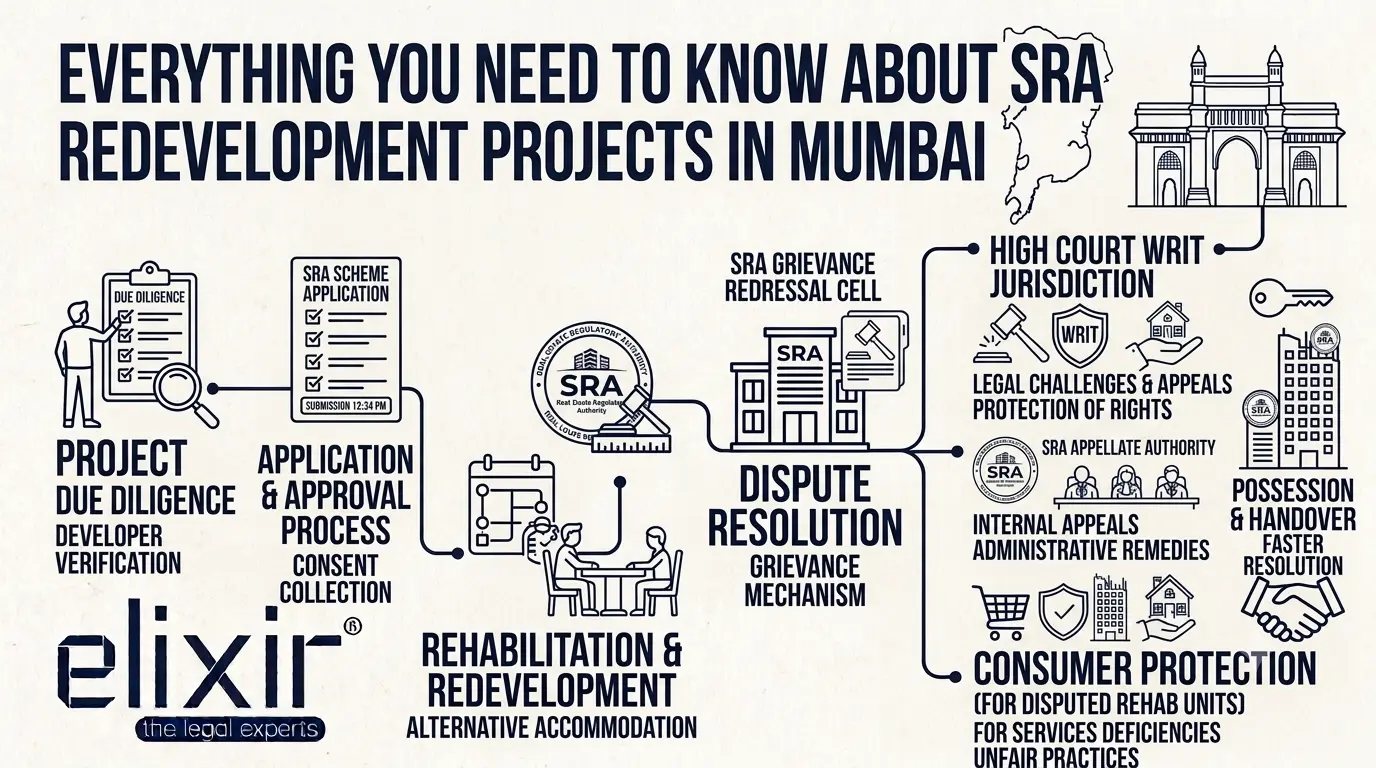
Mumbai’s limited land availability, ageing housing structures and growing demand for urban development have made redevelopment an important part of the city’s real estate landscape. Among the various redevelopment models used in Mumbai, SRA redevelopment projects have a particularly important role in rehabilitating eligible occupants while facilitating planned development.
However, an SRA redevelopment project is not simply a construction project. It involves multiple stakeholders, government authorities, eligibility requirements, society resolutions, developer agreements, approvals, rehabilitation obligations, regulatory compliance and, in some cases, disputes and litigation.
For housing societies, eligible occupants, developers, landowners and other stakeholders, understanding the legal and procedural aspects of an SRA redevelopment project is therefore extremely important.
Elixir Legal Services provides legal assistance in SRA redevelopment and real estate matters in Mumbai, including redevelopment agreements, title verification, regulatory compliance, project approvals, RERA-related matters, society-developer disputes and real estate litigation.
This guide explains the major aspects of SRA redevelopment projects in Mumbai and the legal issues that stakeholders should understand before moving forward.
What Is SRA Redevelopment?
SRA stands for the Slum Rehabilitation Authority. The Authority was established to implement slum rehabilitation schemes in Mumbai and has been given planning-authority functions within its jurisdiction. The SRA framework uses redevelopment as a mechanism to rehabilitate eligible slum occupants while allowing development incentives that help make rehabilitation projects financially viable. (Slum Rehabilitation Authority)
SRA redevelopment therefore involves a combination of:
- Rehabilitation of eligible occupants
- Redevelopment of existing structures or settlements
- Construction of rehabilitation buildings
- Development of sale or free-sale components where permitted
- Government and planning approvals
- Compliance with applicable development regulations
- Society and developer arrangements
- Protection of the rights of eligible occupants
The exact structure and requirements of a project depend on the applicable statutory provisions, development regulations, scheme and project-specific circumstances.
Who Are the Main Stakeholders in an SRA Redevelopment Project?
An SRA project can involve several stakeholders, and each may have different rights, responsibilities and legal concerns.
1. Eligible Occupants
Eligible occupants are at the centre of a rehabilitation project. Their eligibility and documentation can be critical to the project’s progress.
The SRA itself advises beneficiaries to provide genuine and accurate documents, attend society meetings, stay informed about project progress, understand their legal rights and cooperate with the authorities. (Slum Rehabilitation Authority)
2. Housing or Co-operative Society
A society may play an important role in representing members, passing resolutions, selecting or negotiating with a developer, executing agreements and coordinating redevelopment-related matters.
3. Developer
The developer may be responsible for planning, financing, obtaining approvals, constructing rehabilitation and sale components where applicable, and meeting contractual and regulatory obligations.
4. Landowner
Depending on the nature and ownership of the land, the landowner may have significant rights and obligations relating to title, development rights, lease conditions and redevelopment arrangements.
5. SRA and Other Authorities
SRA redevelopment involves interaction with the relevant planning and government authorities. The SRA describes its functions as including implementation of rehabilitation schemes, certification of eligibility, surveys and measurements, building permissions, leasing of rehabilitation and sale plots, and updating property records. (Slum Rehabilitation Authority)
Because several parties are involved, disagreements can arise if responsibilities are not clearly documented.
What Laws and Regulations Apply to SRA Redevelopment?
SRA redevelopment is governed by a combination of legislation, development regulations, government notifications, SRA policies, project approvals and contractual documents.
The Maharashtra Slum Areas (Improvement, Clearance and Redevelopment) Act, 1971 forms an important part of the statutory framework. The SRA also operates under applicable development regulations and planning provisions.
Current SRA material and notices refer to DCPR-2034, including SRA schemes under Regulation 33(10) and Regulation 33(11). (Slum Rehabilitation Authority)
The precise provisions applicable to a project should always be checked against the project’s location, land status, scheme, approvals and the regulations applicable at the relevant time.
This is one reason why obtaining advice from an experienced SRA redevelopment lawyer in Mumbai can be valuable before signing important documents or making major project decisions.
Understanding Regulation 33(10)
Regulation 33(10) is an important provision associated with SRA redevelopment schemes in Mumbai.
The regulation forms part of the development-control framework used for eligible slum rehabilitation projects. Current SRA publications continue to show proposed and approved schemes under Regulation 33(10) of DCPR-2034. (Slum Rehabilitation Authority)
However, it is important not to assume that every redevelopment project automatically qualifies under the same provision. Eligibility, approvals, land status, documentation and other project-specific requirements need to be examined individually.
What Is the SRA Redevelopment Process?
Although the exact process can vary depending on the project, an SRA redevelopment project may broadly involve several stages.
Step 1: Examine the Property and Existing Occupants
The first step is understanding the land, existing structures, occupants, ownership records and available documentation.
This may involve:
- Title documents
- Property cards
- CTS records
- Existing society records
- Occupant documentation
- Previous agreements
- Government records
- Existing approvals
- Survey and measurement records
Proper due diligence at the beginning can help identify potential problems before they become major disputes.
Step 2: Determine Eligibility
Eligibility is a critical issue in SRA redevelopment.
The eligibility of occupants can depend on applicable regulations, cut-off dates, documentary evidence and the nature and location of the structure.
The SRA specifically advises beneficiaries to provide genuine and accurate documentation because proper documentation helps ensure that benefits reach the rightful beneficiaries. (Slum Rehabilitation Authority)
If eligibility is disputed, the issue can significantly affect the redevelopment process.
Step 3: Formation and Functioning of the Society
Where applicable, residents may organise themselves through a co-operative housing society or other appropriate entity.
Society records, resolutions, member lists and other documentation can become extremely important during redevelopment.
Members should understand what is being proposed before approving major redevelopment decisions.
Step 4: Selection of a Developer
Selecting a developer is one of the most important decisions in a redevelopment project.
The society should undertake appropriate due diligence before entering into an arrangement with a developer.
Important considerations may include:
- Developer’s experience
- Financial capacity
- Track record
- Existing projects
- Litigation history
- Ability to obtain project finance
- Proposed construction timeline
- Rehabilitation commitments
- Transit arrangements
- Project approvals
- Contractual protections
A developer should not be selected solely on the basis of promises regarding additional area or attractive commercial terms.
Step 5: Negotiating the Development Agreement
The development agreement is one of the most important documents in a redevelopment project.
It should clearly address matters such as:
- Rights and obligations of the parties
- Rehabilitation premises
- Area and specifications
- Transit accommodation
- Rent or transit compensation where applicable
- Construction obligations
- Project timelines
- Approvals
- Developer’s authority
- Power of attorney
- Default provisions
- Termination rights
- Dispute resolution
- Consequences of delay
- Project handover
- Completion obligations
A poorly drafted agreement can create significant problems later.
This is why SRA redevelopment agreement drafting and review should be undertaken carefully by a lawyer familiar with redevelopment transactions.
Elixir Legal Services provides SRA redevelopment and real estate legal services in Mumbai, including redevelopment agreement drafting and review, title due diligence, project approvals, RERA compliance, dispute resolution and real estate litigation. (Best law firm in Mumbai)
What Should Society Members Check Before Signing a Redevelopment Agreement?
Members should avoid signing redevelopment documents without understanding their contents.
Important questions include:
- What rehabilitation area will each eligible member receive?
- What are the specifications of the rehabilitation premises?
- What temporary accommodation arrangements are proposed?
- What rent or compensation is payable during transit, if applicable?
- Who is responsible for obtaining approvals?
- What is the expected project timeline?
- What happens if construction is delayed?
- What security or safeguards are available?
- What happens if the developer defaults?
- Can the agreement be terminated?
- What are the consequences of termination?
- How will disputes be resolved?
A redevelopment agreement should be reviewed based on the specific project rather than relying on a standard template.
Title Verification and Legal Due Diligence
Title due diligence is another critical component of redevelopment.
Before proceeding, the legal team may need to examine:
- Property cards
- CTS records
- Title documents
- Conveyance documents
- Lease documents
- Encumbrances
- Existing litigation
- Development rights
- Government records
- Previous agreements
- Society records
- Existing permissions
Elixir Legal Services’ SRA practice specifically includes title verification and ownership due diligence, including title searches, ownership verification and encumbrance checks. (Best law firm in Mumbai)
A title or ownership issue discovered at an early stage may be easier to address than a dispute that emerges after substantial money has already been invested in the project.
What Role Does MahaRERA Play in SRA Redevelopment?
MahaRERA can be relevant to redevelopment projects depending on the applicable circumstances and project structure.
MahaRERA’s official FAQ specifically states that MahaRERA applies to SRA schemes under DCR 33(10) and that existing residents of a redevelopment scheme can be covered as allottees under the applicable framework. (Maharera)
This means stakeholders should not assume that an SRA project is outside the RERA framework simply because it is a redevelopment project.
Project-specific legal analysis is important to determine the applicable registration, disclosure and compliance requirements.
MahaRERA also provides an online system through which users can search registered and revoked projects and access project information. (Maharera)
What Are the Common Problems in SRA Redevelopment Projects?
SRA redevelopment projects can face several types of legal and practical disputes.
1. Eligibility Disputes
Disagreements may arise regarding whether a particular occupant qualifies for rehabilitation.
2. Society-Developer Disputes
Members and developers may disagree about:
- Construction timelines
- Transit arrangements
- Additional area
- Project obligations
- Approvals
- Financial commitments
- Delays
3. Developer Delays
Delays can result from regulatory approvals, financing issues, disputes, contractor problems, litigation or other circumstances.
4. Title and Land Disputes
Unclear ownership, competing claims, lease conditions or encumbrances can complicate redevelopment.
5. Agreement Disputes
Ambiguous development agreements can result in disagreements about rights, obligations, timelines and termination.
6. Member Disputes
Not all members may agree with the redevelopment proposal, developer selection or terms of the project.
7. RERA and Regulatory Issues
Where applicable, failure to comply with regulatory requirements can create additional legal and financial risks.
Elixir Legal Services’ SRA practice includes society and developer dispute resolution, including negotiation, arbitration and litigation support. (Best law firm in Mumbai)
Can SRA Redevelopment Disputes Be Resolved Without Going to Court?
Yes, depending on the nature of the dispute.
Possible approaches may include:
- Negotiation
- Mediation
- Arbitration
- Regulatory proceedings
- Civil litigation
- Proceedings before the appropriate authority
- High Court proceedings where legally appropriate
The best approach depends on the agreement, applicable legislation, nature of the dispute, urgency and relief required.
Litigation should not necessarily be the first step in every dispute. A lawyer can assess whether negotiation or another dispute-resolution mechanism may be more appropriate.
What Legal Documents Are Important in SRA Redevelopment?
Depending on the project, important documents can include:
- Title documents
- Property cards
- CTS records
- Society registration documents
- Member records
- Eligibility documents
- Development agreements
- Memorandum of Understanding
- Power of Attorney
- Resolutions
- Project approvals
- SRA documents
- RERA documents where applicable
- Transit-related documents
- Construction and project documents
The exact documentation required depends on the project and its legal structure.
Why Legal Due Diligence Is Important Before Redevelopment
Redevelopment involves significant financial, property and contractual interests.
Legal due diligence can help identify issues involving:
- Ownership
- Development rights
- Eligibility
- Encumbrances
- Existing litigation
- Regulatory approvals
- Contractual obligations
- Developer authority
- Project structure
- Compliance requirements
Identifying these issues before signing major agreements can reduce the risk of costly disputes later.
Why Choose Elixir Legal Services for SRA Redevelopment in Mumbai?
Elixir Legal Services provides legal assistance for SRA redevelopment and real estate matters in Mumbai.
The firm’s SRA Redevelopment & Real Estate Law practice covers legal advisory, redevelopment agreements, title verification, RERA compliance, government approvals, society-developer disputes, real estate litigation, joint ventures and co-development agreements, and property transfers. (Best law firm in Mumbai)
The firm works with different stakeholders, including housing societies, developers, individual property owners and investors, depending on the nature of the engagement. (Best law firm in Mumbai)
Elixir’s broader real estate and SRA legal practice can also be relevant where an SRA matter overlaps with property disputes, redevelopment issues, civil litigation or other legal concerns. (Best law firm in Mumbai)
For disputes involving property or redevelopment, Elixir also provides property dispute legal services in Mumbai, including redevelopment agreement disputes, society redevelopment conflicts, RERA complaints and other real estate-related disputes. (Best law firm in Mumbai)
SRA Redevelopment Checklist for Society Members
Before proceeding with redevelopment, society members should consider the following:
- Review the property’s ownership and title documents.
- Understand the eligibility status of occupants.
- Verify the developer’s background and financial capability.
- Review the proposed redevelopment structure.
- Compare the developer’s commercial and rehabilitation terms.
- Understand transit accommodation arrangements.
- Review the development agreement carefully.
- Confirm the responsibilities of the society and developer.
- Check applicable SRA approvals and permissions.
- Determine whether MahaRERA requirements apply.
- Understand the consequences of delay or default.
- Ensure important promises are incorporated into legally enforceable documents.
- Obtain independent legal advice before signing major agreements.
Frequently Asked Questions About SRA Redevelopment in Mumbai
What is an SRA redevelopment project?
An SRA redevelopment project is a redevelopment scheme implemented under the applicable slum rehabilitation framework to rehabilitate eligible occupants while permitting development in accordance with applicable regulations.
Who regulates SRA redevelopment projects in Mumbai?
The Slum Rehabilitation Authority is the principal authority responsible for SRA redevelopment within its jurisdiction and performs planning and implementation-related functions under the applicable legal framework. (Slum Rehabilitation Authority)
Is MahaRERA applicable to SRA redevelopment?
MahaRERA’s official FAQ states that MahaRERA applies to SRA schemes under DCR 33(10), subject to the applicable framework. Whether specific registration or compliance requirements apply should be determined based on the project. (Maharera)
Can a society change its developer?
Changing a developer can involve significant contractual and regulatory issues. The society should obtain project-specific legal advice before terminating an existing arrangement or appointing another developer.
What should I check before signing an SRA redevelopment agreement?
You should carefully review the rehabilitation entitlement, transit arrangements, timelines, developer obligations, approvals, default provisions, termination rights, dispute-resolution provisions and other project-specific terms.
Can SRA redevelopment disputes be taken to court?
Depending on the nature of the dispute and applicable law, disputes may involve negotiations, arbitration, regulatory proceedings, civil courts or the High Court. The appropriate forum depends on the facts and legal issues involved.
Do society members need a lawyer for SRA redevelopment?
While the specific legal requirements vary from project to project, independent legal review can help society members understand redevelopment agreements, eligibility issues, title concerns, developer obligations and regulatory requirements before important decisions are made.
Final Thoughts
SRA redevelopment can provide an important opportunity to transform ageing or informal settlements while creating rehabilitation housing for eligible occupants. At the same time, these projects involve complex legal, regulatory, contractual and property-related issues.
For a society or individual occupant, the most important step is to understand your rights and obligations before signing documents or approving major redevelopment decisions.
From title verification and eligibility issues to developer selection, redevelopment agreements, approvals, MahaRERA compliance and dispute resolution, every stage should be approached carefully.
If you are a society member, developer, property owner or other stakeholder involved in an SRA redevelopment project in Mumbai, professional legal guidance can help identify risks and protect your interests.
To discuss an SRA redevelopment or real estate matter, you can contact Elixir Legal Services for legal assistance. (Best law firm in Mumbai)
Legal Disclaimer
This article is intended for general informational purposes only and does not constitute legal advice. SRA redevelopment laws, regulations, government policies, eligibility requirements and approval procedures may change and can vary depending on the project and applicable legal framework. Readers should obtain professional legal advice based on the specific facts and documents of their matter before taking any legal or commercial action.