

Anticipatory Bail vs Regular Bail: Understanding the Key Differences
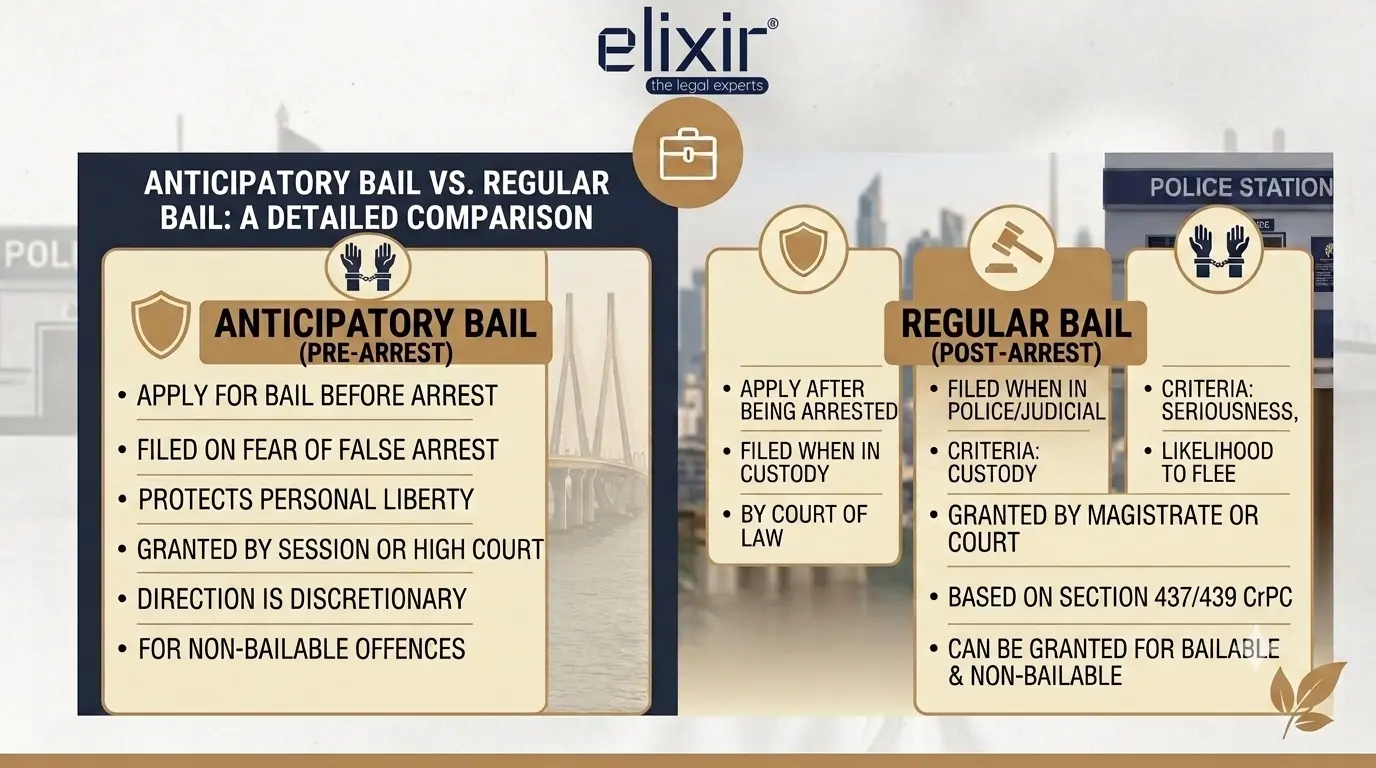
Overview: Anticipatory bail is sought before arrest, when a person believes they may be arrested for a non-bailable offence. Regular bail is sought after arrest, once a person is already in custody. The two are filed in different courts, at different stages, and protect against different things — one prevents custody altogether, the other ends it. Knowing which one applies to your situation, and applying early, makes a real difference to the outcome.
Most people only learn the difference between these two the hard way — usually at 11 PM, with a phone in one hand and a lawyer’s number in the other. So before that happens, here’s the version that actually matters.
What Is Anticipatory Bail?
Anticipatory bail is a pre-arrest legal protection. It’s filed under Section 482 of the Bharatiya Nagarik Suraksha Sanhita (BNSS) — the provision that replaced Section 438 of the old CrPC — by someone who has “reason to believe” they may be arrested for a non-bailable offence. The person hasn’t been arrested yet. They’re asking the Sessions Court or High Court, in advance, to direct that if arrest does happen, they be released on bail rather than held in custody.
This is common in cases like:
- FIRs filed after a business dispute or dowry allegation
- Cheque bounce or financial fraud complaints where the accused fears arrest before investigation is complete
- Cases where someone learns they’re named in an FIR through a third party, before police show up
The whole point of anticipatory bail is to prevent the humiliation and disruption of custody in situations where it isn’t warranted — not to help someone dodge the law altogether. Courts weigh factors like the nature of the accusation, the applicant’s past conduct, and flight risk before granting it.
What Is Regular Bail?
Regular bail comes into play after arrest. Once a person is in police or judicial custody, their lawyer applies to the relevant court — Magistrate, Sessions, or High Court, depending on the seriousness of the offence — for release, with or without conditions. For bailable offences, this is close to a formality; the police themselves are required to inform the arrested person of the right to bail under Section 47 of the BNSS. For non-bailable offences, it’s the court’s discretion, weighed against factors like evidence, the risk of tampering with witnesses, and whether the person is likely to flee.
Regular bail doesn’t erase the arrest. The person has already been taken into custody, produced before a Magistrate within 24 hours as required under Section 58 of the BNSS, and is now seeking release while the case proceeds.
The Core Difference
| Anticipatory Bail | Regular Bail | |
| When it’s sought | Before arrest | After arrest |
| Governing provision | Section 482, BNSS | Sections 478–484, BNSS (bail provisions generally) |
| Where it’s filed | Sessions Court or High Court | Magistrate, Sessions, or High Court depending on offence |
| What it prevents | Custody itself | Continued custody |
| Typical trigger | Fear of arrest, based on an FIR or complaint | Actual arrest has already occurred |
| Conditions attached | Often includes cooperating with investigation, surrendering passport | Similar, plus sometimes local surety or reporting requirements |
Why the Timing Difference Matters So Much
This is the part people underestimate. Anticipatory bail only works if it’s filed before the arrest happens — the moment custody begins, the application becomes irrelevant, and the person is stuck applying for regular bail instead, from inside a lock-up, with far less room to negotiate.
If you have any reason to believe an FIR has been filed against you, or that the police may be looking for you, that’s the window to act — not after you’ve already been picked up. This is exactly why anticipatory bail applications tend to get filed the same day someone hears about a complaint, not after a wait-and-see approach.
Which One Applies to You?
A rough way to think about it:
- Already arrested? You need regular bail. The priority becomes speed — getting the application before the right court as fast as possible.
- Not yet arrested, but named in an FIR or worried about one? Anticipatory bail is your option, and time isn’t on your side. Courts are far less sympathetic to anticipatory bail applications filed after a person has actively evaded arrest for days or weeks.
- Unsure which situation you’re in? This is common — people sometimes only find out about an FIR through a phone call from a relative or a lawyer friend. Get legal advice immediately rather than guessing.
What a Lawyer Actually Does at This Stage
Bail applications, of either kind, aren’t just paperwork. A lawyer needs to build the argument around the specific facts — prior conduct, the nature of the allegation, whether custodial interrogation is genuinely necessary for the investigation, and precedent from similar cases in Mumbai courts. Weak drafting or a rushed filing can mean the difference between bail granted with reasonable conditions and bail denied outright, forcing a second, harder attempt later.
This is where having the Best Criminal Law Firm in Mumbai on call — rather than searching for one after the fact — changes the outcome. Our criminal litigation practice handles both anticipatory and regular bail applications across Mumbai’s Sessions Courts and the Bombay High Court, and our criminal defense lawyers are used to moving fast when timing is the whole game.
If you think you or someone close to you might need either kind of bail, get in touch with us as early as possible — the earlier we’re involved, the more options are still on the table.
Frequently Asked Questions
1. Can anticipatory bail be applied for after an FIR is filed? Yes — in fact, that’s usually when it’s needed most. It should be filed as soon as someone becomes aware of the FIR and believes arrest is likely, not after the police have already started looking for them.
2. Does anticipatory bail mean I’ll never be arrested? No. It means that if arrest happens, you’ll be released on bail under specified conditions, rather than held in custody while the matter is contested.
3. Is anticipatory bail available for all offences? No, it’s only relevant for non-bailable offences. Bailable offences already carry a right to bail, so anticipatory bail isn’t needed for those.
4. Which court handles anticipatory bail applications in Mumbai? Typically the Sessions Court first, with the Bombay High Court as the next option if the Sessions Court rejects the application.
5. Can regular bail be denied even for a first-time offence? Yes, particularly for serious non-bailable offences, if the court believes there’s a risk of tampering with evidence, influencing witnesses, or fleeing.
6. How long does a bail application usually take? It varies by court workload and case complexity, but urgent applications, especially anticipatory bail, can sometimes be heard and decided within a few days when properly filed.