

Can’t Recover Your Money from a Delayed Builder? Here’s What IBC 2026 Allows You to Do
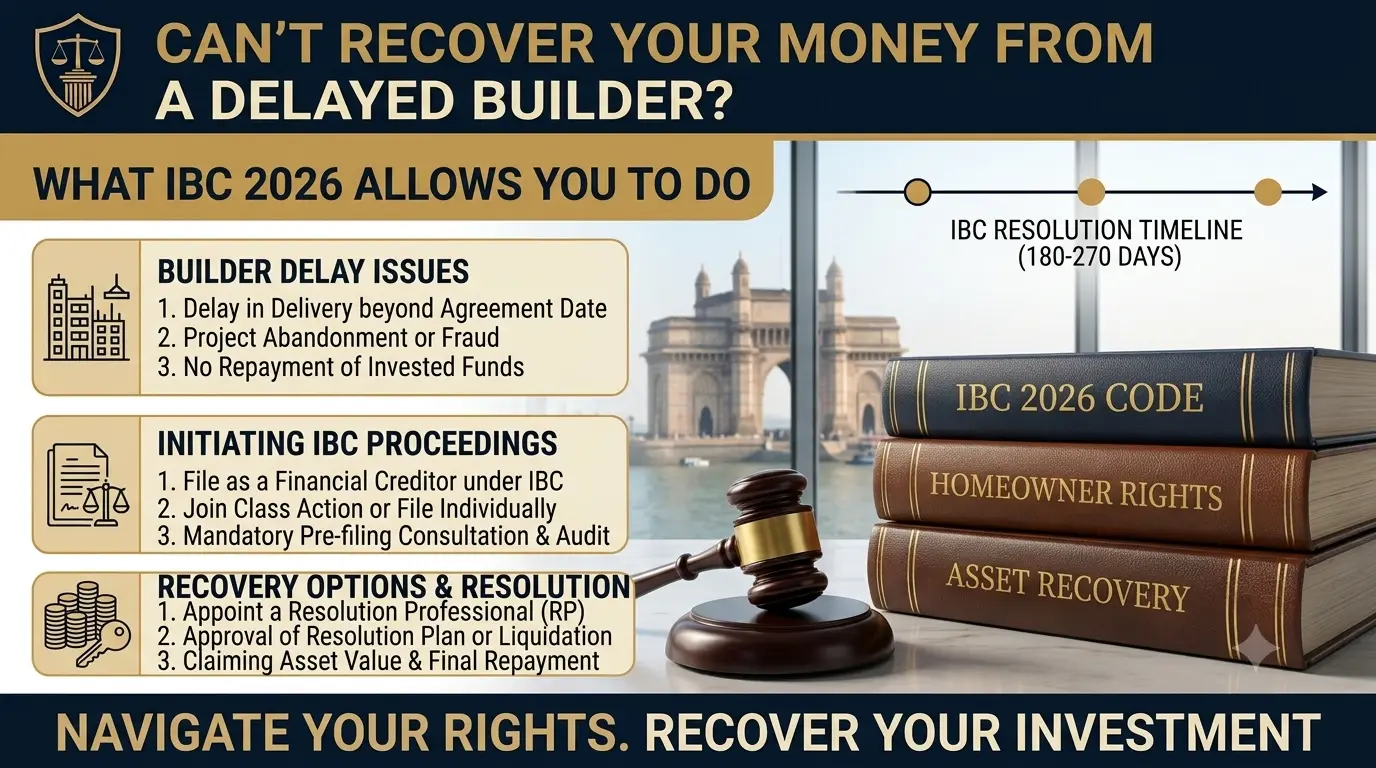
IBC Amendment Act 2026: New Homebuyer Rights Against Defaulting Builders
Thousands of Indian homebuyers are sitting on stalled projects. The law just changed — and it changed in your favour.
Elixir Legal Services · Real Estate & Insolvency · May 2026 | 10 min read
⚖ Breaking Law Update: The Insolvency and Bankruptcy Code (Amendment) Act, 2026 received Presidential assent on 6 April 2026 and is now in force. Combined with the IBBI Committee’s 155-point recommendation report (7 April 2026), this is the most significant overhaul of homebuyer insolvency rights since 2018. If your builder has defaulted or delayed possession, your legal options are stronger today than they have ever been.
Your Builder Has Gone Silent. Your Money Is Stuck. What Now?
You paid in full — or close to it — for a flat that was supposed to be delivered two, three, maybe five years ago. The builder is either missing deadlines, citing “market conditions,” or has quietly stopped construction altogether. Your emails go unanswered. Your RERA complaint is pending. The bank EMI keeps coming.
This is not a niche problem. According to industry data, over 4.5 lakh housing units across India’s top eight cities are stuck in stalled or severely delayed projects. Many of these builders are technically insolvent — they’ve diverted homebuyer funds, overextended on land acquisition, or simply collapsed under debt.
The good news: the Insolvency and Bankruptcy Code (IBC), as amended in April 2026, gives homebuyers sharper, faster legal tools to recover their money or force project completion. Here’s exactly what changed — and how to use it.
- 4.5L+ housing units stalled or severely delayed across India’s top 8 cities
- ₹1 Cr minimum joint default threshold to file a Section 7 NCLT petition
- 330 maximum CIRP days (including litigation) under the IBC framework
- 155 recommendations in the IBBI Committee Report (7 April 2026) impacting homebuyers
What the IBC Amendment Act 2026 Actually Changes for Homebuyers
The IBC Amendment Act, 2026 is not cosmetic. It introduces structural reforms that directly affect how homebuyer claims are handled inside insolvency proceedings. Here are the most critical changes:
1. Mandatory Admission When Default Is Proved
This is arguably the most powerful change for homebuyers. The Supreme Court clarified in Elegna Co-operative Housing Society v. Edelweiss Asset Reconstruction (January 2026) that once a financial debt and default are established, admission of a Section 7 petition is mandatory — the NCLT has no discretion to reject it citing project viability or construction status. The 2026 Amendment codifies this principle into statute, ending the “Vidarbha discretion” debate once and for all.
What this means for you: If your builder owes you money and has defaulted, the NCLT cannot dismiss your petition because the project is “almost complete” or because admission would harm other buyers. Default = admission. Period.
✓ Win for Homebuyers: The Supreme Court has firmly held that project viability, homebuyer interest, or alleged misuse of IBC are not threshold defences at the admission stage. Issues of feasibility and project completion are for the Committee of Creditors — not the court’s admission filter.
2. Creditor-Initiated Insolvency Resolution Process (CIIRP)
A brand-new mechanism under the 2026 Amendment: the Creditor-Initiated Insolvency Resolution Process (CIIRP). Unlike the standard CIRP, this route allows creditor groups — including organised homebuyer associations — to initiate and actively drive the resolution process with greater control over timelines and outcomes. The CoC approval threshold for certain CIIRP decisions has been lowered from 66% to 51%, making it easier for homebuyer blocs to push through resolution plans.
3. Project-Wise Resolution and Possession During CIRP
One of the most practically significant insertions: the 2026 Act now codifies project-wise resolution. This means a builder with multiple projects can have each project ring-fenced and resolved independently — so a failed commercial tower doesn’t drag down your half-built residential complex. The new law also includes provisions allowing possession handover to allottees during CIRP itself, in appropriate circumstances, rather than waiting for the entire process to conclude.
4. Expanded Look-Back Period for Avoidance Transactions
The Amendment expands the “look-back” window for challenging preferential and fraudulent transactions to two years. If your builder transferred assets, created sham charges, or paid off connected parties to strip the company of value, the Resolution Professional can now challenge a wider set of transactions — potentially recovering funds that flow back to homebuyer creditors.
5. IBBI Committee Report — 155 Recommendations
Filed on 7 April 2026 pursuant to Supreme Court directions in Mansi Brar Fernandes v. Shubha Sharma, the IBBI Committee examined 55 critical structural issues in real estate insolvency and made 155 recommendations. This report signals how the NCLT, IRP firms, and CoCs will be expected to operate going forward — including stronger transparency obligations to allottees and mandatory written reasons when the CoC recommends liquidation over completion.
“Once the existence of a financial debt and occurrence of default are established, admission under Section 7 is mandatory. Issues of project viability or completion status are squarely within the domain of the Committee of Creditors — not a threshold admission test.”
— Supreme Court of India, January 2026 · Elegna Co-operative Housing Society v. Edelweiss ARC
RERA vs IBC vs Consumer Court: Which Route Should You Take?
This is the most searched question among homebuyers facing builder default — and the honest answer is: it depends on your specific situation. Here’s a head-to-head breakdown of your three primary legal routes.
| Factor | RERA | IBC (Section 7 NCLT) | Consumer Court (NCDRC) |
|---|---|---|---|
| Best For | Solvent builder causing delay; seeking possession or delay compensation | Insolvent or near-insolvent builder; recovering principal amount | Delay compensation + mental agony damages; small or mid-ticket cases |
| Can You File Alone? | Yes — individual complaint | No — requires 100 allottees OR 10% of total project allottees (whichever is less), jointly | Yes — individual complaint |
| Minimum Default Amount | No minimum | ₹1 crore (joint aggregate) | No minimum |
| Execution of Orders | Historically weak — builder can delay enforcement | Strong — NCLT has direct enforcement powers; moratorium freezes assets | Moderate — can be enforced but builders often appeal |
| Compensation Available | Delay interest at MCLR + 2%; refund with interest | Full principal recovery via Resolution Plan; CoC-negotiated | ₹1–10 lakh mental agony + 12–18% interest (NCDRC 2026 trend) |
| Builder Uses to Delay | Builder often uses IBC moratorium to stay RERA orders | CIRP moratorium can pause RERA execution | Less affected by IBC moratorium |
| Timeline (Ideal) | 6–18 months for adjudication | CIRP: 180 days + 90 days extension (330 days max with litigation) | 1–3 years (can be faster with strong evidence) |
| Post-IBC Amendment 2026 | RERA remains primary route for solvent builders | Stronger — mandatory admission, project-wise resolution, possession during CIRP | Concurrent with RERA; not displaced by IBC |
ℹ Strategic Note — The “Two Forum” Play: Many experienced lawyers now advise homebuyers to file RERA first (cheaper, individual, no minimum threshold) to establish the default record — and simultaneously organise a homebuyer group for a Section 7 IBC filing if the builder is clearly insolvent. The Supreme Court in Pioneer Urban Land v. Union of India confirmed that RERA and IBC are not mutually exclusive. Filing one does not bar the other.
How to File a Section 7 IBC Petition Against Your Builder — In 2026
Filing under Section 7 of the IBC requires meeting specific procedural and numerical thresholds. Here’s the current process:
- Establish your financial creditor status. Every homebuyer who has paid money under an allotment agreement is a “financial creditor” under IBC. Your payment constitutes a “financial debt” — this was confirmed by the Supreme Court in Chitra Sharma v. Union of India (2018) and has been upheld consistently since.
- Organise your homebuyer group — meet the threshold. You need either 100 allottees or 10% of the total allottees in your project (whichever is fewer) to jointly sign the petition. For a 500-unit project, that means getting 50 buyers on board. Homebuyer WhatsApp groups, RWAs, and housing society organisations are your starting points. A lawyer can help structure the coalition and prepare a joint application.
- Confirm the aggregate default exceeds ₹1 crore. The combined amount owed to your group (principal + delay interest) must cross ₹1 crore. With 50+ buyers, this is typically not a problem, but ensure each member’s default is documented — allotment letters, payment receipts, demand letters, RERA complaint copies.
- File the Section 7 petition at the relevant NCLT bench. In Mumbai, filings go to the NCLT Mumbai Bench (Bandra Kurla Complex). Under the 2026 Amendment, once debt and default are proved, admission is mandatory. The builder cannot use project viability as a defence at this stage. A Resolution Professional (IRP) is then appointed by the NCLT.
- Moratorium kicks in — builder’s assets are frozen. Upon admission, a moratorium under Section 14 IBC is imposed. No debt enforcement against the builder, no asset transfers, no new legal proceedings against the company — everything freezes. The RERA authority cannot execute its own orders against the builder during this period. This is actually a double-edged sword: it protects the company’s assets for collective resolution.
- File your claim with the IRP and participate in the CoC. Once the IRP takes over, all creditors — including homebuyers — must file their individual claims. Homebuyers form part of the Committee of Creditors (CoC) and can vote on resolution plans. Under the 2026 Amendment, the Information Memorandum must now mandatorily disclose details of all allottees, ensuring homebuyers have visibility into the full claim pool.
- Resolution plan or liquidation — your outcome. The CoC votes on a Resolution Plan submitted by a Resolution Applicant (typically a new developer or investor). Under the 2026 Act, project-wise resolution means your specific residential project can be separated and resolved independently. If no plan is viable, liquidation proceeds — in which case homebuyers participate in asset distribution as financial creditors.
⚠ Critical Warning: Do not miss the IRP’s claim deadline. Once a CIRP is admitted, the IRP issues a public announcement setting a deadline (usually 30 days) for all creditors to submit claims. If you miss this window, your claim may not be admitted in the resolution plan — even if you are a genuine allottee. Monitor filings for your builder’s CIRP at ibbi.gov.in.
Homebuyer FAQs — Builder Default & IBC 2026
My builder is not yet officially “insolvent.” Can I still file under Section 7 IBC?
Yes. You don’t need a court declaration of insolvency before filing. What you need is proof of a “financial debt” (your payments under an allotment agreement) and proof of “default” (non-delivery of possession by the contracted date, or a formal demand that went unpaid). The builder’s solvency status is assessed during CIRP — not before admission.
My builder filed for insolvency themselves. What happens to my flat?
If the builder (Corporate Debtor) is already in CIRP, you must immediately file your claim with the Interim Resolution Professional (IRP). Your allotment agreement qualifies as a financial debt. Homebuyers as a class form part of the CoC and can vote on whether a new developer takes over the project. Under the 2026 Amendment, possession handover provisions during CIRP can protect your rights even before final resolution.
I have a MahaRERA order in my favour but the builder isn’t paying. Does IBC help?
Yes — but with a caveat. If your builder is in CIRP, the IBC moratorium pauses execution of your RERA order. However, your RERA-adjudicated amount is recognised as a financial debt and you can file your claim in the CIRP. If the builder is not in CIRP, you can use MahaRERA’s enforcement mechanism (penalty of ₹5,000/day for non-compliance) or initiate a separate IBC petition if you meet the threshold requirements.
RERA vs IBC — which gives me money back faster?
RERA adjudication can be faster (months, not years) for a straightforward delay compensation case where the builder is still operational. However, RERA’s execution mechanism has historically been weak — getting the order is one thing; getting paid is another. IBC’s CIRP, while longer (up to 330 days), creates a moratorium that prevents asset stripping and puts a court-supervised professional in charge. For insolvent builders, IBC is the more effective tool for actual recovery. For solvent builders who are merely delaying, RERA + Consumer Court is often the faster and cheaper route.
Can I approach Consumer Court even if there is a RERA forum available?
Yes. The Supreme Court has confirmed that the Consumer Protection Act is a beneficial legislation whose remedies are in addition to — not in derogation of — RERA. Section 79 of RERA bars civil courts, not Consumer Courts. In 2026, NCDRC has been awarding 12–18% interest plus ₹1–10 lakh in mental agony compensation. This is often higher than RERA’s fixed-rate formula. An experienced lawyer can advise on which forum gives you the best outcome for your specific default quantum and facts.
I only have 30 buyers in our project willing to fight. Can we still file an IBC petition?
You need either 100 allottees or 10% of the total project allottees — whichever is less. So for a project with 200 flats, 10% means 20 buyers — which means 30 buyers is enough. For a project with 500+ units, you’d need 50. Our team can help you identify the exact threshold for your project and structure the joint petition.
The 2026 Legal Moment Homebuyers Cannot Afford to Ignore
The convergence of the IBC Amendment Act 2026, the Supreme Court’s January 2026 mandatory-admission ruling, and the IBBI Committee’s 155-recommendation reform report is not coincidence. It reflects a broader judicial and legislative consensus: homebuyers are genuine financial creditors whose rights have been structurally under-protected, and the law must catch up.
The regulatory overlap between RERA and IBC has historically been exploited by defaulting builders — using IBC moratoriums to stay RERA orders, or using RERA complaints to argue against IBC admission. The 2026 framework closes several of these loopholes, particularly through mandatory admission and project-wise resolution codification.
What this creates is a narrow but real enforcement window. If your builder is genuinely insolvent or has diverted funds, acting now — before a lender-driven CIRP is initiated without homebuyer coordination — means you enter the process with organised claim documentation, a seat at the CoC table, and the ability to influence the resolution plan outcome.
Waiting means entering the process late, scrambling to file claims after deadlines, and potentially watching secured lenders shape a resolution plan that leaves homebuyers with a fraction of what they’re owed.
Speak to a Real Estate Insolvency Lawyer in Mumbai
Elixir Legal Services advises homebuyers, housing societies, and investors on RERA complaints, Section 7 IBC petitions, and CoC participation strategy across Mumbai and Maharashtra.
Request a Free Initial Consultation
RERA · IBC / NCLT · Consumer Court · MahaRERA Enforcement
Legal Disclaimer: This article is for general informational purposes only and does not constitute legal advice. The law described reflects the IBC Amendment Act 2026 and judicial developments as of May 2026. Every case is fact-specific. You should consult a qualified insolvency or real estate lawyer before taking any legal action.
Elixir Legal Services · Mumbai, Maharashtra
Real Estate & Insolvency | NCLT Filings | MahaRERA Representation | CoC Advisory
© 2026 Elixir Legal Services. All rights reserved. This content is protected under applicable copyright law.